
Earnest Money Funding Without Using Your Own Cash
The deal itself usually isn’t the tough part. You lock in a property at a price that works, the numbers check out, and you have a clear exit, either a buyer lined up or a refinance plan. Then the title company asks for earnest money, but your cash is tied up in another project, sitting in reserves, or locked in a bridge loan you don’t want to touch.
That’s the earnest money problem. On a $400,000 contract, you’re looking at $4,000 to $12,000 for the deposit. Bigger commercial or multifamily deals can require $25,000, $50,000, or even six figures. The deposit isn’t lost money, it usually counts toward the purchase price or comes back if you close cleanly. But you have to wire it before you officially control the property.
Here’s how earnest money deposit (EMD) funding works from the lender’s perspective: what gets funded, what I look for, what makes me say no, and how to prepare your file so a funder can say yes quickly. For the full details, see the parent guide: Earnest Money Deposits in Real Estate: Investor's Guide to $10K+ EMDs.
What Earnest Money Actually Does
Earnest money is your “I’m serious” deposit. It’s held by a title company, escrow agent, or attorney, not the seller. The National Association of Realtors calls it proof you intend to close.
The contract protects the deposit, not default law. If you back out within a contingency period, inspection, financing, title, the deposit usually comes back. But if you walk away outside those protections, the seller can keep it. NAR’s coverage on refunds and returns notes that most disputes end with refunds since court is slow and costly. Still, don’t assume your deposit is safe if you breach the contract.
That’s the main risk in EMD funding. The funder isn’t lending against the property. They’re advancing a deposit held in escrow, and their risk is whether the deposit is protected and whether the deal closes.
Why Investors Run Short on Deposit Cash
Most investors needing EMD funding aren’t broke. Their money is just busy.
- Capital is tied up elsewhere, maybe a rehab in progress, waiting on a refinance, or reserved for other projects.
- Deal flow moves faster than liquidity. You might have three contracts but enough deposit cash for only one.
- Wholesalers and transactional operators work on thin margins. If your profit spread is $10,000 to $25,000, locking up $10,000 for 30 days is a real cost.
- Bigger deals mean bigger deposits. Multifamily, land, and commercial contracts often require five-figure deposits or more.
- Sellers want proof. Weak or late deposits can cost you the deal.
Using your own cash is fine if you have it and it doesn’t cost you another opportunity. EMD funding makes sense when missing a deal or draining reserves is the alternative.
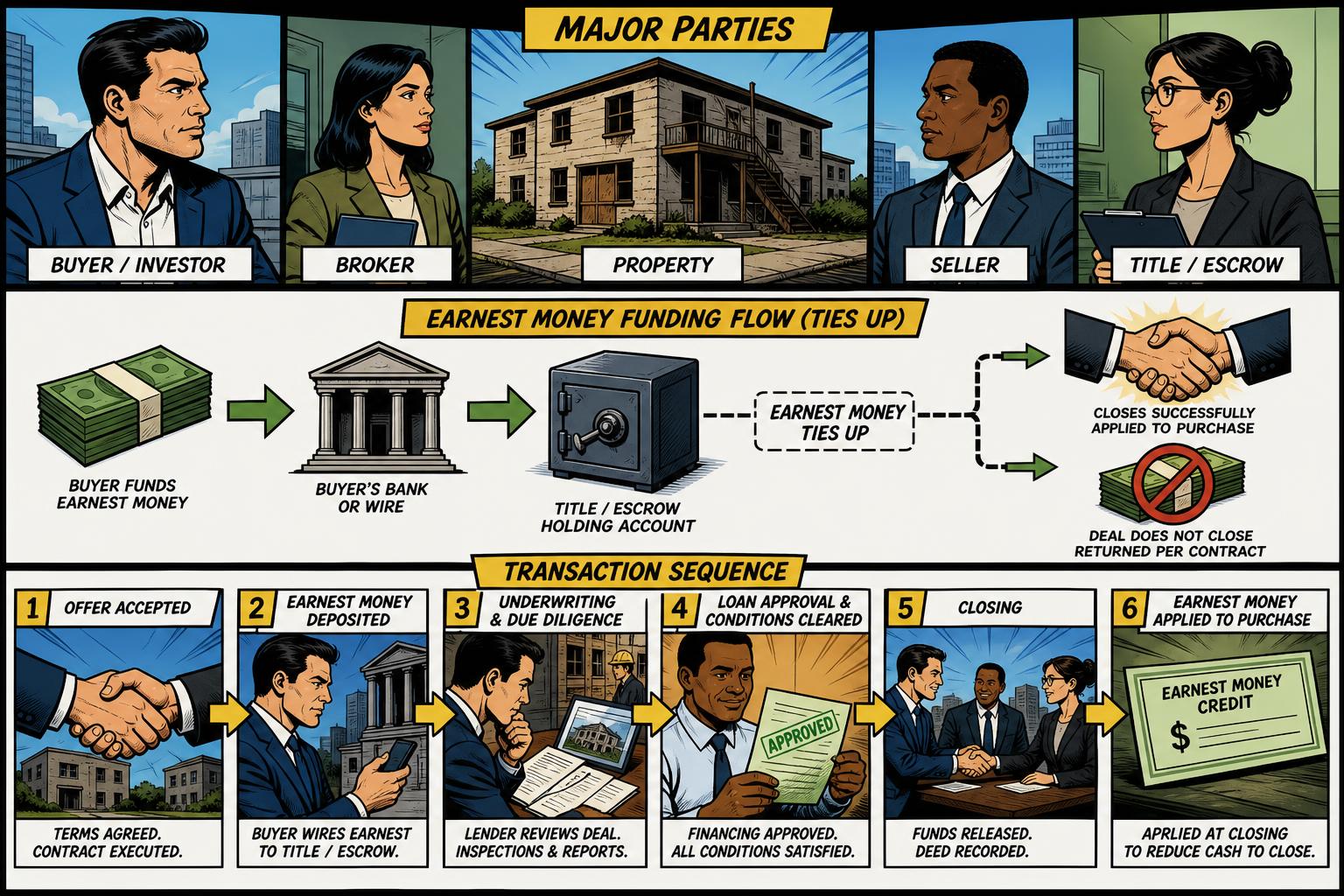
How EMD Funding Usually Works
Every funder has their own approach, but the basics are the same.
- You have a signed purchase contract with buyer, property, price, deposit amount, and deadline.
- The funder reviews the contract and your exit plan. This is the real underwriting.
- The funder sends the deposit straight to the title or escrow company, not to your personal account. This way, the money stays traceable and linked to the transaction.
- At closing or termination, the deposit is repaid. If the deal closes, repayment usually happens at the table. If you exit under a valid contingency, the refund goes back to the funder.
- You pay a fee for the advance. Usually a flat fee or percentage, sometimes with a minimum. The fee is earned whether the deal closes or not.
Notice what’s missing: no appraisal, no full rehab budget, no 30-day underwriting. This product is short-term and focused. The main questions are: will the deposit come back, and will the funder get paid?
EMD Funding vs. Borrowing Against Your Own Credit
Traditional lenders care a lot about where deposit money comes from. Fannie Mae’s Selling Guide says if a deposit can’t be traced to your account, the lender verifies the source and checks that funds actually moved. Large deposits get extra scrutiny.
That’s agency mortgage logic, not private EMD funding. But private funders ask similar questions: deposits must be documented, traceable, and make sense for the deal.
If you plan to finance the deal with a conventional loan later, check with your lender before using EMD funding. Some underwriters treat third-party deposits as borrowed funds, which can complicate things. Ask your loan officer before signing, not at closing.
When EMD Funding Works Best
EMD funding fits best when the exit is clear and the contract protects the deposit.
- Wholesale and assignment deals with a real end buyer or enough spread to cover the fee.
- Double closings where the deposit is out only briefly.
- Fix-and-flip purchases when your cash is tied up elsewhere.
- Multifamily and commercial contracts with large deposits.
- Joint ventures where one partner brings the deal, another brings capital, and a short-term advance bridges the gap.
It’s a poor fit when the contract is nonrefundable from day one, the exit is shaky, or the investor lacks track record or backup repayment sources.
Hypothetical Example: Single-Family Assignment in Dallas, Texas
This example is just for illustration; it doesn’t represent a real borrower or deal.
An investor contracts a distressed single-family home in Dallas for $412,000. The contract requires $12,000 earnest money to the title company within three business days. There’s a seven-day option period and a 30-day close. The investor has a verbal commitment from an end buyer at $430,000 but no signed agreement.
Their cash is tied up in a rehab and a pending purchase. Paying the deposit would leave reserves thin, so they seek EMD funding.
Here’s how the numbers might look:
- Advance: $12,000 wired to title
- Funding fee: 8% ($960), plus about $400 in processing and wire costs
- Total cost: $1,360
- Expected assignment spread: $18,000 ($430,000 minus $412,000)
- Cost as share of spread: about 7.5%
- Repayment: $12,000 returned from escrow at closing, fee paid from proceeds
The risk: If the investor exits during the option period, the deposit should come back (Texas contracts often have a separate, nonrefundable option fee). If they terminate after the option period without a valid contingency, the $12,000 is at risk. The funder would look to the investor, usually with a personal guarantee, for repayment.
So the funder isn’t asking if Dallas is a good market. The real questions are: Does the contract protect the deposit? Is the end buyer real? Can the investor repay if the deal falls through? Here, the weak spot is the unsigned end buyer. I’d want a signed assignment or proof of funds before funding. At minimum, a stronger backup exit.

What I Review Before Funding
When a deposit request comes in, here’s what I look for:
- The contract. I read the actual signed agreement, not a summary. I check deposit amount and deadline, contingency periods, refund conditions, and who holds the deposit. Terms like “nonrefundable upon execution” or vague due diligence windows change the risk.
- The escrow holder. The deposit should go to a reputable title company, escrow agent, or attorney trust account. I verify wire instructions by phone, never just by email.
- The exit. Is there a signed end-buyer agreement, a refinance commitment, or strong evidence of demand? How does the investor get from contract to closing, and how long does it take?
- The numbers. Does the spread cover the funding cost with room to spare? If a $1,400 fee kills the deal, the deal has bigger problems.
- The borrower. I look at experience, prior closings, liquidity outside this deal, and credit. The funder needs a repayment source beyond just the deal.
- Deposit size vs. price. If the deposit is much higher than local custom, I want to know why. Is it protecting the investor or just adding pressure?
- Seller and counterparties. Is the seller the real owner? Is the title clean? Is the end buyer verified?
- Downside recovery. If the deal fails, how does the funder get paid back? A personal guarantee is common since the deposit is the funder’s exposure if the contract is breached.
For more, see how investors fund $10K+ EMDs and this companion article on funding larger deposits.
Red Flags
Here’s what makes me hesitate or say no:
- Incomplete contracts or blanks where deposit terms should be.
- Nonrefundable deposits with no clear path to closing. If the money is gone on day one, the funder is taking deal risk, not just timing risk.
- End buyer is just a conversation. Verbal interest isn’t an exit.
- Wire instructions that change or come only by email. Classic fraud pattern. Always verify independently.
- Unverifiable seller or property. Title issues, unclear ownership, or a seller who can’t produce documents.
- Abnormally large deposit for the area, with no good reason.
- Rushed timeline pushed by a third party. If you’re pressured to fund before reviewing documents, that’s a reason to wait.
- Borrower has no liquidity outside the deal. If one failed contract wipes them out, risk is too high.
- Unclear contingencies. If nobody can say what happens if inspection or financing fails, the deposit isn’t protected.
- Unwillingness to provide basic documents. Missing ID, entity docs, or proof of experience is a stop sign.
Before a lender reviews proof of liquidity, your file should be organized enough to answer basic underwriting questions quickly.
Borrower Readiness Checklist
Have these ready before you ask. It speeds up the process and improves your chances.
- Fully executed purchase contract, with all addenda
- Clear deposit amount, due date, and escrow holder
- Title company or attorney contact, with verified wire instructions
- Contingency dates and specific refund conditions
- Signed assignment, end-buyer agreement, or documented exit plan
- Proof of end buyer’s ability to close, if relevant
- Entity documents and ID for buyer and guarantor
- Short summary of your experience and recent closings
- Proof of liquidity or other repayment sources outside this deal
- Your numbers: purchase price, expected resale or refinance value, all costs including the funding fee
- Plan for what happens if the deal doesn’t close
- Confirmation from your lender (if there’s a financing contingency) that a funded deposit won’t cause problems later
What EMD Funding Costs, and When It’s Not Worth It
The cost is real. Measure it against the deal, not just the deposit. An 8% fee on $12,000 is $960, but if your net profit is $5,000, you’re giving up a big chunk.
Use EMD funding when:
- The spread easily covers the fee.
- Your own cash is better used elsewhere, and you know exactly where.
- The contract protects the deposit.
Skip it when:
- The deal only works if everything goes perfectly.
- You’re using funding to chase a contract you haven’t really underwritten.
- You couldn’t cover the deposit if the deal fails after contingencies expire.
A funded deposit doesn’t make a weak deal strong. It just shifts the capital risk from your balance sheet to someone else’s, for a price. The deal still has to stand on its own.
FAQ
Can I borrow the earnest money deposit from a bank?
Not usually. Traditional mortgages expect the deposit to come from your own verified funds. Private, short-term EMD funding is a separate product for investors and works differently.
Does the funder wire the money to me or to title?
To the title company, escrow agent, or attorney. Never to your personal account.
What happens if the deal doesn’t close?
It depends. If you exit under a valid contingency, the deposit is refunded and returned to the funder. If you breach, the seller may keep the deposit, and you typically owe the funder directly. That’s why guarantees are common.
Is the deposit refundable in Texas?
It depends on the contract. Texas forms often have a separate, nonrefundable option fee. The earnest money is treated differently. Check your contract and ask your title company or attorney. This isn’t legal advice.
How fast can an EMD be funded?
It depends on how complete your file is. With a signed contract, verified escrow, and a clear exit, it can happen in days. Missing documents slow things down.
Do I need good credit?
Credit matters, but it’s just one factor. Contract quality, exit strength, experience, and liquidity usually matter more for a short-term deposit advance.
Can this be used in a joint venture?
Yes. When one partner brings the deal and another brings capital, a funded deposit can secure the contract while JV terms are finalized. Spell out the advance, repayment, and roles before money moves.
How is the fee calculated?
Usually as a flat amount or a percentage of the advance. Ask what’s included, if there’s a minimum, and if the fee is earned even if the deal falls through.
Next Step
If you have a contract and a deposit deadline coming up, send the signed agreement, escrow contact, and a short exit summary. A funder can quickly tell if the deposit is protected and if the numbers make sense.
You can submit a deal for review at JointVentureLoans.com. Bring the documents from the checklist above, and be upfront about any weak spots. It’s easier to solve problems before the wire than after.
Further Reading and Source Context
These outside references can help you compare definitions, market language, and general real estate financing context. They are provided for education only and do not imply endorsement by those publishers: