
Transactional Funding vs Private Money: Which Capital Structure Fits the Deal
Most real estate headaches come from using the wrong type of financing. The timeline and exit strategy drive everything. A wholesaler who needs $142,000 for a few hours is in a very different position than a rehabber who needs $160,000 for nine months. Both might call it “short-term money,” but if you don’t match the financing to the deal, you’ll end up paying too much in fees, risk losing your closing, or get stuck when the lender realizes what you’re actually trying to do.
Both transactional funding and private money come from non-bank sources, but they’re structured, priced, and repaid very differently. Picking the wrong one can cost you. This article explains how each works, where they overlap, where they don’t, and how I think about the choice as a private credit operator. It’s a framework, not a guarantee that any deal will qualify.
What Transactional Funding Actually Is
Transactional funding is meant for the purchase side of a double closing. You have a contract to buy a property (A to B) and a contract to sell it to your end buyer (B to C). Both closings happen back to back, usually on the same day. The end buyer’s funds pay off the transactional lender.
The lender isn’t betting on a long-term hold. They care about whether the second closing will actually happen and if the funds will flow back through title as planned. Collateral matters, but the real risk is execution: can the end buyer close, is the contract solid, and is the title company experienced with both sides?
Because the loan lasts only hours or a day or two, pricing is usually a flat fee or a small percentage of the amount funded, not an annual interest rate. For more detail, check the Transactional Funding page or the guide on transactional funding and double closings. For a step-by-step breakdown, see How Transactional Funding for Double Closing Works in 2026.
What transactional funding is NOT: financing for a property you plan to own, fix, or refinance. The lender expects to be paid back by the B-to-C closing, not by your rehab profit or a future refinance.
What Private Money Actually Is
Private money is a loan backed by real estate and provided by an individual, a fund, or a private lender rather than a bank. Typically, these loans last six to eighteen months, require interest-only payments, include origination fees, and place a lien on the property.
The underwriting focuses on the asset and the plan: what you’re paying, what you’ll spend on rehab, what it’ll be worth after, how you’ll exit, and your experience. The lender is comfortable holding risk for months, so they care about the property’s value if your plan falls through, not just whether a closing happens tomorrow.
Private money fits if you’re going to own the asset for a while. That includes fix-and-flips, bridge loans, and acquisitions where you’ll refinance or sell later.
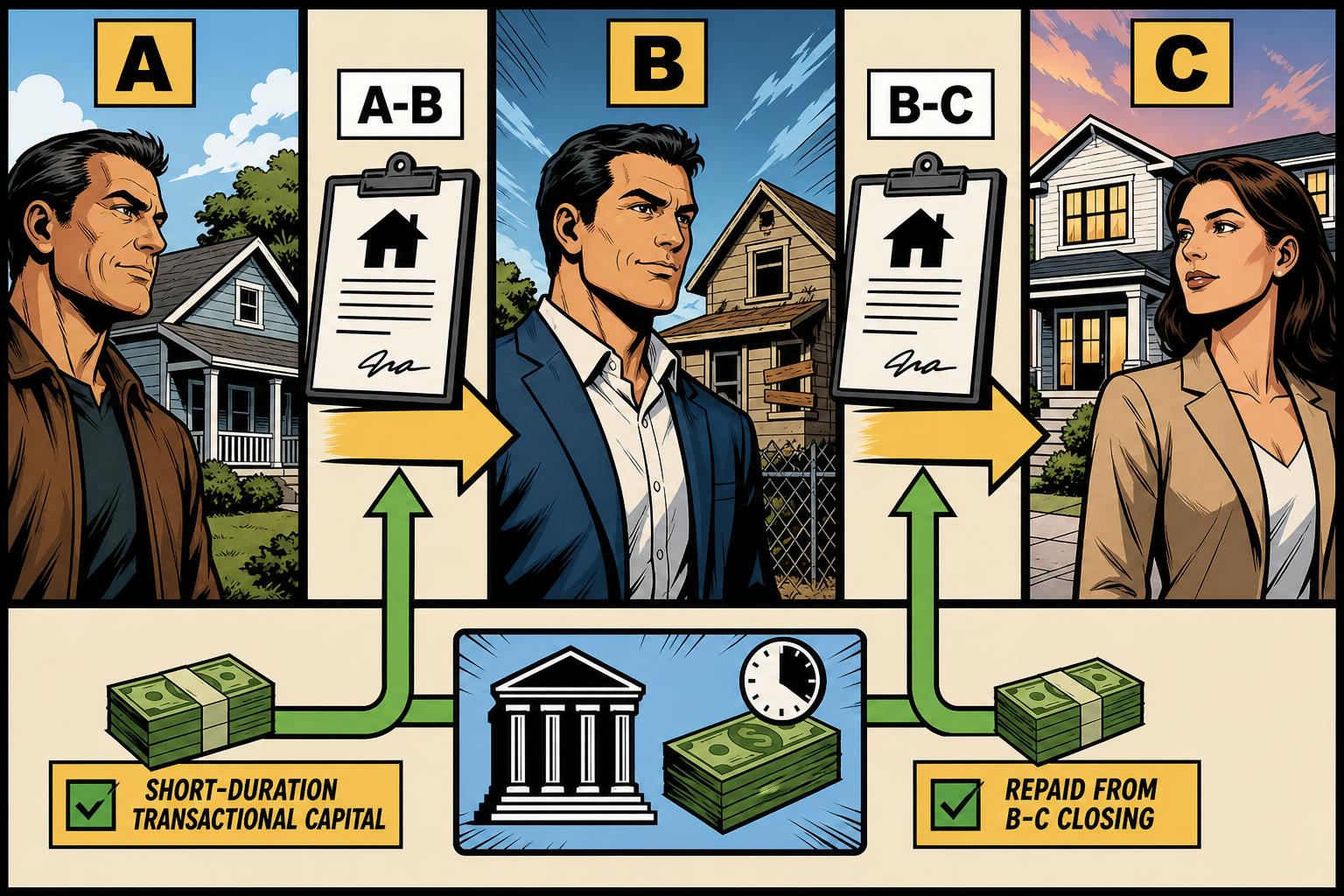
The Real Difference Is Duration and Source of Repayment
Forget the jargon. Here’s what sets them apart:
- How long is the money out? Hours or days means transactional funding. Months means private money.
- What pays back the lender? If the end buyer’s funds repay the loan at a simultaneous or near-simultaneous closing, that’s transactional. If it’s a sale, refinance, or rehab exit, that’s private money.
- Will you actually hold title? In a double closing, you hold title briefly. In a private money deal, you hold title and do something with it.
- Who’s holding property risk? Transactional lenders carry almost none, since the property isn’t held. Private money lenders carry condition, value, and market risk for the whole term.
Pricing follows risk. A transactional loan might cost a few thousand on a $140,000 purchase, which looks high as a percentage, but it’s only for a few hours. A private money loan at 11% annual plus points looks cheaper per day, but over a long hold, it adds up. Comparing them by headline rate is a rookie mistake.
Where Joint Venture Money Fits Beside These Two
Sometimes neither fits. If the deal needs both purchase capital and a partner to share risk, or if the borrower lacks experience or balance sheet for straight debt, a joint venture might be the right choice. That’s a different conversation about equity, splits, and control. For now, just know it’s a third option when neither debt product fits.
Hypothetical Example: A Double Closing in Indianapolis, Indiana
This is a made-up example with sample numbers, not a real deal.
A wholesaler agrees to buy a single-family house in Indianapolis for $142,000. They’ve also signed a contract to sell it to a cash buyer for $168,500, making a gross profit of $26,500. Since the wholesaler doesn’t have $142,000 to complete the first purchase and prefers not to assign the contract, a double closing could be a simpler option depending on the terms and the profit margin.
Here’s how it might look with transactional funding (assuming these fees):
- A-to-B purchase funded: $142,000
- Funding fee (1.5% assumed): $2,130
- Flat processing fee: $495
- Settlement/title charges (assumed): $3,250
- Gross spread: $26,500
- Estimated net to wholesaler: about $20,625
This only works if the B-to-C closing happens as planned. The lender will want to see the end buyer’s proof of funds, the executed B-to-C contract, a title company that can handle a double closing in Indiana, and confirmation that nothing in either contract blocks the sequence. If the end buyer’s funds don’t show up, the lender ends up with a property the borrower never wanted to keep. That’s why transactional lenders are strict about verifying the end buyer.
Now, change the plan. Suppose the buyer isn’t cash, but an investor who wants to buy at $142,000, spend $38,000 on rehab, and sell at an after-repair value of $215,000 in nine months. That’s not a double closing. That’s a private money deal. A lender might advance 85% of the purchase ($120,700) plus the full rehab budget in draws ($38,000), totaling $158,700.
Assumed terms: 11% interest, 2 points.
- Origination points: about $3,174
- Interest over nine months (with rehab draws): roughly $11,500
- Total financing cost: about $14,700 before closing, holding, and sale costs
Same house, same address, but the capital structure is completely different. If you treated this investor like a transactional funder, it wouldn’t work because there’s no second closing to repay the loan. And if you put the wholesaler into a private money loan, they’d have to pay points and go through a full origination process just for money they only need for a few hours.
If an Indianapolis investor asked me which way to go, my first question would be: who’s repaying whom, and when?
When Transactional Funding Fits
Transactional funding usually fits when:
- Both contracts are signed and the B-to-C buyer is verified.
- The spread covers funding fees, closing costs, and leaves a real profit.
- Your title or settlement agent has done a double closing before and will accept the sequence.
- The timeline is days, not weeks.
- You don’t plan to own the property.
Transactional funding isn’t just for small deals. If you’re working on syndications or commercial assets, see Transactional Funding for Commercial & Multifamily Syndications. The same principle applies: short exposure, defined repayment.
If you’re a wholesaler deciding between a double closing and an assignment, Double Closings for Wholesalers breaks down the tradeoffs.
When Private Money Fits
Private money fits better when:
- You’ll own the property for more than a few days.
- There’s rehab, lease-up, entitlement, or stabilization work between purchase and exit.
- The repayment source is a future sale or refinance.
- You need draw administration, an extension option, or a term that matches your plan.
- Your experience, credit, or liquidity make bank financing tough.
If you try to force a hold-and-rehab deal into a transactional structure, the lender won’t let you sit on the property. If you use a nine-month loan for a same-day flip, you’re paying for time you don’t need.
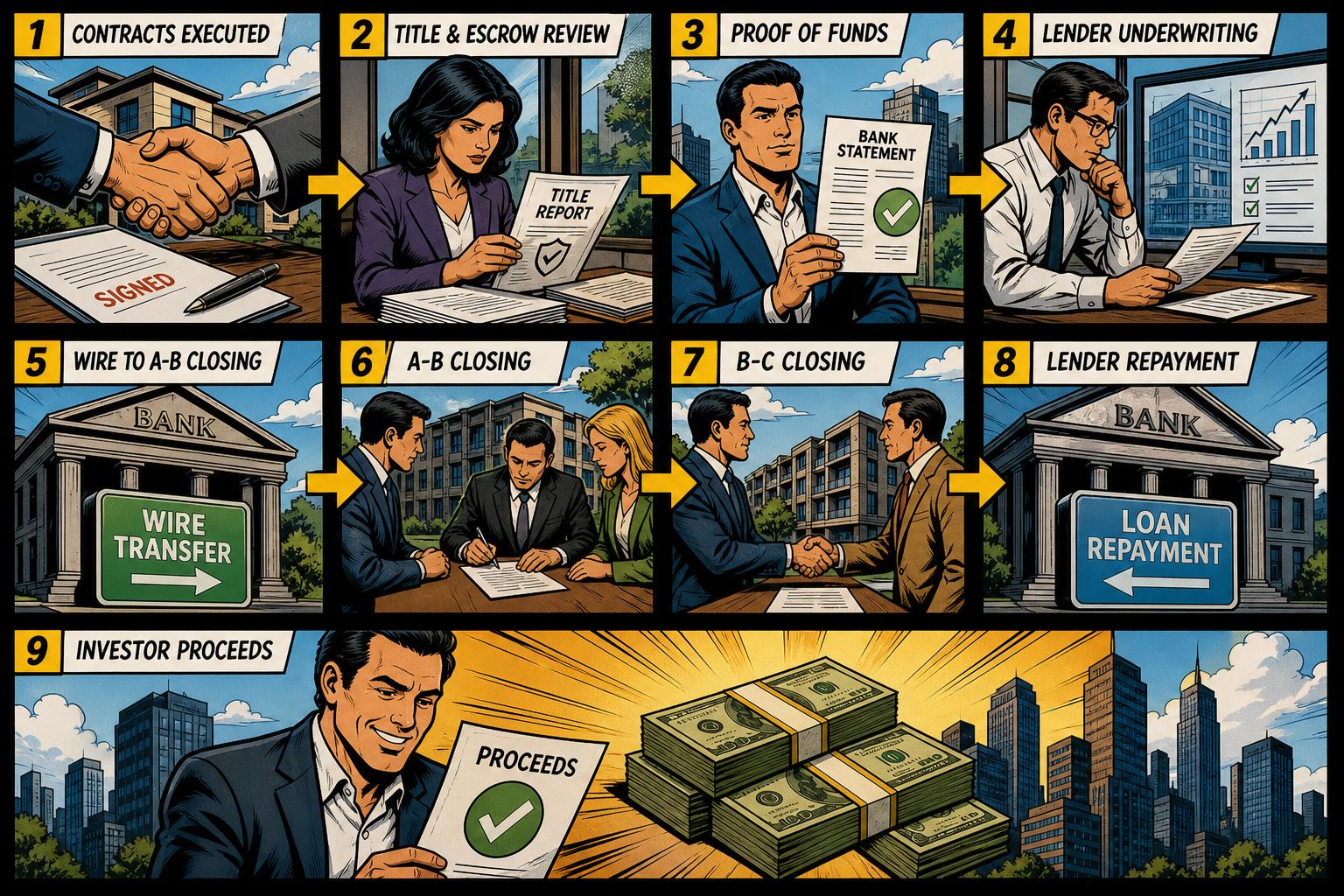
Why Funds Movement and Title Matter More Than Borrowers Expect
Both structures depend on clean funds flow. This is where small mistakes kill deals. Settlement agents need good funds in escrow before they disburse. The American Land Title Association’s Model Good Funds Law FAQ explains why funds must be in escrow to pay proceeds, lienholders, and other disbursements. In a double closing, this makes timing between closings critical: the B-to-C funds must arrive before the transactional lender gets repaid.
For a general look at what happens at closing, the CFPB has a plain-language explainer on what a mortgage closing involves and their closing disclosure page covers how funds are typically delivered. These are written for consumer mortgages, and most investor loans fall outside those rules, so use them for context, not as the rulebook. Your title company and attorney are your real sources.
What I Would Review Before Funding This
When a request comes in, here’s what I want to see before deciding which structure (if any) fits.
For transactional funding:
- Both executed contracts, with all addenda and assignment/non-assignment language
- Proof of funds and ID for the end buyer; are funds cash or financed?
- Settlement agent’s written confirmation they’ll handle both closings and the sequence
- Draft settlement statement for each side, showing the spread and all costs
- Any option, earnest money, or inspection contingency that could let a party walk
- Title commitment, including liens, judgments, or ownership issues that could block closing
- Borrower’s track record with this kind of transaction, if any
For private money:
- Purchase contract, scope of work, and rehab budget with contractor bids
- Valuation support: real comps, not just an opinion
- Exit strategy and a backup if the first one slips
- Borrower experience with similar projects and liquidity for overruns
- Insurance, entity docs, and any existing liens
- Loan-to-cost and loan-to-ARV math under a conservative scenario
In both cases, I’m asking: if the plan fails, what’s left, and can I get repaid?
Red Flags
These are patterns that make me slow down or say no:
- End buyer can’t be verified. A B-to-C contract is worthless if the buyer’s funds aren’t real.
- Spread disappears after costs. If fees and closing costs eat the margin, there’s no room for error.
- Title company has never done a double closing. Sequence errors and disclosure problems often start here.
- Contract language restricts resale or assignment. Some contracts and local rules limit what you can do. Have counsel review before relying on a plan.
- A “double close” that’s really a hold. If the exit depends on finding a buyer later, it’s private money and should be priced and underwritten accordingly.
- Rehab budgets built on hope. Private money lenders see this all the time. No contingency or no real bids is a red flag.
- Valuation based on the highest comp. Anchoring to the best sale inflates leverage and weakens the exit.
- Pressure to fund before docs are ready. Urgency is normal. Missing paperwork is not.
- Borrowers who can’t explain the exit in two sentences. If the plan needs a long story, there’s probably a gap.
Before a lender reviews proof of liquidity, your file should be organized enough to answer basic underwriting questions quickly.
Borrower Readiness Checklist
Before you request funding, get your ducks in a row. Having this ready speeds up the process and makes your request easier to evaluate.
Core items for any request:
- Entity docs and ID for all signers
- Executed purchase contract
- Property address, parcel info, and any known title issues
- Short written summary of the deal and the exit
- Contact info for the title or settlement agent
Additional for transactional funding:
- Executed B-to-C contract
- End buyer proof of funds or approval letter
- Draft settlement statements for both closings
- Confirmation the settlement agent will handle the double closing
- Your calculation of net proceeds after all fees
Additional for private money:
- Rehab scope and budget with contractor quotes
- Comparable sales and your ARV logic
- Project timeline and draw schedule
- Evidence of liquidity for reserves and overruns
- Prior project history, if you have it
Final checks:
- Can you state the repayment source and date in one sentence?
- Does the deal still work if closing slips by a week?
- Have you had an attorney review the contracts where needed?
Choosing Between Them: A Simple Test
Ask yourself three things:
- Do I plan to own this property beyond closing? If yes, look at private money. If not, transactional funding may fit.
- Is there a second closing already lined up and verified? If yes and the timeline is days, transactional. If not, you probably have a hold or a pipeline problem.
- Does the math work with all fees included? Run the numbers with real costs and a possible delay, not just the best case.
If the answers point in different directions, you may need a different structure, like a joint venture or a reworked contract. Better to find that out before you’re up against a closing deadline.
Frequently Asked Questions
Is transactional funding the same as a hard money loan?
No. Hard money or private money is underwritten against the property and your plan, and repaid over months. Transactional funding covers a same-day or near-same-day purchase and is repaid by the end buyer’s closing.
Can I use private money for a double closing?
Some lenders will, but you’ll pay for a longer loan structure you don’t need. If the second closing is verified and imminent, transactional funding usually fits the risk better.
Why does transactional funding cost a flat fee or small percentage instead of an interest rate?
Because the loan lasts only hours or days. An annual rate would produce a tiny dollar amount that doesn’t cover the lender’s cost to underwrite, wire, and coordinate with title.
Do I need good credit for transactional funding?
Credit usually matters less than the strength of the contracts, the end buyer, and the title company. Requirements vary by lender, so check what applies to your request.
What happens if the end buyer doesn’t close?
The lender has funded a purchase for a property the borrower never planned to keep. That’s the main risk, which is why verifying the end buyer and reviewing contracts come first. Depending on the terms, the borrower may be responsible for repayment and costs, so know your obligations before signing.
Is double closing in Indianapolis, Indiana different from other states?
The structure is the same nationally, but title practices, closing costs, and contract requirements vary by state and settlement agent. Talk to a local title company or attorney about how they handle back-to-back closings.
Can I turn a wholesale deal into a rehab deal if the end buyer falls through?
You can, but it changes the capital need. You’d be looking at private money or other financing for a hold, and the numbers have to work on their own, not just on the original spread.
When would a joint venture make more sense than either option?
When the deal needs equity as well as debt, or the sponsor doesn’t have the experience or balance sheet for straight financing. In that case, you trade some upside for shared capital and risk.
Next Step
If you have a deal and aren’t sure which structure fits, send the contract, the end-buyer details if there are any, and a short summary of your plan. I’ll tell you whether it looks like a transactional funding request, a private money loan, or something that needs reworking first.
Start with the Transactional Funding page, or review the full Transactional Funding & Double Closings guide and then submit your scenario at JointVentureLoans.com. Funding is always subject to underwriting and approval. Nothing here is a commitment to lend.
Further Reading and Source Context
These outside references can help you compare definitions, market language, and general real estate financing context. They are provided for education only and do not imply endorsement by those publishers:
- I'm about to close on a real estate purchase transaction with a mortgage. What can I expect in the mortgage closing process? | Consumer Financial Protection Bureau
- § 1026.38 Content of disclosures for certain mortgage transactions (Closing Disclosure). | Consumer Financial Protection Bureau
- CFPB Consumer Laws and Regulations RESPA CFPB April 2015 RESPA 1 Regulation X