
Real estate deal closing can become complicated when a wholesale contract cannot be assigned. An assignment is usually straightforward: you sign a purchase agreement, assign your interest to an end buyer for a fee, and move on without taking title. But this approach only works when the contract and everyone involved allow it. If the seller prohibits assignment, the end buyer’s lender needs to see a direct purchase, or the property is bank-owned or HUD-owned with restrictions, your expected closing can quickly stall.
The key challenge is finding a legitimate way to complete the real estate deal closing when an assignment is not practical. You may have a motivated seller, a ready end buyer, and a workable profit margin, but still need to close the purchase before reselling the property. In some transactions, a double closing can solve that problem. You close with the original seller first, then complete a separate sale to your end buyer, often on the same day. Short-term transactional funding may be used to fund the first closing and repaid from the second closing. Your potential profit is the difference between the purchase and resale prices, minus funding fees and closing costs.
Why Real Estate Deal Closing Can Get Complicated
An assignment usually works when three things line up: the seller’s contract allows it, the end buyer accepts the arrangement, and the buyer’s lender and closing agent are comfortable with the transaction. If any one of those conditions is missing, your real estate deal closing may need a different structure.
Here are common situations where an assignment may not be practical:
- Non-assignable contracts. REO, HUD, and institutional sellers may include no-assignment clauses. Some individual sellers and agents also restrict assignments in their purchase agreements.
- End-buyer financing requirements. When the end buyer uses a mortgage or other financing, the lender may require a particular transaction structure or additional documentation. Discuss the planned closing with the lender and closing attorney before proceeding.
- Keeping the purchase and resale transactions separate. An assignment can disclose the wholesaler’s fee. A double closing creates two separate transactions, but it does not remove applicable disclosure, legal, or lender requirements.
- Title company or attorney policies. A closing agent may not handle assignments or may require additional documents. Confirm the closing agent’s requirements early rather than assuming the structure will be accepted.
Assignment can be useful, but it is not suitable for every transaction. Real estate investors should understand the available closing options and confirm that their contracts, title company, and funding source support the chosen structure. Never assume a double closing automatically resolves a contract restriction or lender concern.
How Transactional Funding Can Help Close a Deal
Transactional funding is short-term capital that may be used to fund the first purchase in a double closing. The investor closes with the original seller, then resells the property to the end buyer and repays the funding from the second closing’s proceeds. Our Transactional Funding page explains how we structure this type of financing. Approval generally depends on the documented transaction, the end buyer’s ability to close, the title process, and the expected repayment timeline.
This is different from a bridge or rehabilitation loan, which may be outstanding for weeks or months. Transactional funding is designed for a short interval between two closings, so the second transaction needs to be credible and properly coordinated. Costs, timing, and funding conditions vary by lender and transaction.
For a step-by-step explanation of the sequence, read our guide to how transactional funding for double closing works. Our guide to transactional funding and double closings provides more background on the process.
How a Double Close Works
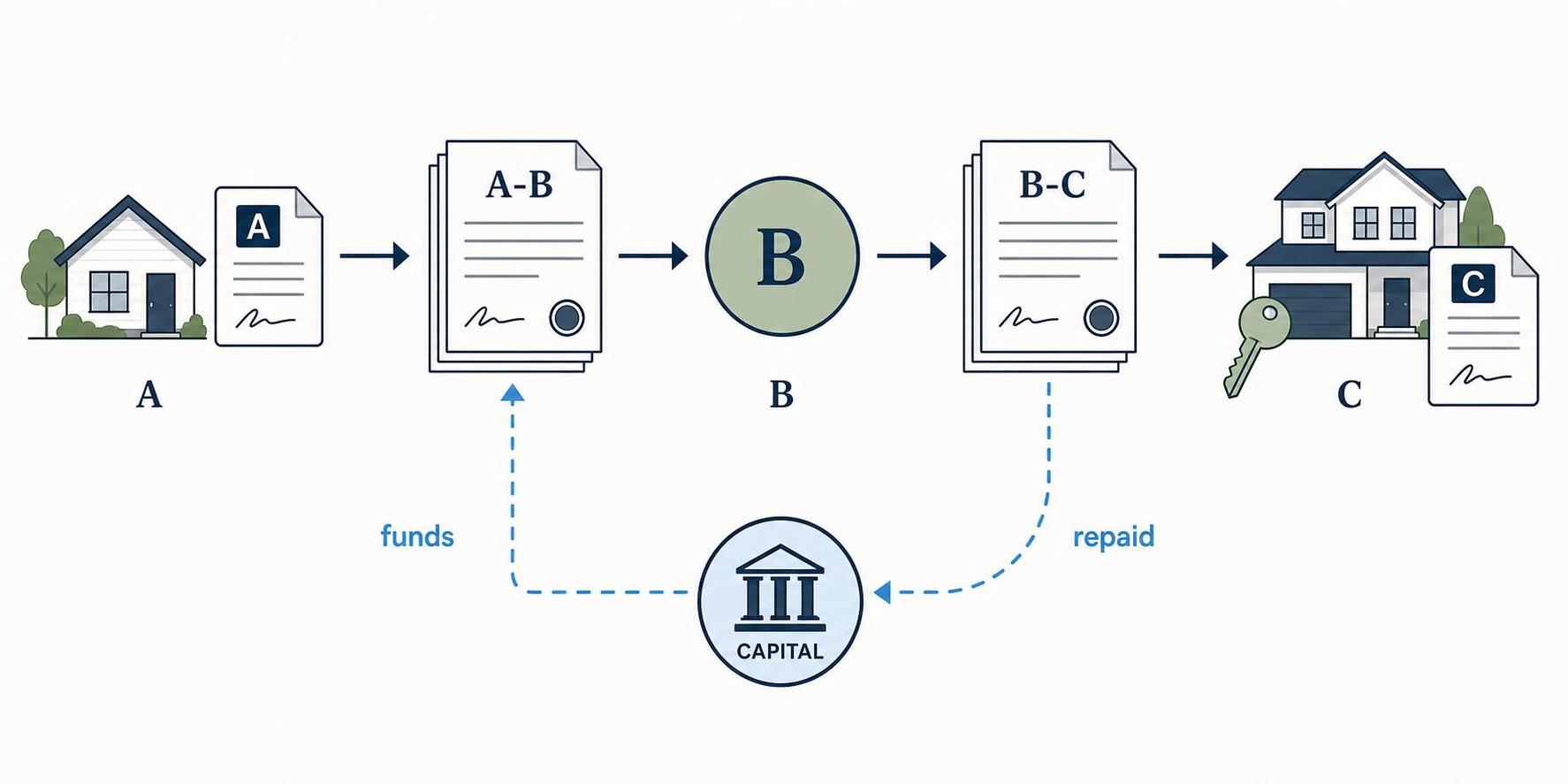
A double close involves two separate property sales arranged close together, often at the same title company or attorney’s office so the paperwork and funds can be coordinated.
- A-to-B closing. You, as Buyer B, purchase the property from the original seller (A). If approved, short-term funding pays the purchase price and title transfers according to the closing documents.
- B-to-C closing. You then sell the property to your end buyer (C), sometimes on the same day or the next business day. The end buyer’s funds are used to complete the resale.
- Funding payoff. The funding provider is repaid from the second closing’s proceeds as arranged with the closing agent. Remaining funds, after the purchase price, fees, and closing costs, represent your potential profit.
The main risk is a delay between the two closings. If the end buyer’s financing is not ready, a title issue appears, or the buyer cannot send funds on time, you may be left owning the property while still responsible for the short-term financing. Confirm the second closing’s readiness and have a contingency plan before the first purchase is funded.
Example: A Double Closing in Indianapolis
Here is a hypothetical example showing how the numbers and timing might work.
Suppose you have a single-family home under contract in Indianapolis for $145,000. An end buyer has agreed to purchase it for $168,000. The difference is $23,000 before fees and other costs.
However, the original purchase agreement restricts assignment. After reviewing the contract and transaction with the relevant professionals, you explore a double closing and arrange short-term funding for the first purchase.
- A-to-B closing: you purchase the property for $145,000, with title transferred according to the closing documents.
- B-to-C closing: the resale to the end buyer is scheduled for the same afternoon, subject to the buyer’s funds and closing requirements being ready.
- Funding cost: the agreed funding fee is disclosed and paid as provided in the closing instructions.
- Net spread: the $23,000 gross difference is reduced by funding fees, closing costs for both transactions, wire fees, and any other agreed expenses.
A double closing creates two separate sales rather than an assignment. The parties, title company, and any lender must receive the disclosures and documents required for the transaction. Indianapolis is only an example; the same general considerations may arise in other markets, but local law, contract language, and lender rules can differ.
What Lenders Review Before Funding
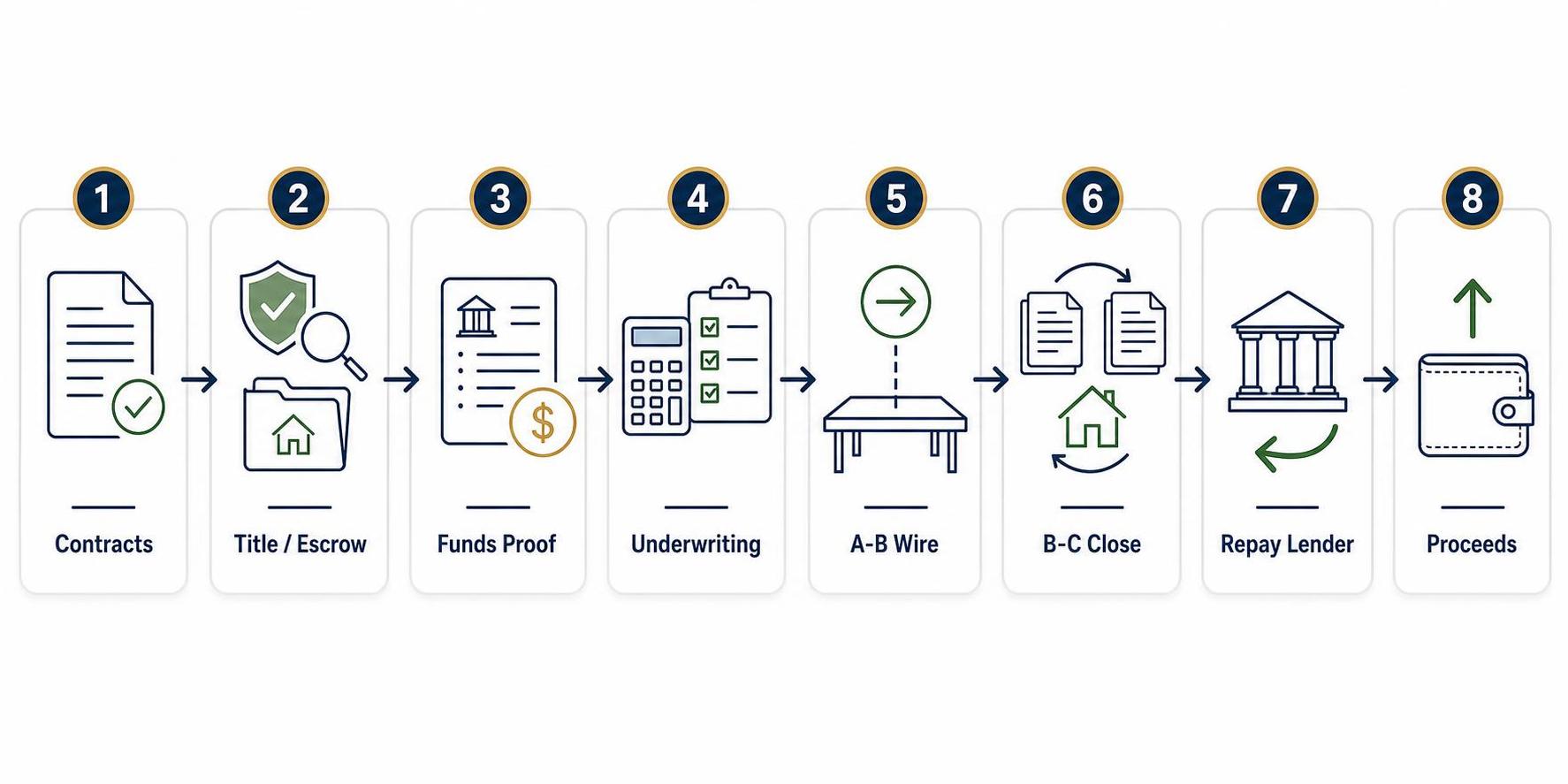
Before funding the first side of a double closing, a lender may ask to review:
- Evidence of the end-buyer transaction. A signed purchase agreement is stronger evidence than a verbal commitment or letter of intent. If the buyer is financing the purchase, the lender may also request loan-status details or proof of funds.
- Confirmed closing dates and closing agent. Both transactions need to be coordinated, and the title company or attorney should confirm it can handle the required sequence.
- Preliminary title information. Liens, judgments, probate issues, or other title problems may delay or prevent closing.
- The actual profit margin after costs. Compare the purchase price, resale price, funding fee, title charges, and other costs. A deal that looks profitable at first may leave little margin after expenses.
- Contract terms and assignment restrictions. The funding provider and closing professionals need to understand the contract and the reason a double closing is being considered.
- The end buyer’s funds and timeline. A cash buyer with verified funds may present a different timing profile from a buyer whose loan still needs final approval.
Red Flags That Can Delay Closing
- No signed purchase agreement with the end buyer when funding is requested.
- A same-day closing is planned, but the end buyer’s lender has not cleared the transaction or the funds are not confirmed.
- The parties have not clearly addressed the planned resale or required disclosures with their closing professionals.
- The title company is unfamiliar with double closings or has not confirmed it can handle both transactions on the required date.
- The expected spread barely covers the funding fee and closing costs, leaving no room for unexpected expenses.
- The investor expects to hold the first purchase for an extended period without confirming that the funding terms allow it.
Before a funding provider reviews the transaction, organize the documents so the purchase, resale, title status, costs, and expected repayment can be assessed without unnecessary delays.
Real Estate Deal Closing Readiness Checklist
- [ ] Fully executed purchase agreement with the original seller, including any assignment restrictions
- [ ] Fully executed resale agreement with the end buyer and a confirmed price
- [ ] End buyer’s proof of funds or relevant loan-status documentation
- [ ] Both closings coordinated with a title company or attorney familiar with the proposed structure
- [ ] Preliminary title information reviewed for potential issues
- [ ] Written calculation of the expected net spread after all fees and closing costs
- [ ] A practical contingency plan if the resale closing is delayed
FAQ
Is transactional funding the same as hard money?
No. Hard money loans are commonly used for acquisitions or rehabilitation over a longer period and may accrue interest over time. Transactional funding is intended for a much shorter period, often to fund the first side of a double closing and be repaid from the second sale. Terms differ by provider.
Why would a seller refuse to allow assignment?
A seller may use a no-assignment clause because of company policy, contract preferences, or concerns about how the transaction will proceed. Some institutional sellers restrict assignments. Review the actual contract and consult the closing attorney before choosing another structure.
Does a double close cost more than an assignment?
It often does. There may be closing costs on both transactions as well as a funding fee. Calculate the total cost before committing, and confirm all charges with the title company and funding provider.
How quickly can a double closing happen?
Some double closings take place on the same day, while others require more time. The schedule depends on title readiness, signed documents, the end buyer’s funds or loan, lender requirements, and the closing agent’s process.
Can this approach work for commercial or multifamily properties?
It may be possible, but larger or more complex transactions can involve additional underwriting, title, entity, and lender requirements. Our article on transactional funding for commercial and multifamily syndications discusses larger transactions, while double closings for wholesalers covers common wholesale scenarios.
Closing a Real Estate Deal When Assignment Won’t Work
If assignment is not permitted or is not practical, your real estate deal may still have a path to closing—but the alternative must comply with the purchase contract, applicable law, lender requirements, and the closing agent’s procedures. A double closing may let you purchase the property and then resell it, with short-term funding potentially covering the first transaction until the end buyer’s proceeds arrive.
If you have a deal where assignment may not work and you are considering a double closing, contact Joint Venture Loans to discuss your timeline, title work, end-buyer documentation, and the requirements for funding the first closing.
Further Reading and Source Context
These references provide additional information about escrow, settlement procedures, and mortgage closing disclosures. They are educational resources and do not imply endorsement by the publishers: