
Transactional Funding vs Private Money: Which Capital Structure Fits the Deal
Every real estate operator eventually faces the same problem: you’ve got a contract, a closing date, and a funding gap you can’t fill with your own cash. The real question isn’t who will lend you money; it’s which capital structure actually fits the deal in front of you. Transactional funding and private money solve different problems. Use the wrong one, and you either burn unnecessary fees or take on risk you didn’t need.
This isn’t just a marketing distinction. These two structures are different in duration, collateral, underwriting, and what happens if your timeline slips. Get it wrong, and you’ll either overpay for capital you only needed for a few hours, or you’ll pay weeks of interest for a deal that closes out in an afternoon. Let’s break down both structures so you can make the right call before you’re in the middle of negotiations.
What Transactional Funding Actually Is
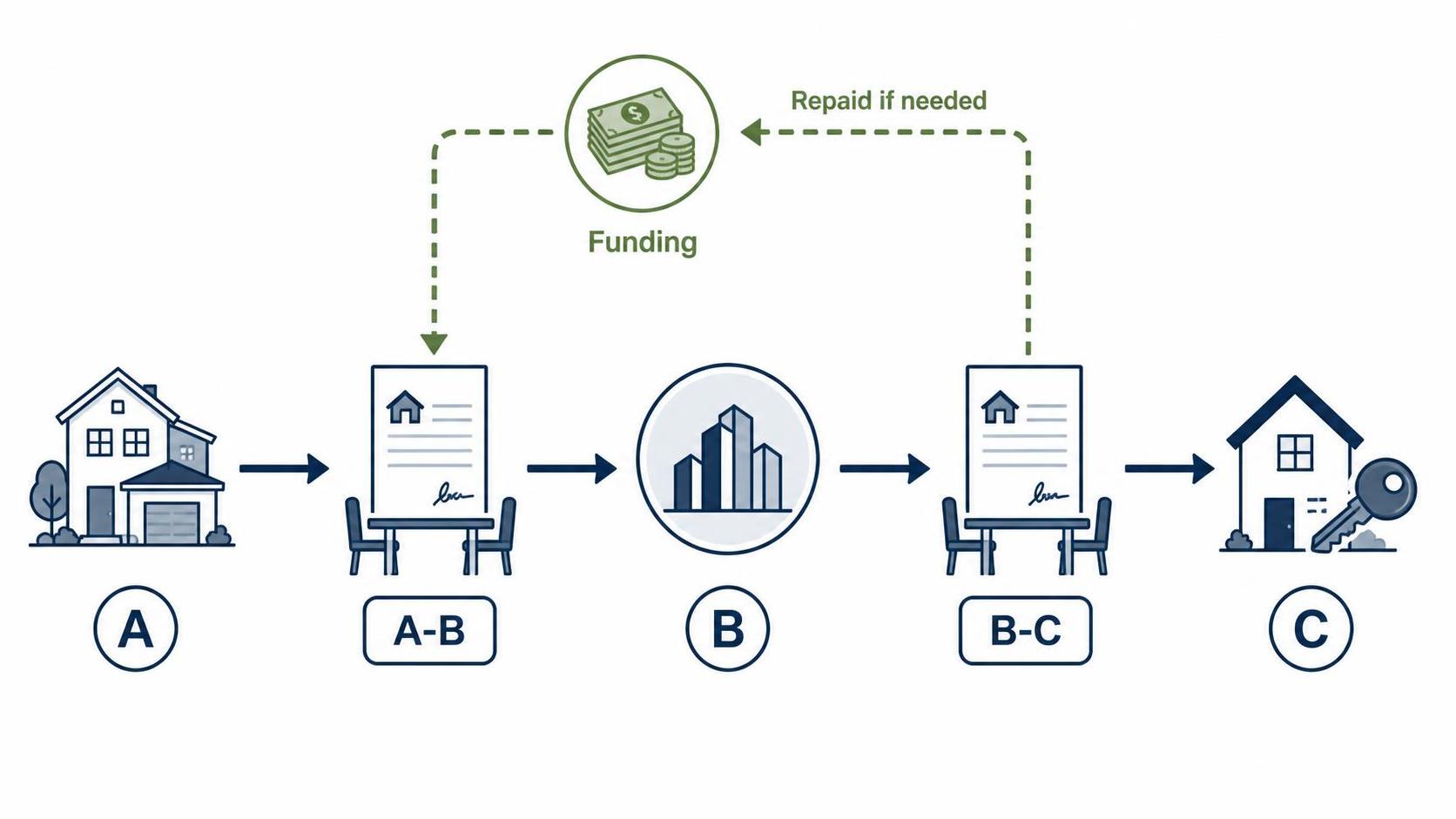
Transactional funding (sometimes called flash funding or A-B-C funding) is short-term capital used for a double closing. You’re buying from Seller A and reselling to Buyer C, usually within hours. You need funds to close the A-to-B leg before the B-to-C buyer’s money comes in.
The lender isn’t focused on your credit, your holding costs, or your exit strategy over months. They’re looking at the transaction itself: is there a real, funded end buyer, are both closings scheduled and documented, and is the title company or attorney ready to handle a true double close? This loan exists for hours, not weeks. Fees are usually flat or short-term, not monthly interest.
If you want a step-by-step breakdown, check out our guide on how transactional funding for double closing works. If you’re new to wholesaling, double closings for wholesalers explains why investors use this structure instead of assignments.
What Private Money Actually Is
Private money is a term loan secured by a note and mortgage (or deed of trust), usually for 30 to 360 days, sometimes longer. Unlike transactional funding, the lender is taking on real duration risk. Their capital is at work for weeks or months, exposed to market swings, renovation timelines, and your ability to execute the exit (sale or refinance).
Because of that, private money underwriting looks more like bridge lending: after-repair value, loan-to-cost, your experience, exit plan, scope of work if there’s rehab, and often a personal guarantee. The cost matches the risk: points at origination plus a monthly interest rate, not a flat same-day fee.
Private money is the right tool when you’re actually holding the asset: a fix-and-flip, buy-and-hold before a refinance, new construction, or any deal where you need weeks to reposition the property before you exit.
Side-by-Side: Structure, Duration, and Cost
| Transactional Funding | Private Money | |
|---|---|---|
| Duration | Hours to same-day | 30–360+ days |
| Collateral hold | Momentary, no equity position held | Recorded lien for the loan term |
| Underwriting focus | Verified funded end buyer, closing docs | Borrower experience, ARV, exit plan |
| Cost structure | Flat fee | Points + monthly interest |
| Typical use case | Double closing, wholesale spread protection | Flip, rehab, bridge-to-refi |
| Borrower credit relevance | Minimal | Material |
The structure drives everything else. Transactional funding is priced for a deal that resolves the same day. The lender’s capital is only at risk for a few hours, so the fee is about convenience and execution, not duration risk. Private money is priced for capital that’s out in the market, exposed to the deal’s outcome over weeks or months.
When Transactional Funding Fits the Deal
Transactional funding is the right fit when:
- You have a real double closing with a verified, funded end buyer under contract
- You want to protect your assignment spread without disclosing it to the seller
- Your B-to-C closing is scheduled for the same day or very close to it
- You don’t want to use your own capital, or you don’t have enough to fund the A-to-B leg
- Your title company or attorney is experienced with back-to-back closings
If any of those aren’t true (especially if you don’t have a verified, funded end buyer), transactional funding isn’t the right tool. Most transactional funders won’t approve the deal anyway. This structure depends on the B-to-C closing actually happening. For a full framework, see the Ultimate Guide to Transactional Funding & Double Closings.
When Private Money Fits the Deal
Private money is the right fit when:
- You’re acquiring a property to hold for renovation, stabilization, or repositioning
- Your exit is a future sale or refinance, not a same-day resale
- You need draw-based funding tied to a rehab scope of work
- You’re buying to hold for cash flow, not to flip immediately
- The deal has enough spread or equity to absorb points and monthly interest over the hold period
Private money also applies in commercial and multifamily deals where the capital stack is more complex, such as bridge acquisition financing ahead of a syndication close. If that’s your scenario, check out our article on transactional funding for commercial and multifamily syndications for where transactional funding still applies at that scale and where it doesn’t.
Cost Structure: Fees vs. Interest
This is where most investors get tripped up. Transactional funding fees are flat because the lender’s capital is at risk for hours. If you try to compare that to a 30-day private money rate, it looks expensive as a percentage, but that is not a real comparison because the durations are totally different.
The right way to look at it is dollar cost versus what the structure actually gets you:
- Transactional funding lets you close a double close without disclosing your spread and without using your own cash, even for a day.
- Private money gives you weeks or months of capital to execute a business plan, such as renovation, lease-up, or stabilization, that transactional funding simply cannot provide.
If you use private money for a same-day double closing, you’re paying for duration you don’t need. If you try to force a rehab deal through transactional funding, it won’t fit the underwriting box, there’s no funded end buyer for a property you plan to hold and renovate.
Underwriting Differences That Actually Matter
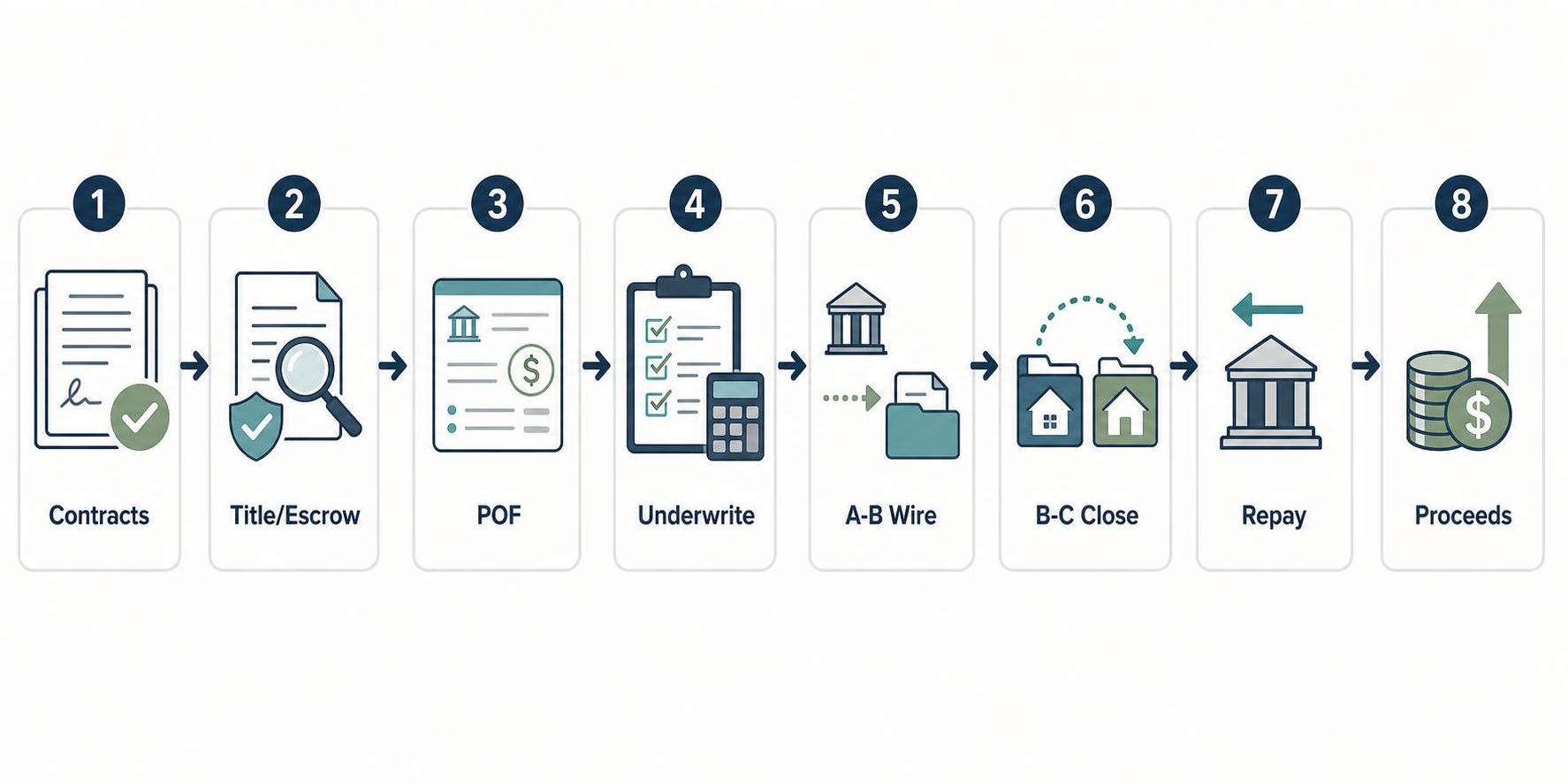
A transactional funder is focused on the mechanics: closing documentation, proof of the B-to-C buyer’s funding (proof of funds or loan commitment), title company confirmation of a simultaneous or back-to-back closing, and clean chain of title on the A-to-B leg. Your personal balance sheet and track record matter less because the exposure window is so short.
A private money lender is underwriting the deal’s fundamentals over the full loan term: purchase price versus after-repair value, your renovation budget and timeline, comps supporting your exit, your track record with similar projects, and often a personal guarantee or cross-collateral if the deal doesn’t fully support the loan. This is closer to how a term lender looks at risk, closing disclosures, settlement statements, and title work all matter more because the lender is exposed for the full hold period. The CFPB’s closing disclosure explainer is a good primer if you haven’t reviewed how settlement costs are itemized and disclosed, since both structures ultimately run through similar settlement mechanics at the title or escrow level.
Hypothetical Example: A Double Closing in Indianapolis, Indiana
This is a hypothetical scenario for illustration only, not a real transaction or client.
Let’s say an investor in Indianapolis has a single-family property under contract at $145,000 from a motivated seller. The investor already has an end buyer (a local landlord) under contract to purchase at $168,000, with both closings scheduled for the same afternoon. The investor does not want to disclose the $23,000 spread to the seller and does not have $145,000 in liquid cash to fund the A-to-B leg.
This is a classic transactional funding scenario. The investor’s title company sets up a double closing in Indianapolis, with the A-to-B and B-to-C closings scheduled back to back on the same day. The transactional funder reviews the end buyer’s proof of funds, confirms both closings are scheduled with the same title company, and wires funds for the A-to-B leg. When the B-to-C closing funds, the transactional loan is repaid out of proceeds, and the investor keeps the spread minus the flat funding fee and closing costs.
Now, change one variable: instead of a funded end buyer ready to close same day, the investor wants to hold the property, put $30,000 into renovation, and sell in four months. That’s not a transactional funding deal, there’s no same-day exit. It’s a private money scenario, underwritten on after-repair value, the renovation scope, and the investor’s plan to carry the property through a longer hold. Same city, same investor, two completely different capital structures depending on what the deal actually requires.
Indianapolis is just used here as an example, the mechanics work the same way in any market where an investor is running double closings or short-term bridge deals.
What I Would Review Before Funding This
Before funding either structure, here’s what actually gets checked:
For transactional funding:
- Fully executed purchase contract for the A-to-B leg, with no unresolved contingencies
- Fully executed purchase contract for the B-to-C leg, with proof of funds or a loan commitment letter from the end buyer’s lender
- Confirmation from the title company or closing attorney that both closings are scheduled back-to-back or simultaneously
- Preliminary title report showing no liens or judgments that would delay closing
- Settlement statement or estimated closing disclosure for both legs to confirm the numbers actually work
For private money:
- Purchase contract and comps supporting both purchase price and projected after-repair value
- Detailed scope of work and contractor bids if renovation is involved
- Borrower’s track record, prior flips, rentals, or projects of similar scope
- Exit strategy: sale comps or refinance terms with a lender already identified
- Personal financial statement and, where needed, entity documentation for the borrowing entity
In both cases, closing mechanics matter. A title company that doesn’t know how to handle back-to-back closings, or can’t produce clean settlement statements for each leg, is a bigger risk to the deal than most borrowers realize.
Red Flags
Watch for these, no matter which structure you’re pursuing:
- No verified end buyer for a “same-day” transactional request. If the B-to-C buyer’s funding isn’t documented, it’s not a transactional funding deal, it’s just a hope.
- Title company unfamiliar with double closings. Not every closing attorney or title company handles back-to-back closings correctly. This is where deals fall apart at the last minute.
- Private money requests with no exit plan. “I’ll figure out the sale later” isn’t underwriting. A lender needs comps or a refinance term sheet before funding.
- Borrower trying to force a rehab deal into transactional funding. If there’s no same-day resale, transactional funding is the wrong product and most lenders will decline it outright.
- Spread too thin to absorb fees. If the transactional funding fee or private money points and interest eat most of the projected profit, the deal probably doesn’t have enough margin to justify the capital.
- Inconsistent numbers across contract, settlement statement, and payoff. Any mismatch between the purchase price on the contract and the numbers on the settlement statement needs to be resolved before funding, not after.
Before a lender reviews proof of liquidity, your file should be organized enough to answer basic underwriting questions quickly.
Borrower Readiness Checklist
Before you approach a lender for either structure, have this ready:
- [ ] Fully executed purchase contract(s) for the transaction
- [ ] For transactional funding: proof of funds or loan commitment from the end buyer
- [ ] For private money: comps supporting purchase price and ARV, plus scope of work if renovating
- [ ] Title company or closing attorney confirmed and experienced with the structure you’re requesting
- [ ] Preliminary title report or title commitment
- [ ] Entity documentation (LLC operating agreement, EIN) if borrowing through an entity
- [ ] Track record summary, prior deals of similar type and scale
- [ ] Clear breakdown of costs (funding fee or points/interest, closing costs, any holding costs) against projected proceeds
FAQ
Can transactional funding be used if I don’t have an end buyer yet?
No. Transactional funding requires a verified, funded end buyer under contract for the same-day resale. Without that, there’s no repayment source, and lenders will decline the request.
Is private money more expensive than transactional funding?
Not necessarily, they’re priced for different durations. Comparing a flat transactional funding fee to 60-90 days of private money interest and points isn’t apples-to-apples. Look at total dollar cost versus what each structure actually enables for your deal.
Can I switch from transactional funding to private money mid-deal if my end buyer falls through?
Sometimes, but it means re-underwriting as a term loan. There’s no guarantee the same lender offers both products or that your deal qualifies. It’s better to make sure your end buyer’s funding is solid before closing the A-to-B leg.
Does transactional funding show up on my credit or require a personal guarantee?
Usually, no personal credit pull is required since the exposure is so short, but this varies by lender. Private money loans more often involve a personal guarantee because of the longer duration and higher risk.
What happens if the B-to-C closing doesn’t happen on the same day as promised?
This is the core risk in transactional funding. Most lenders require same-day or near-simultaneous closings to limit this risk. If your B-to-C closing is delayed, talk to your lender immediately, don’t let it slip.
Can transactional funding work for commercial or multifamily deals?
It can, but the mechanics get more complex with bigger numbers and layered closings. See our article on transactional funding for commercial and multifamily syndications for how this works at scale.
Talk to JVL Before You Pick a Structure
Guessing wrong on capital structure means you either overpay for a loan or end up with an underfunded deal. If you’re weighing transactional funding against private money for an upcoming closing, whether it’s a same-day double close or a longer hold with a rehab component, talk it through with our team before you lock in terms. Visit Joint Venture Loans to review our transactional funding process and get a structure that actually fits the deal you have, not just the one that’s easiest to sell.
Further Reading and Source Context
These outside references can help you compare definitions, market language, and general real estate financing context. They are provided for education only and do not imply endorsement by those publishers: