
What Title Companies Need to Know About Transactional Funding and Double Closings
Title companies are used to closing standard mortgage deals every day. Then a wholesaler walks in with two contracts for the same property, a same-day closing schedule, and a lender nobody in the office has dealt with before. Suddenly, the file grinds to a halt. Not because the deal is shady, but because the escrow officer doesn’t have a clear playbook for this kind of structure.
That hesitation is normal. Double closings put title companies in the middle of a transaction that doesn’t look like a typical purchase: there’s no long-term note, no mortgage for the end buyer, and the lender’s money is only in the deal for a few hours. Title and escrow staff who don’t see transactional funding often either reject it outright or accept it without asking the right questions. Both approaches can cause problems. This article is for the title and escrow side: what transactional funding really is, what you need to verify before closing, and where the real risk sits in a back-to-back deal.
What Transactional Funding Actually Is
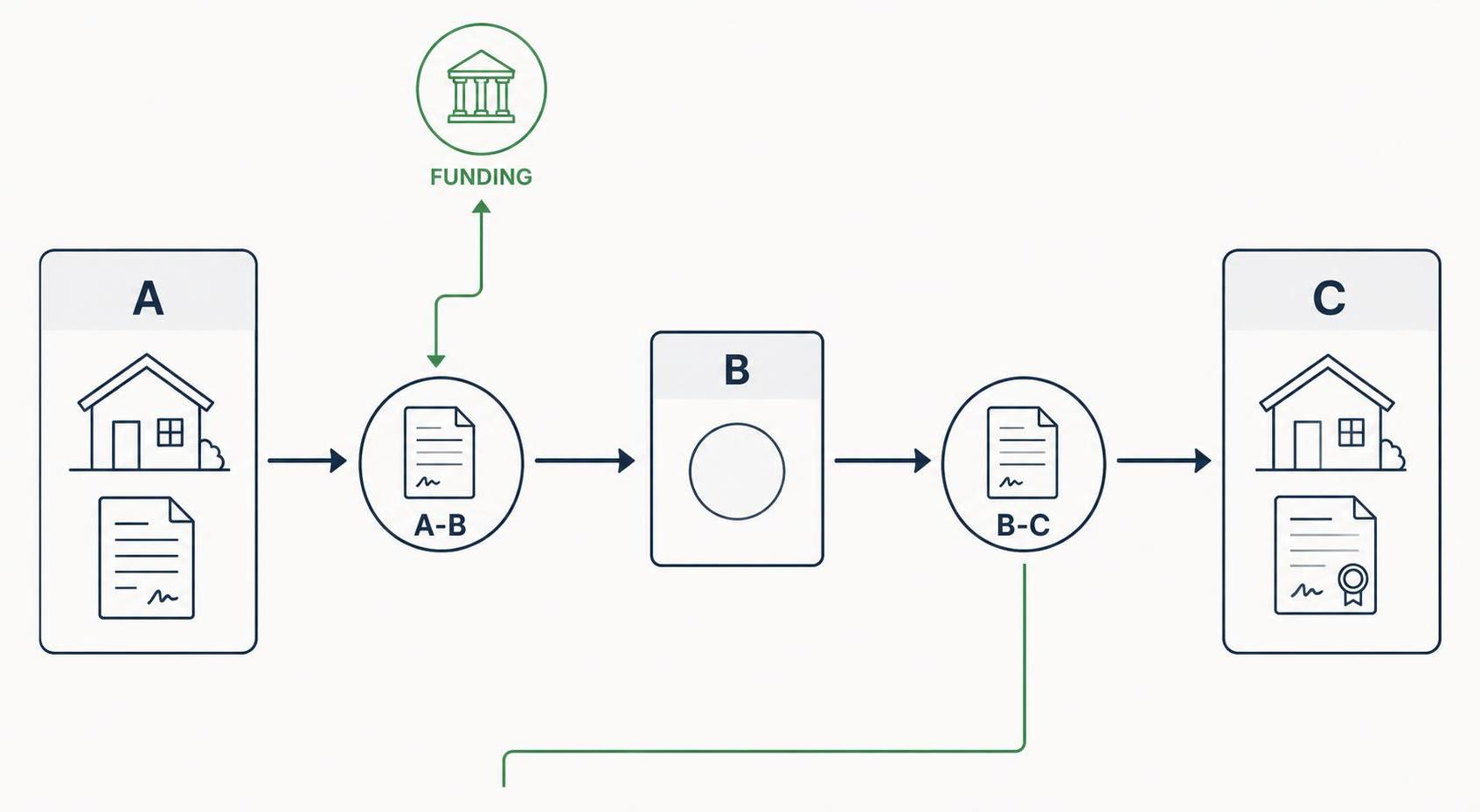
Transactional funding is short-term capital, typically used and repaid within 24 hours. It helps close the first part of a double closing (the A-B transaction) so the wholesaler or investor doesn’t need to use their own money. The funds from the end buyer in the B-C closing pay off the transactional loan almost right away. There’s no credit check on the investor, no traditional appraisal, and no long-term lien. The lender bases the loan on the difference between the two contracts, not on the borrower’s credit.
For a title company, this means closing two transactions on the same property, often on the same day and sometimes back to back in one session. J&M Business Capital’s overview (source outlines the key documents: signed purchase agreements for both parts, proof of funds from the final buyer, and, most importantly, a title company willing to manage both closings. That last part is completely up to you.
If your office hasn’t handled a double closing before, JVL’s Ultimate Guide to Transactional Funding & Double Closings walks through the mechanics from the investor’s side, and How Transactional Funding for Double Closing Works in 2026 breaks down the funding timeline step by step. Both are solid references for a closing team seeing this structure for the first time.
How the Two Legs Actually Move Through Your Office
A double closing is not one closing with two signatures. It’s two separate closings.
Leg one (A-B): The original seller sells to the wholesaler or investor. The transactional lender provides full funding for this purchase, including closing costs, and expects repayment within hours rather than months.
Leg two (B-C): The investor entity, now holding title, sells to the end buyer. The end buyer’s funds, either cash or their own financing, pay off the transactional loan, cover A-B closing costs, and leave the spread as the investor’s profit.
Both legs usually close on the same day, and in a true double closing, B actually takes and disburses title before C’s transaction starts. In a simultaneous or “back-to-back” closing, the two transactions are more tightly linked. Title companies need to be clear internally about which version they’re running, because it affects the disbursement order and what the transactional lender is relying on for repayment.
ALTA’s standardized settlement statement framework exists for a reason: itemized, transparent settlement charges protect everyone, title company, lender, buyers, and sellers (source. On a double closing, using clean, separate ALTA statements for each leg, rather than blending numbers, is the simplest way to keep the file audit-ready.
Where Transactional Lenders and Title Companies Actually Interact
The transactional lender isn’t underwriting the investor’s credit. They’re underwriting the deal: is there a real, executed B-C contract with a qualified end buyer, and is there a title company committed to closing both legs on the timeline needed to repay the loan the same day? The title company becomes part of the lender’s risk picture, even if nobody says it out loud.
In practice, this shows up in a few recurring friction points:
Wiring instructions and disbursement order. The transactional loan is repaid from the B-C proceeds, so the title company’s disbursement sequence matters. If the B-C leg doesn’t fund and close on schedule, the lender is exposed longer than planned. Most transactional lenders will not accept open-ended exposure.
Title commitment on both legs. The title company must issue clean title commitments for both A-B and B-C transactions. That means resolving any liens, judgments, or clouds before the closing date. A last-minute title issue on a double closing doesn’t just delay one transaction, it stalls both, and leaves the lender’s funds tied up.
Simultaneous issue policies. With two transfers happening quickly, title companies often need to coordinate simultaneous issue title policies for both legs. This requires more upfront coordination than a standard single-closing file.
HUD-1 / Closing Disclosure treatment. If the end buyer is using purchase-money financing, RESPA and TILA-RESPA disclosure timing can apply to the B-C leg, even if the A-B leg is cash. Regulation X’s definition of a “table funding” transaction is relevant for any closing involving a federally related mortgage loan (source, and the CFPB’s closing disclosure guidance is a good baseline for what the end buyer’s side should look like (source. This doesn’t change the structure of transactional funding, but it does mean the title company needs to know which leg is subject to which disclosure rules before scheduling.
Escrow’s core obligations don’t change just because two closings are stacked together. California’s escrow reference materials describe the escrow holder’s duty to follow the principals’ instructions exactly and to resolve competing claims within the chain of title before disbursing (source. On a double closing, that duty applies twice, in sequence, under time pressure, which is why the title company’s internal process matters more here than on a standard file.
What I Would Review Before Funding This
From the lending side, before putting capital into a double closing, I’m looking at the file the same way I’d want a title company to look at it:
- Two fully executed purchase agreements, A-B and B-C, with matching legal descriptions and no unresolved contingencies on the B-C side.
- Proof of funds or a financing commitment from the end buyer, not just a pre-approval letter, but real evidence that the B-C leg can close on schedule.
- A title company confirmed, in writing, to handle both legs and understands the disbursement sequence. I don’t fund into a file where the title company is still deciding whether to take the deal.
- Clean title on the property, no open liens, judgments, or probate issues that could delay the A-B closing.
- A realistic closing timeline. Same-day or next-day repayment is the norm. Anything longer changes the risk profile.
- The spread between the two contracts. If the margin between A-B and B-C is thin, there’s less room for the deal to absorb a title issue or a delayed wire without breaking the structure.
Red Flags
A few patterns that should slow down both the lender and the title company:
- A B-C contract that isn’t fully executed, or still has financing contingencies at the time the A-B closing is scheduled.
- An end buyer who hasn’t been verified, no proof of funds, no confirmed lender pre-approval, just a name on a contract.
- A title company that hasn’t closed a double closing before and is improvising the disbursement order.
- Requests to blend both legs onto a single settlement statement instead of keeping them separate.
- Pressure to skip a title search or rush a title commitment because “the deal has to close today.” Time pressure is normal in transactional funding; skipping title work is not.
- A spread between the two contract prices that barely covers closing costs, leaving no margin for delay.
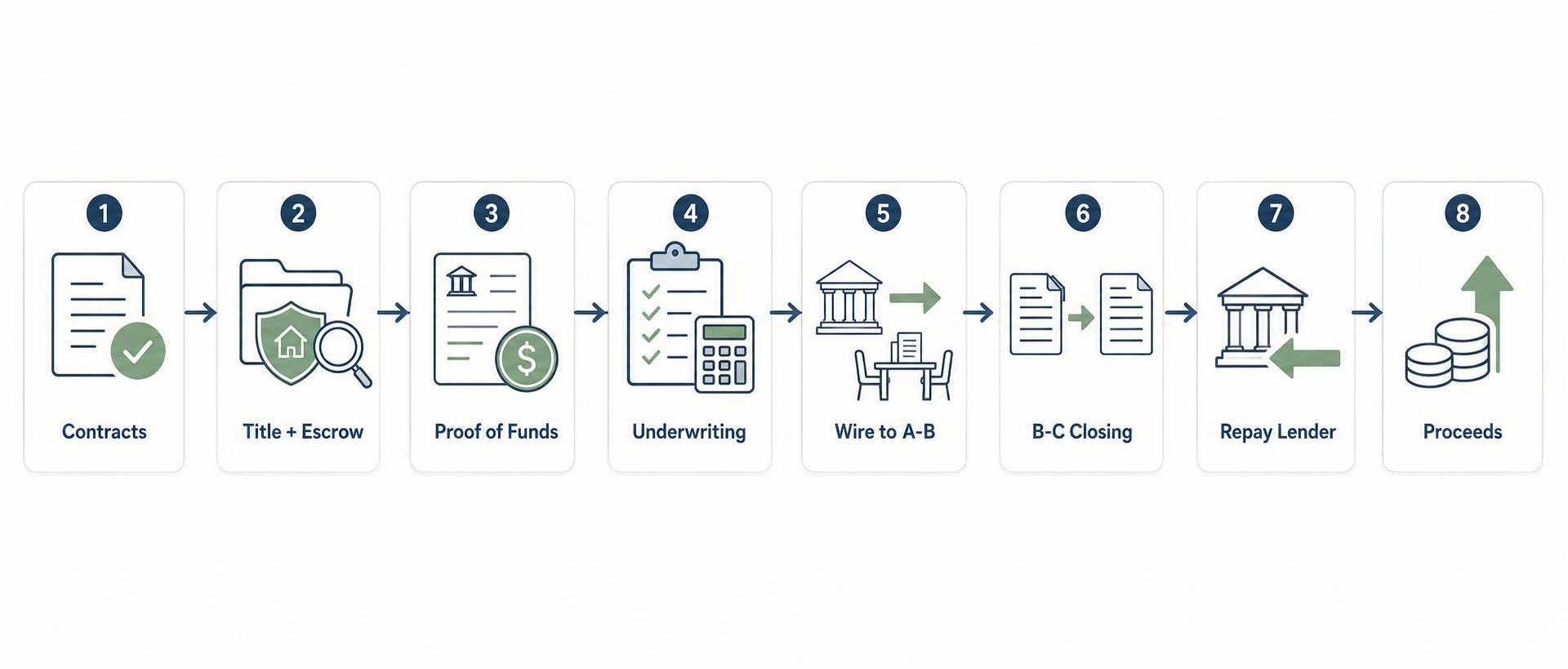
Before a lender reviews proof of liquidity, your file should be organized enough to answer basic underwriting questions quickly.
Borrower Readiness Checklist
For investors and wholesalers bringing a double closing to a transactional lender and title company, having these ready before you ask for funding speeds up the process:
- Fully executed A-B and B-C purchase agreements
- End buyer’s proof of funds or financing commitment
- Title company confirmed and committed to closing both legs
- Preliminary title report or commitment ordered
- Clear entity documentation (LLC operating agreement, EIN, authorized signer)
- Realistic closing date that gives the title company time to sequence disbursements
- Contact information exchanged between the lender and the title/escrow officer before closing day
If you’re newer to this structure, Double Closings for Wholesalers: Unlocking Profits Without Using Your Own Capital covers the wholesaler-side mechanics that feed into what the title company ultimately needs.
Hypothetical Example: A Double Closing in St. Louis, Missouri
Let’s make this concrete with a hypothetical scenario, not an actual closing or client of Joint Venture Loans.
An investor in St. Louis, Missouri, contracts to buy a single-family property for $140,000 (A-B) and has it under contract to an end buyer for $168,000 (B-C), a $28,000 spread before closing costs. The investor doesn’t want to bring $140,000 of their own capital to the A-B closing, so they arrange transactional funding in Missouri to cover the purchase.
The title company confirms it will close both legs on the same day, orders title, and coordinates disbursement so that the A-B closing funds first, followed immediately by the B-C closing, whose proceeds repay the transactional loan plus fees. Because this is transactional funding in St. Louis, not a purchase-money mortgage, there’s no long-term lien to release, the loan is in and out within hours.
For a St. Louis real estate investor doing this kind of deal regularly, the bottleneck usually isn’t finding a transactional lender, it’s finding a title company comfortable enough with the structure to schedule both legs without treating it as unfamiliar territory. That’s consistent with how the structure is described generally: a short-term, 100 percent financing tool used specifically to close back-to-back transactions without the investor’s own capital in the deal (source.
This example uses round numbers for illustration only. Actual spreads, fees, and timelines vary by market, property, and the terms of the specific transactional loan.
FAQ
Does the title company take on lending risk in a double closing?
No. The transactional lender is the party at risk on the A-B leg. But the title company controls the disbursement sequence that determines whether the lender gets repaid on schedule, which is why lenders care about working with a title company that understands the structure.
Can one title company close both legs, or do they need to be handled separately?
One title company handling both legs is standard and generally preferred. It allows the disbursement order to be coordinated directly, rather than relying on two separate offices to synchronize wires.
What happens if the B-C closing doesn’t happen on the same day as A-B?
The transactional loan remains outstanding until the B-C leg funds. Most transactional lenders price and structure these loans for same-day or next-day repayment, so a longer gap should be discussed with the lender before the A-B closing, not after.
Do title companies need special licensing or certification to handle double closings?
No special licensing is required beyond standard title and escrow authority. Title companies unfamiliar with the structure benefit from walking through the disbursement sequence and documentation requirements with the lender before the first file.
Is a double closing legal and does it require special disclosure?
Double closings are a legal transaction structure. Disclosure requirements depend on whether either leg involves a federally related mortgage loan, which can trigger RESPA and TILA-RESPA obligations on that specific leg. Title companies should confirm which disclosure rules apply to each transaction rather than assuming both legs are treated identically.
How is transactional funding different from hard money or a bridge loan?
Hard money and bridge loans typically run for months and are secured by a recorded lien against the property. Transactional funding is designed to be repaid the same day or within a day or two, funding the A-B leg only long enough for the B-C leg to close.
Transactional funding works when everyone in the file, investor, lender, and title company, understands the sequence and timeline before closing day, not during it. If you’re a title or escrow professional working a double closing for the first time, or an investor who needs same-day capital for the A-B leg, Joint Venture Loans can walk through the funding structure, documentation, and timeline directly with your closing team before the file is scheduled.
Further Reading and Source Context
These outside references can help you compare definitions, market language, and general real estate financing context. They are provided for education only and do not imply endorsement by those publishers: