
Wholesalers like assignment contracts because they’re straightforward. You sign a purchase agreement, assign it to your end buyer for a fee, and you’re done, no title transfers, no holding period, just a clean fee and you move on. But assignment only works if the deal allows it. If the seller blocks assignment, the end buyer’s lender wants to see your actual purchase price, or you’re dealing with a bank-owned or HUD property that prohibits assignment, what seemed like an easy strategy can quickly stall your deal.
This is the main hurdle that trips up many wholesale transactions. You have a real seller, a real buyer, and a real profit margin, but no legal way to get from A to C without actually closing as B. That’s where transactional funding comes in. Instead of assigning the contract, you close the A-to-B leg using short-term capital, then immediately close the B-to-C leg with your end buyer’s funds, often on the same day. There’s no assignment fee. Your profit is the difference between your purchase price and your sale price, minus costs.
Why Assignment Isn’t Always the Right Choice
Assignment works smoothly when three things line up: the seller’s contract allows it, the end buyer doesn’t mind how you control the property, and no one downstream needs to see your purchase price. Take away any one of those, and assignment falls apart.
Here’s when transactional funding usually becomes necessary:
- Non-assignable contracts. REO, HUD, and institutional sellers often include “no assignment” clauses. Some retail agents do this too, either out of habit or because previous deals fell apart on assignment.
- End buyer financing with arm’s-length rules. If your end buyer uses a mortgage, their lender’s underwriter may flag an assignment as a red flag for flipping or price manipulation, especially within 90 days. A double close, where you actually take title, looks different to underwriters.
- Keeping your profit margin private. Assignment fees reveal exactly what you’re making. Sellers sometimes see this and try to renegotiate. A double close keeps your buy and sell prices separate.
- Title company or attorney policies. Some closing agents won’t process assignments due to state law, title insurance rules, or their own risk policies. If the title company says no, you either double close or the deal falls through.
Assignment isn’t a bad tool, but it’s not always an option. If you want to succeed in wholesaling, you need to have both strategies ready. Depending only on assignment puts you at a risk you can’t manage.
What Transactional Funding Does
Transactional funding is short-term capital, usually just for a few hours or a day, that lets you close the A-to-B purchase with someone else’s money, then pay it back immediately when you close the B-to-C sale to your end buyer. Our Transactional Funding page explains how we structure this, but the basic idea is simple: the lender underwrites the certainty of your same-day or next-day payoff, not the property itself.
This is different from a bridge or rehab loan. There’s no interest ticking away, no draw schedule, and usually no traditional appraisal. What matters is whether the B-to-C closing is real, funded, and scheduled. If it isn’t, the lender ends up holding a short-term loan with no exit.
If you want a detailed walkthrough of how the two closings are sequenced and funded, check out our article on how transactional funding for double closing works. If this is your first time using this strategy, our pillar guide to transactional funding and double closings goes deeper into the mechanics.
How a Double Close Works
A double close is simply two back-to-back closings on the same property, usually at the same title company or attorney’s office so everything aligns.
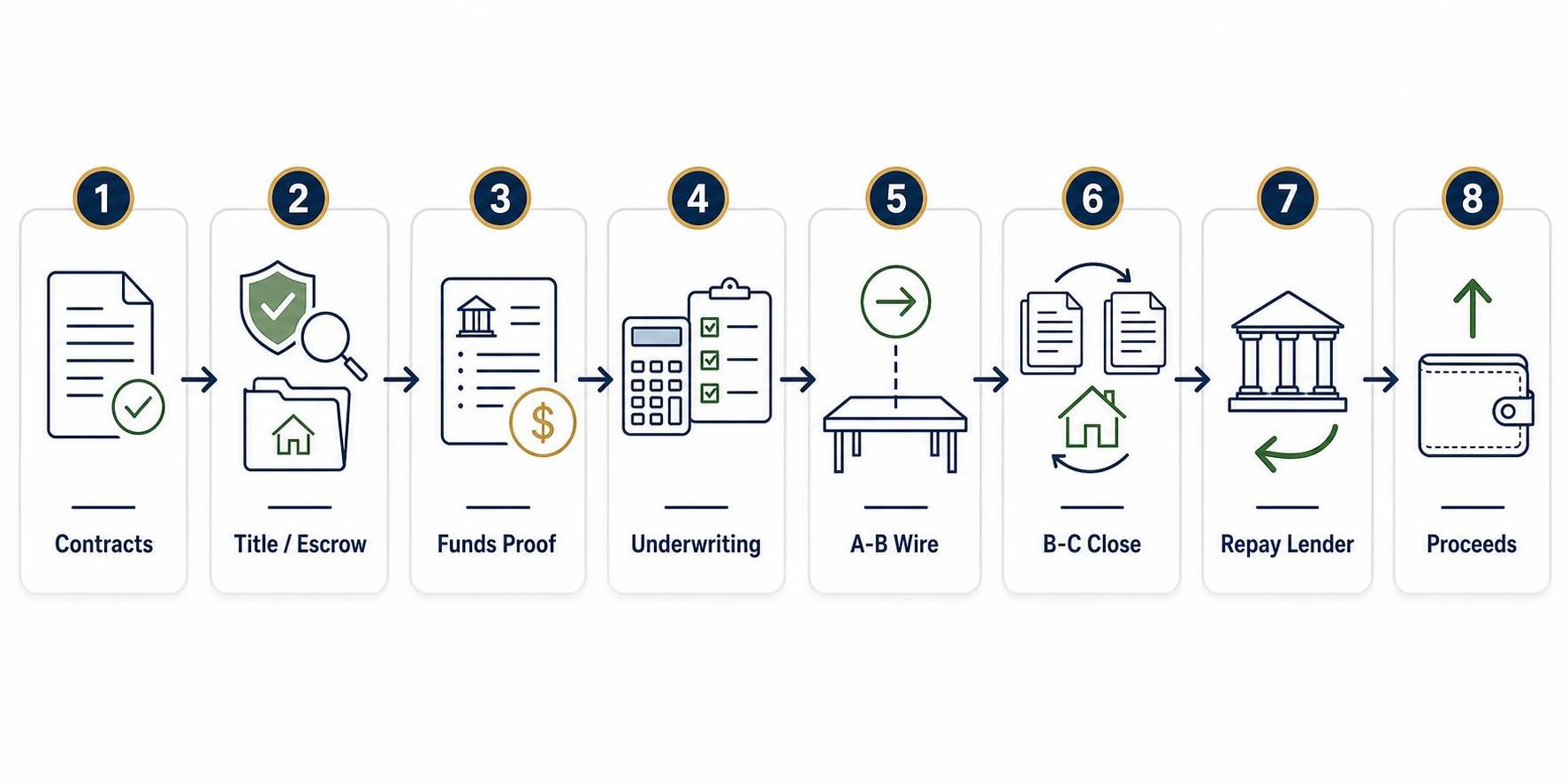
- A-to-B closing. You (Buyer B) close on the property from the original seller (A) using transactional funding. Title transfers to you. This is a normal purchase, fully funded and recorded.
- B-to-C closing. Right after, sometimes the same day, sometimes the next business day, you sell to your end buyer (C). Their funds, whether cash or a loan, pay off the transactional funding plus fees, cover your acquisition cost, and the rest is your profit.
- Payoff. The transactional lender is paid back directly from the B-to-C closing proceeds, usually by the title company, not by you wiring money around.
The real risk is the gap between the two closings. If the C-side closing is delayed even a day, maybe the buyer’s financing falls through, there’s a last-minute title issue, or an appraisal problem, you’re stuck holding a property with borrowed money and no immediate way to repay it. That’s why transactional lenders want to see that the B-to-C closing is solid before funding the A-side.
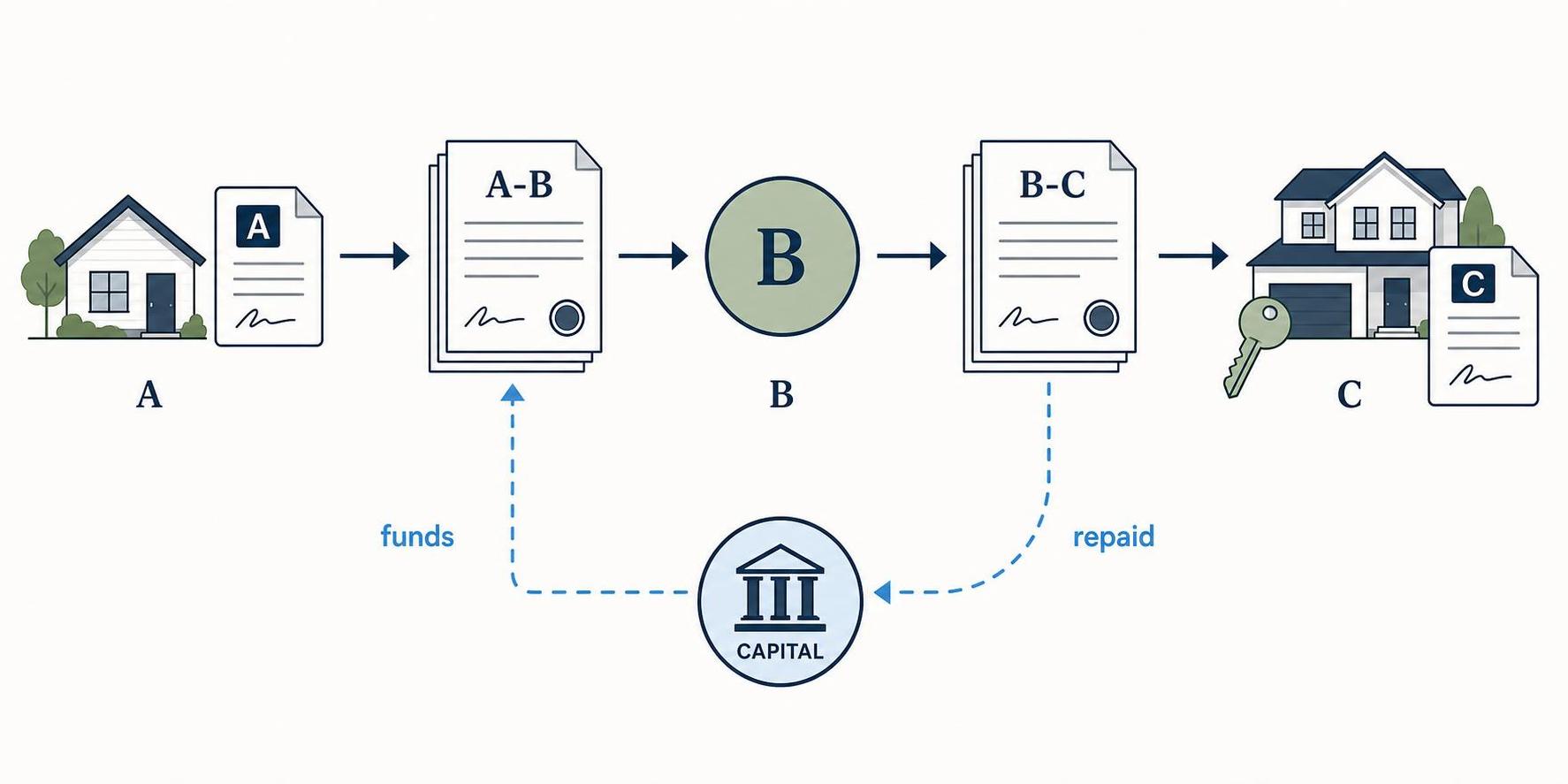
Example: A Double Closing in Indianapolis
Here’s a hypothetical example to show how the numbers and timing work.
Suppose you have a single-family house under contract in Indianapolis for $145,000 from a motivated seller. You’ve found a rehabber willing to pay $168,000. That’s a $23,000 spread before costs.
But the seller’s attorney included “no assignment” language in the contract. Assignment is off the table, so you arrange transactional funding to close the A-to-B leg.
- A-to-B closing: you close at $145,000 using transactional funding, and title goes into your LLC.
- B-to-C closing: scheduled for the same afternoon, with the end buyer’s hard money lender wiring $168,000.
- Funding cost: a flat transactional funding fee, disclosed upfront, paid from the B-to-C proceeds.
- Net spread: your $23,000 gross spread, minus the funding fee, title and closing costs on both legs, and any wire or per diem fees.
Because this is a double close, the seller never sees your resale price, and the end buyer’s lender sees a straightforward arm’s-length purchase from an entity that held title, not an assignment. This setup is common in markets like Indiana where non-assignable contracts or lender scrutiny make assignment impractical. Indianapolis is just an example, the same logic applies anywhere.
What I Look For Before Funding
Before releasing capital on the A-side of a double close, I want to see:
- Proof the C-side closing is real. A fully executed purchase agreement with the end buyer, not just a handshake or letter of intent. If the end buyer is financing, I want their pre-approval or proof of funds.
- Confirmed closing date and title company for both legs. Ideally, both closings happen at the same title company or attorney to make same-day sequencing reliable.
- Clean title on the A-side. Any liens, judgments, or probate issues that could delay the first closing put the whole deal at risk.
- The actual spread, net of costs. I want to see the A-side price, the C-side price, and all fees. A spread that looks good on paper can shrink quickly once you subtract title costs, funding fees, and repair credits, sometimes twice.
- Whether the seller’s contract really prohibits assignment or if you’re double closing mainly to keep your spread private. Both are valid but affect the paperwork I need.
- The end buyer’s funding source and timeline. A cash buyer closing the same day is a very different risk than one with a 30-day conventional loan.
Red Flags
- No signed contract on the C-side when funding is requested, just “I have a buyer lined up.”
- Same-day closing requested, but the end buyer’s lender hasn’t cleared to close or there’s no confirmed wire.
- The A-side seller doesn’t know the property is being resold the same day, and explanations are vague.
- The title company isn’t familiar with double closings or won’t confirm they can handle both legs on the needed date.
- The spread barely covers transactional funding fees and closing costs, leaving no margin if either closing slips.
- The investor wants to extend the gap between closings “just in case,” which defeats the purpose of transactional funding and puts risk back on the lender.
Before a lender reviews proof of liquidity, your file should be organized enough to answer basic underwriting questions quickly.
Borrower Readiness Checklist
- [ ] Fully executed A-side purchase agreement, with any assignment restrictions clearly identified
- [ ] Fully executed B-to-C purchase agreement at a confirmed price
- [ ] End buyer’s proof of funds or loan approval on file
- [ ] Both closings scheduled with a title company or attorney who can handle same-day sequencing
- [ ] Clean preliminary title report on the A-side property
- [ ] Written breakdown of the net spread after all fees on both legs
- [ ] Contingency plan if the C-side closing slips by a day or two
FAQ
Is transactional funding the same as hard money?
No. Hard money loans usually last weeks or months for acquisition or rehab, with interest accruing over time. Transactional funding is a same-day or next-day loan used specifically to fund the A-to-B leg of a double close, paid back immediately at the B-to-C closing.
Why would a seller refuse to allow assignment?
Several reasons. Some sellers’ attorneys use standard no-assignment language. Some sellers don’t want to know they’re being wholesaled. Institutional or bank-owned sellers often prohibit it as policy. Once it’s in the contract, you need another way to close.
Does a double close cost more than an assignment?
Usually, yes. There are two sets of closing costs instead of one, plus the transactional funding fee. Most investors see that as the price of closing a deal that couldn’t move any other way, not as a routine substitute for assignment.
How fast does the money actually move?
In a same-day double close, the A-side funds first, title transfers, and the B-side closing usually follows within hours at the same title company. The transactional loan is paid back at the B-to-C closing table.
Does this work for commercial or multifamily deals, not just single-family wholesale?
The same logic applies, but underwriting is more involved. Our article on transactional funding for commercial and multifamily syndications explains how this works for bigger deals, and our piece on double closings for wholesalers covers the single-family side in more detail.
Getting a Deal Funded When Assignment Won’t Work
If you can’t assign the contract, your deal isn’t dead, it just needs a different closing structure. Transactional funding fills this gap: a same-day loan that lets you take title long enough to complete a legitimate double close, paid back as soon as your end buyer’s funds arrive.
If you have a deal where assignment isn’t an option and you need to move quickly on a double close, reach out to Joint Venture Loans. We’ll discuss your timeline, title work, and what’s needed to fund the A-side on schedule.
Further Reading and Source Context
These outside references can help you compare definitions, market language, and general real estate financing context. They are provided for education only and do not imply endorsement by those publishers:
- 8. Escrow
- CFPB Consumer Laws and Regulations RESPA CFPB April 2015 RESPA 1 Regulation X
- I'm about to close on a real estate purchase transaction with a mortgage. What can I expect in the mortgage closing process? | Consumer Financial Protection Bureau
- § 1026.38 Content of disclosures for certain mortgage transactions (Closing Disclosure). | Consumer Financial Protection Bureau