
What Makes a Real Estate Deal Ready for Private Money
Every real estate operator eventually hits the same wall: you find a solid deal, the timeline is tight, and the bank’s process just can’t keep up. Traditional lenders want months, perfect paperwork, and a story that fits their criteria. Private money exists because real deals don’t wait. But don’t mistake “private money is faster” for “private money is easy.” The underwriting just shifts to a different set of questions. If you don’t know what those questions are, you’ll waste time pitching a deal that was never going to get funded.
A deal ready for private money isn’t just a tidy spreadsheet. It means the numbers, the exit plan, and your own preparation all come together so a lender can review and approve it quickly and confidently. Here’s what that looks like from the lender’s point of view, so you know what to expect before you submit your file.
Why Private Money Underwriting Is Different
Banks start by looking at the borrower, then the deal. Private lenders flip that order. The property, the numbers, and the exit strategy carry most of the weight. Your credit score and W-2 history matter far less than they would at a bank.
That doesn’t mean private lenders ignore you as the borrower. They just focus on a sharper question: can this specific deal pay back the loan, and how much room is there for error if things go wrong? Even big banks assess risk by borrower, property, and market, then set terms to manage what’s left. Private lenders do the same, but the asset and plan matter more than the person.
That’s why “ready for private money” is a clear, answerable standard, not just a gut feeling that a deal “looks good.”
The Core Questions Private Lenders Actually Ask
Forget the marketing. Private money underwriting boils down to five questions, usually in this order:
1. Does the Collateral Actually Support the Loan?
Private money is secured by the real estate. The lender needs to trust the current value and, if it’s a rehab, the after-repair value (ARV). Comps matter more than your pro forma. If your ARV is based on a few cherry-picked sales from another neighborhood or last year, the underwriter will catch it before you finish your pitch.
2. What’s the Exit?
This is where most deals break down. Selling to a retail buyer, refinancing with a DSCR loan, or doing a BRRRR cash-out are all valid exit strategies, but each carries its own risks and timelines. Saying “We’ll figure it out” isn’t a plan. Underwriters begin by looking at the property and loan amount, but it’s the exit strategy that decides whether the loan gets paid off or just lingers.
3. Is the Renovation Scope Real?
On fix-and-flip or value-add deals, a vague budget kills credibility fast. A detailed, line-item scope of work shows you’ve thought it through. A loose estimate raises a red flag. Private lenders aren’t trying to micromanage your contractor, they just want to see if your numbers are realistic.
4. What’s the Borrower’s Track Record?
Not your credit score, your track record. Have you done this before, at this scale, with this type of property? A first flip and a tenth flip are very different. If you’re new, bring in a contractor, project manager, or JV partner with the experience you lack, and be upfront about it.
5. Does the Capital Stack Actually Close?
Many deals die here. The purchase loan is approved, but you’re still short on the down payment, closing costs, or early carrying costs, and there’s no plan for that gap. That’s not a bad deal, it’s a structuring problem. Gap funding exists for this exact reason. If you’re working with a hard money or bridge lender and still have a shortfall, learn how gap funding fits into the structure before you walk away.
What I Actually Review Before Funding
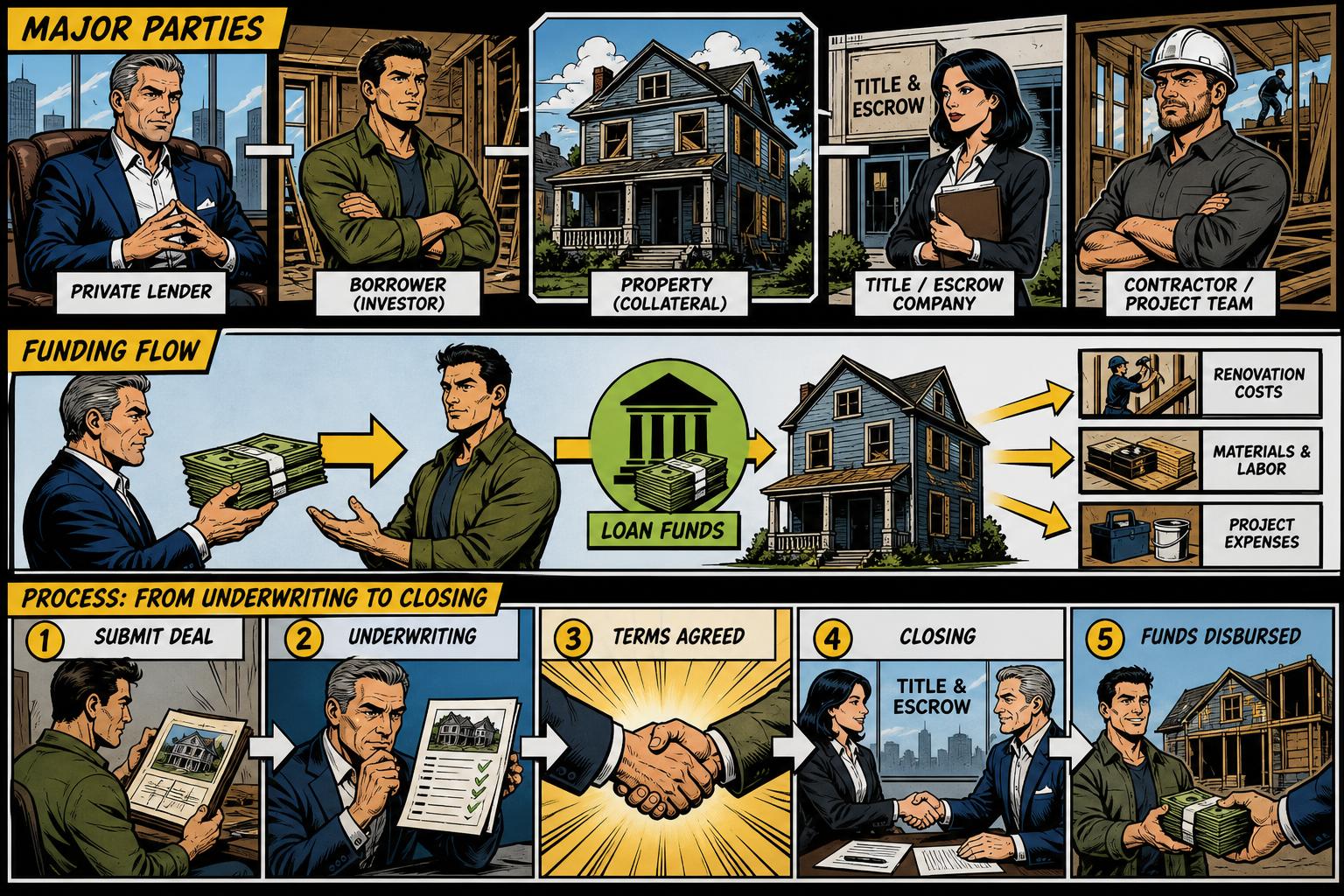
When a deal lands on my desk, here’s how I go through it:
- Purchase contract and timeline: What’s the real closing date, and does the funding timeline fit?
- Comps for as-is and ARV: These aren’t Zestimates. Use actual closed sales, adjusted for condition and location.
- Scope of work with line items: Labor, materials, permits, contingency. If the budget is just a round number, I’ll ask why.
- Exit strategy with clear options: sell, refinance, or hold. Also, outline what must happen to ensure the exit occurs on schedule.
- Entity and title: Is it in an LLC? Is the title clean? Liens, judgments, or title issues can kill a closing fast.
- Capital stack and gap: Where is every dollar for purchase, rehab, and closing coming from? Is the gap funded, or just a hope?
- Borrower’s experience vs. deal complexity: A cosmetic rehab and a full gut job carry very different risks.
- Insurance, taxes, and holding costs should be calculated based on a realistic timeline, not just an optimistic estimate.
None of this is exotic. It’s the same discipline any private credit underwriter uses. It just moves faster because the questions are tighter and the collateral does more of the work.
Red Flags
Some issues can be fixed with more paperwork. Others mean the deal just isn’t ready, no matter how fast the lender is. Watch for:
- ARV based on bad comps: Different school district, lot size, or old sales, these should make you double-check.
- No written scope or just a lump-sum budget: This gets renovation deals declined or re-priced quickly.
- Exit strategy that’s just a hope: “The market should be better by then” is not a plan.
- Title issues found late: Open liens, probate, or ownership disputes can stall a closing indefinitely.
- Funding gap with no source: If the loan covers 80-90 percent and the rest is “we’ll figure it out,” that’s the weakest link.
- Borrower overreach: Taking on a project way bigger than your track record, without an experienced partner.
- Inconsistent numbers: If the contract, budget, and loan request don’t match, every underwriter will slow down.
Before a lender reviews proof of liquidity, your file should be organized enough to answer basic underwriting questions quickly.
Borrower Readiness Checklist
Before you approach a private lender, you should be able to hand over:
- Signed purchase contract or a clear timeline to one
- As-is value support (comps or recent appraisal)
- ARV support with recent, nearby comps
- Line-item scope of work and renovation budget
- Contractor bids or a credible internal cost basis
- Specific exit strategy (sale, refinance, or hold) with a timeline
- Entity documents (LLC operating agreement, EIN) if closing in an entity
- Proof of funds for your share of the capital stack
- A funded plan for any gap between senior financing and total project cost
- Track record summary, prior projects, outcomes, and your team
If you can hand over all ten without scrambling, you’re not just ready to apply, you’re ready to close quickly. That’s the whole point of private money.

Hypothetical Example: A Gap-Funded Rehab in Dallas, Texas
Here’s a made-up example (not a real client or deal) to show you how it works.
Imagine an investor has a single-family home under contract in Dallas for $240,000. The renovation plan covers a new kitchen, updated bathrooms, new flooring, and some foundation repairs, all estimated to cost $65,000 based on detailed line items and two contractor bids. Recent comparable sales suggest the after-repair value (ARV) will be around $365,000.
A hard money lender agrees to fund 85 percent of the purchase price and cover all rehab draws, based on the completed work. This covers most of the deal, but the investor still needs to come up with the down payment and early carrying costs like taxes, insurance, and the first couple of months of holding expenses before rehab draws begin.
That shortfall is a capital stack issue, not a deal quality problem. This is where gap funding comes in: a second layer of capital that bridges the difference between what the senior lender will fund and what the borrower has, so the deal can close on time. For a private investor in Dallas working this structure, knowing how gap funding fits between the senior loan and your own capital often makes the difference between closing and stalling out.
The gap can appear for different reasons: sometimes it’s the down payment, other times it’s carrying costs between draws or rehab costs running over budget. The key question remains the same: is there a clear, fundable explanation for the shortfall, or does it mean the deal was miscalculated from the beginning?
All figures above are for illustration only and not tied to any actual loan, borrower, or closing.
Deal Readiness vs. Deal Quality
It’s important to separate two things: a good deal and a fundable deal. A property can have real upside and still not be fundable yet, maybe the paperwork isn’t there, the exit isn’t clear, or the capital stack has a hole. Readiness isn’t about perfection. It’s about the underwriter being able to see, quickly and clearly, how the loan gets paid back.
This is where private money differs from banks. A bank underwriter might model income, market, and risk over weeks. Private lenders compress that analysis into days, but only if you show up with everything organized. The speed private money is known for isn’t a favor, it’s a direct result of how prepared you are.
FAQ
How fast can a private money deal close once it’s ready?
Once the collateral, exit, and paperwork are in order, many private money deals close in one to two weeks. The real variable is how much you still need to assemble when you start the conversation.
Does my personal credit score matter?
It matters less than at a bank, but it’s rarely ignored. Most private lenders will check it as one data point, but the property, exit, and your track record matter much more.
What if I don’t have the full down payment or closing costs?
That’s a capital stack gap, not an automatic deal killer. It’s worth seeing if gap funding for down payments and carrying costs can bridge the shortfall before you assume the deal is dead.
Do private lenders require an appraisal?
It depends. Some use broker price opinions or internal models for speed; others want a full appraisal, especially on bigger loans. Either way, have your own comps ready before you’re asked.
Is private money only for fix-and-flip deals?
No. It’s used for flips, bridge loans, value-add multifamily, ground-up construction, and any deal where a conventional loan can’t close fast enough. The same underwriting principles apply: collateral, exit, documentation.
What’s the biggest reason a deal that looks fundable actually isn’t?
Almost always, it’s the exit strategy. If it’s vague or depends on market conditions you can’t control, the deal will stall.
Bring the Deal, Not Just the Pitch
A private money lender isn’t interested in your excitement. They want to see if the numbers, the exit strategy, and the paperwork all check out quickly and clearly. Well-organized deals close faster. If there’s a capital gap, the deal will stall, no matter how promising the property looks.
If you’re looking at a deal and the capital stack doesn’t quite close, whether it’s the down payment, rehab costs, or carrying costs between draws, Joint Venture Loans specializes in that gap-funding space alongside senior lenders. Reach out to talk through your deal structure before you assume the shortfall is a dead end.
Further Reading and Source Context
These outside references can help you compare definitions, market language, and general real estate financing context. They are provided for education only and do not imply endorsement by those publishers: