
Where Gap Funding Fits in a Real Estate Capital Stack
Every deal that doesn’t close usually comes down to one thing: there’s a number that doesn’t get covered. The purchase contract says one thing, the senior lender’s term sheet says another, and the investor’s cash is somewhere in the middle, usually not enough. That gap isn’t a failure. It’s just how real estate finance works. Knowing exactly where that gap sits in the capital stack is what separates an operator who gets deals done from one who loses contracts waiting for a bank to come through.
This isn’t a pitch for gap funding as a magic fix. It’s a straightforward look at where gap capital fits in a stack, what it’s for, what it isn’t for, and what a lender is really considering when you ask for it.
What the Capital Stack Actually Means
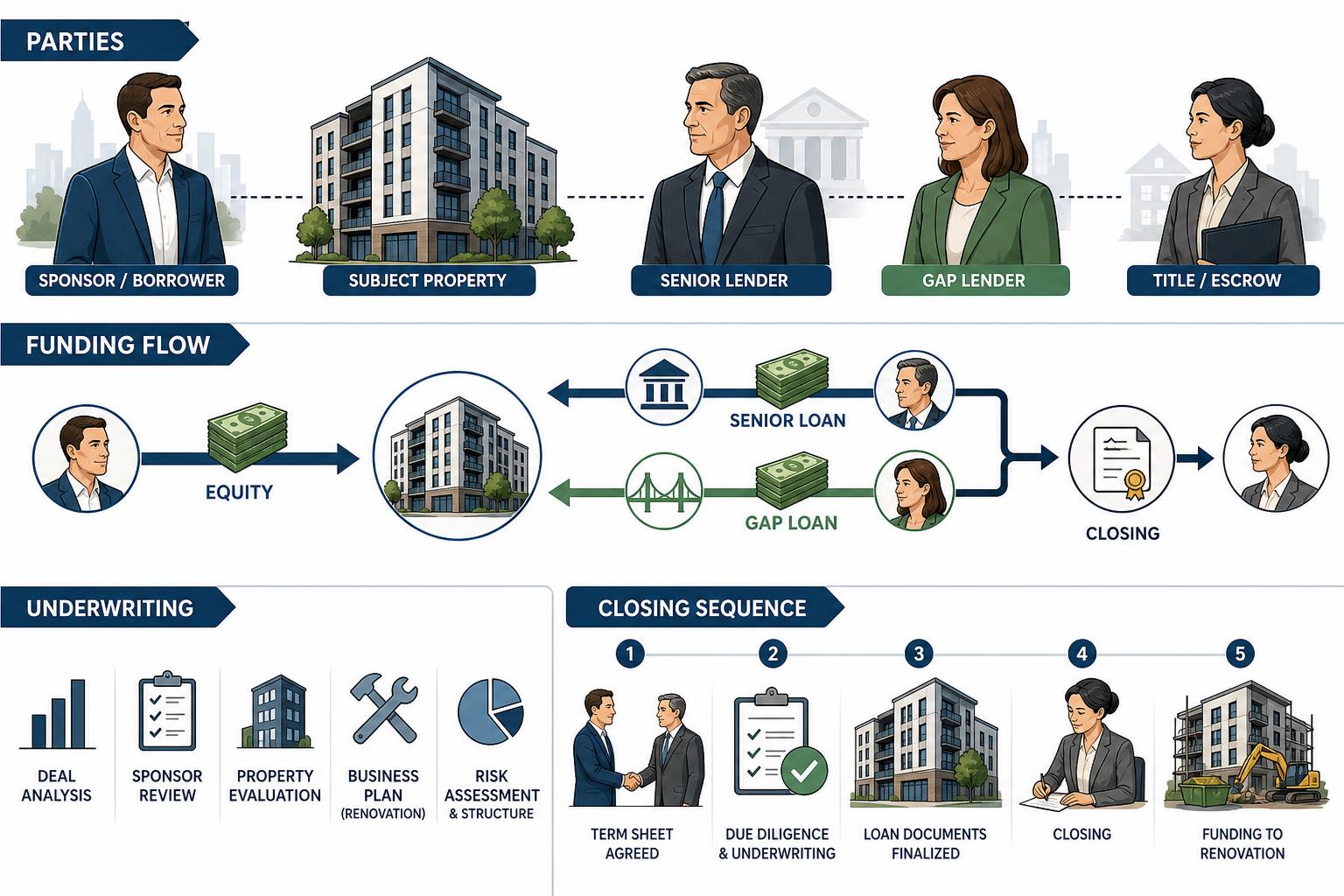
The capital stack is simply the order of who gets paid first from a deal’s proceeds. On a typical investment property, it usually looks like this:
- Senior debt: The first-position loan, usually from a bank, credit union, or private lender, secured by a first mortgage or deed of trust. This is the largest and cheapest part of the stack because it’s the safest.
- Gap or mezzanine capital: This sits behind the senior lien but ahead of the sponsor’s own cash. It fills the space the senior debt won’t cover.
- Sponsor equity: The investor’s own cash or capital raised from partners. This is the first money at risk if the deal goes sideways.
Senior lenders almost never fund 100% of a project’s total cost. On a fix-and-flip, a private lender might cap out at 70 to 75% of the purchase price or after-repair value. On a ground-up build, a construction lender might fund a percentage of costs but hold back on the land. On a commercial deal, senior debt often stops around 65 to 75% loan-to-value. Whatever’s left, the down payment, reserves, or rehab shortfall, has to come from somewhere. That’s the gap.
Where Gap Funding Actually Sits
Gap funding has a specific spot: behind the senior lender, ahead of the sponsor’s equity. It’s not senior debt, and calling it that is a mistake I see investors make when scrambling for capital.
As one industry explainer puts it, “gap loans typically sit behind the senior loan but ahead of borrower equity in the capital stack” (SDC Capital. That order matters. It means gap capital is subordinate, the senior lender gets paid first, in full, before the gap position sees anything if things go wrong. That’s why it costs more than senior debt, and why a lender in the gap position underwrites differently than a first-lien lender.
Let’s be clear about what gap funding is not, because the language gets sloppy:
- It’s not a bridge loan in the refinance sense. A bridge loan often carries a property between two financing events, like acquisition and permanent debt, and is usually the main lien. Gap funding usually layers on top of or alongside an existing first-position loan, not replacing it.
- It’s not mezzanine debt on a big commercial stack. Mezzanine financing appears on large multifamily or commercial deals where senior debt covers 65 to 75% LTV and the sponsor needs more leverage before bringing in equity, often with equity kickers or preferred returns. That’s capital stack engineering for a $20 million deal, not a $35,000 earnest money gap or a 60-day flip shortfall.
- It’s not equity. Gap funding gets repaid on a schedule or at a defined exit. It doesn’t take an ownership stake like a joint venture partner.
For most single-family and small multifamily investors, gap funding is short-term capital covering a down payment shortfall, a rehab budget gap between draws, or carrying costs while a property sits between purchase and resale. If that’s your situation, see our guides on gap funding for down payments and carrying costs and gap funding for rehab cost shortfalls.
When Gap Funding Fits, and When It Doesn’t
Gap funding fits when the deal has real equity or a clear exit, and the shortfall is about timing or structure, not viability. It’s the right tool when:
- The senior loan is already committed or close to closing, and there’s a known, fixed dollar gap between what it covers and the total project cost.
- The exit, sale, refinance, or lease-up, is realistic within the funding term, not just wishful thinking.
- The investor has a track record or a deal structure (like a documented rehab scope with a licensed contractor) that supports the underwriting.
It doesn’t fit when the “gap” really signals an under-capitalized investor trying to stretch into a deal that’s too big for their liquidity, or when the numbers only work if every assumption, ARV, timeline, exit price, lands perfectly. Adding subordinate debt to a deal that’s already thin just pushes the failure point down the road.
There’s also confusion about what “carrying costs” gap funding covers. It’s meant to bridge insurance, taxes, interest reserves, and utilities during a hold, not to bail out a project that’s already over budget with no clear path to finish. Our breakdown of carrying-cost gap funding between draws covers that in more detail.
What I Would Review Before Funding This
When a gap funding request lands on my desk, I’m not re-underwriting the senior loan. That’s someone else’s collateral position. I’m underwriting the layer where I’m actually taking risk. Here’s what I want to see:
- The senior lender’s term sheet or commitment letter. I need to know exactly what’s been approved, at what LTV/LTC, and under what conditions, so I know where my position sits.
- A clear, itemized use of the gap funds. Down payment, specific rehab line items, or a defined carrying-cost period, not a vague “working capital” request.
- The exit plan and its timeline. Sale, refinance, or stabilized lease-up, with a realistic date.
- The sponsor’s liquidity and track record. Gap positions carry more risk than senior debt, so I look harder at who’s behind the deal if the exit slips.
- Total combined leverage across the stack. Senior debt plus gap capital, measured against realistic value, not the seller’s asking price or an inflated ARV.
- Documentation on the property. Purchase contract, scope of work, contractor bids, permit status if needed, and insurance in place.
Red Flags
Certain patterns suggest a gap request is covering a structural problem, not just a timing issue:
- The requested gap amount keeps growing between conversations, showing the budget wasn’t solid to start with.
- The sponsor can’t clearly explain the senior lender’s terms.
- Combined leverage across senior debt and gap funding exceeds what the deal’s real value supports.
- The exit depends on a single assumption, a specific sale price, a refinance rate, a buyer who isn’t vetted, with no backup plan.
- There’s no reserve for delays. Every project slips a bit; a stack with no cushion is fragile.
- The sponsor has no skin in the deal. Gap funding fills a shortfall; it’s not meant to replace the investor’s own contribution entirely.
Before a lender reviews proof of liquidity, your file should be organized enough to answer basic underwriting questions quickly.

Borrower Readiness Checklist
Before you approach a gap funding source, you should be able to provide:
- Signed purchase contract or assignment agreement
- Senior lender’s term sheet or pre-approval, including LTV/LTC and conditions
- Itemized budget showing exactly where the gap dollars go
- Contractor bids or scope of work, if rehab-related
- A realistic timeline from close to exit, with a stated contingency
- Personal financial statement and a summary of recent completed projects
- Entity documents (LLC operating agreement, EIN) if borrowing through an entity
- Insurance binder or plan for coverage at closing
Having these doesn’t guarantee approval, but it shows a lender you’ve thought the request through, not just thrown it together the week before closing.
Hypothetical Example: A Gap Funding Deal in Orlando, Florida
Let’s make this concrete with a hypothetical scenario, not a real closed transaction, of a small-scale investor in Orlando, Florida.
An investor contracts to buy a single-family property in Orlando for $310,000, with a rehab scope estimated at $65,000 to bring it to a sellable after-repair value of $460,000. A private senior lender agrees to fund 80% of the purchase price and 100% of rehab costs, structured as draws. That covers $248,000 of the purchase price and the full $65,000 rehab budget, but it leaves a $62,000 shortfall on the purchase side that the senior lender won’t cover.
The investor has some liquidity but not $62,000 available without draining reserves needed for holding costs, permits, and contingency. This is where gap funding in Orlando, or anywhere with a similar structure, fits: a short-term, subordinate position covering that $62,000 down payment gap, repaid at the property’s sale alongside the senior loan, usually within a 6- to 9-month resale window.
A lender reviewing this hypothetical would check the senior lender’s commitment terms, the contractor’s bid against comparable rehab scopes for the area, recent comparable sales supporting the $460,000 ARV, and whether the combined senior-plus-gap position stays within a leverage range that leaves enough margin if the resale takes longer or nets less than projected. An Orlando investor bringing this kind of request with all that documentation is in a different conversation than someone just bringing a contract and an asking price.
FAQ
Is gap funding the same as a second mortgage?
Not exactly, though they’re similar. Gap funding is usually short-term and tied to a specific project cost shortfall, while a second mortgage is often a standing lien used more broadly. Both sit behind a first-position loan.
How much does gap funding typically cost compared to senior debt?
Because it’s a subordinate position with more risk, gap capital carries a higher rate and often points or fees on top of what senior debt charges. Pricing reflects its place in the repayment order, not just the loan size.
Can gap funding cover 100% of a down payment?
Sometimes, but lenders still want the sponsor to have some financial exposure to the deal’s outcome. A request to fund the entire down payment with none of the investor’s own cash is a tougher underwrite.
What’s the difference between gap funding and mezzanine debt?
They occupy a similar spot in the stack, subordinate to senior debt, ahead of equity, but mezzanine debt usually applies to larger commercial or multifamily deals with more complex structures, sometimes including equity participation. Gap funding on smaller residential deals is more straightforwardly a short-term loan.
Does gap funding work for new construction, not just flips?
It can, when the shortfall is between what a construction lender funds per draw schedule and actual costs at a given stage. The same underwriting questions apply: what’s the exit, what’s the timeline, and what does combined leverage look like against completed value.
Will a gap lender require the senior lender’s approval?
Most senior lenders include language about subordinate financing, and many require notice or consent before a second position is recorded. This should be confirmed before assuming gap capital can be layered onto a specific senior loan.
Where This Leaves an Investor
Gap funding isn’t a workaround for an under-capitalized deal, and it’s not a substitute for realistic underwriting on the sponsor’s side. It’s a specific layer in the capital stack with a clear job: covering a defined, temporary shortfall between what senior debt provides and what the project actually costs, for a sponsor who has a credible plan to exit and repay it.
If you’re structuring a deal with a gap between your senior financing and your total project cost, review the full mechanics in our gap funding guide or check out our gap funding program directly. Bring the senior lender’s terms, your itemized budget, and your exit plan, that’s the conversation that gets a gap request underwritten quickly, wherever your deal sits.
Further Reading and Source Context
These outside references can help you compare definitions, market language, and general real estate financing context. They are provided for education only and do not imply endorsement by those publishers: