
Most real estate investors don’t run out of deals. They run out of the right capital for the deal in front of them. You’ve got a property under contract, the numbers make sense, and now you’re deciding: do you borrow the money, or do you bring in a partner? These are two very different moves, each with its own risk, cost, and control. Pick wrong, and a decent deal can turn into a headache.
Let’s break down how private lending and joint venture funding actually work in the field, how I’d underwrite each, and which type of operator fits each structure. If you want the bigger picture on creative finance, check out our full guide here: creative finance strategies in real estate.
The Core Difference: Debt vs. Equity
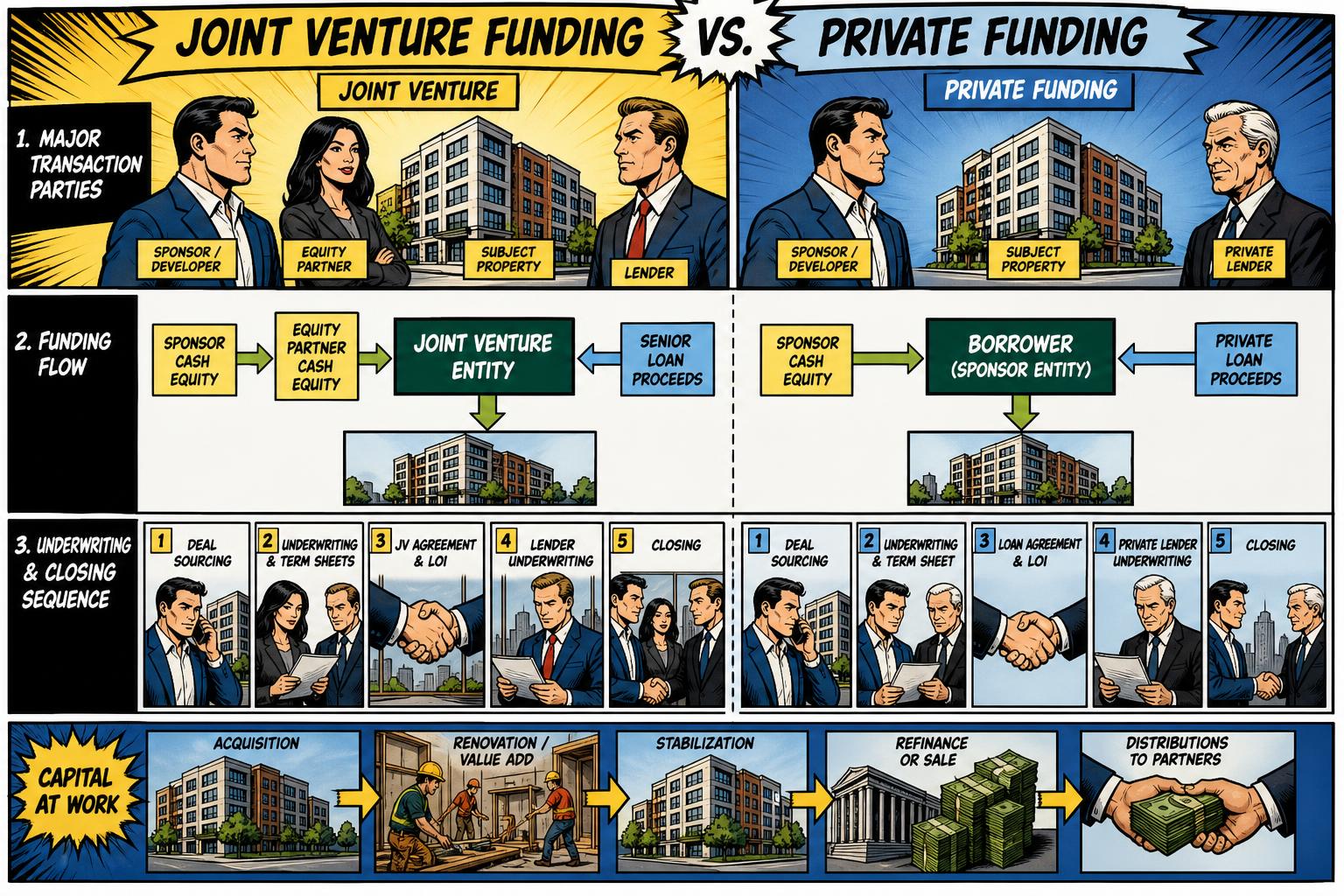
A private loan is a form of debt. The lender provides cash in exchange for a promissory note and secures it with a lien, typically a deed of trust or mortgage. You’re responsible for repaying the principal, interest, and any fees, regardless of whether the deal earns $20,000 or $200,000. If the investment does well, the lender still receives their fixed return. If it doesn’t, you bear the loss.
A joint venture is equity. The capital partner puts money into the deal (often through a single-purpose LLC) and shares in the outcome. Their return depends on how the deal performs, usually with a preferred return and a profit split. If the deal underdelivers, both sides feel it.
Everything else flows from this: who makes decisions, who gets paid first, what happens if things go sideways, and how much upside you keep.
One thing to watch for: some capital sources blur the line. There’s a BiggerPockets discussion on this exact topic. Sometimes, a funding partner is really a lender with a note and deed of trust, paid a fixed rate or a share of profits at payoff. That hybrid is common. Always read the documents, not just the label. If a “partner” gets a fixed return, a lien, and no operating role, you’re dealing with a lender in disguise.
How Private Lending Works
Private lending is capital from individuals, family offices, or small funds, usually for short-term real estate: acquisitions, rehabs, bridge loans, and fast closings.
Typical terms in the market look like this (but every lender, asset, and borrower is different):
- Interest-only payments, or interest accrued and paid at payoff
- Origination points at closing
- 6 to 24 month terms
- Advance rates based on purchase price and after-repair value (ARV)
- First-position lien on the property
- Draw schedules for renovation funds
The borrower keeps control and keeps the upside. The tradeoff: you usually need to bring cash to closing, often 10% to 25% of the total project cost. Lenders want to see experience and liquidity.
Private lending is a fit when:
- The deal has real equity and a clear exit
- The borrower has cash for the down payment and reserves
- The borrower has completed similar projects
- Speed matters and the file is clean
How Joint Venture Funding Works
In a JV, one party (the sponsor/operator) finds the deal, runs the project, and takes on execution risk. The other party (the capital partner) brings most or all of the money. As this real estate JV guide explains, you define roles and contributions, agree on splits and preferred return, form an LLC, sign the agreement, then fund, operate, report, and exit.
The usual economics:
- Preferred return: The capital partner earns a priority return (usually an annual percentage) before the sponsor shares in profit.
- Profit split: Remaining profit is divided by a negotiated percentage, sometimes with tiers based on performance.
- Return of capital: Typically paid before profit splits.
- Fees: Some deals include an acquisition or management fee to the sponsor. This must be disclosed and agreed in writing.
JV funding is for operators with deal flow and execution skill but not enough capital. It’s also useful when a deal doesn’t fit a lender’s box: thin liquidity, an unusual asset, or a project where the lender wants more skin in the game than the sponsor can provide.
The price: you give up a meaningful share of the profit. If the deal is strong, JV is the more expensive money. Better to know that up front than be surprised at payoff. For more on this, see Equity Share vs. Joint Venture: Which Structure Is Better for Real Estate Investors?
Side-by-Side Comparison
| Factor | Private Lending | Joint Venture Funding |
|---|---|---|
| Nature of capital | Debt, secured by a lien | Equity, shared outcome |
| Borrower cash needed | Usually yes | Often little or none |
| Cost of capital | Interest and points, fixed | Preferred return plus profit share |
| Upside to operator | Keeps all profit after loan costs | Shares profit with partner |
| Downside to operator | Owes the loan regardless | Loss shared, but pref may consume profit |
| Control | Operator, subject to covenants | Shared, per JV agreement |
| Documentation | Note, deed of trust, guaranty | JV or operating agreement, often an LLC |
| Best fit | Experienced borrower with cash | Operator with deal and skill, short on capital |
Hypothetical Example: A Value-Add Fourplex in Dallas, Texas
This is a hypothetical scenario for illustration only. It’s not a real borrower, client, or closing, and none of these numbers are a quote or a promise.
Let’s say an investor in Dallas puts a small fourplex under contract. Dallas is just the setting here.
Deal assumptions
- Purchase price: $400,000
- Renovation budget: $90,000
- Closing, insurance, taxes, and carry: $30,000
- All-in cost before financing: $520,000
- Projected ARV: $640,000
- Selling costs at 6%: $38,400
- Net sale proceeds: $601,600
- Profit before financing: $81,600
- Hold period: about nine months
Option A: Private loan
Suppose a private lender advances 75% of the purchase price ($300,000) and 100% of the renovation ($90,000), for a total loan of $390,000 (about 61% of ARV). The borrower brings $130,000.
Financing cost: two points ($7,800) plus interest at 11%, roughly $28,000 after draw timing. Total: about $35,800.
Borrower profit: $81,600 minus $35,800 = $45,800 on $130,000 invested, about 35% over nine months. The lender gets their principal, interest, and points.
Option B: Joint venture
Now, suppose the investor doesn’t have $130,000. A capital partner funds the full $520,000 through a JV LLC with an 8% annual preferred return and a 50/50 profit split.
Preferred return for nine months on $520,000: about $31,200. Profit remaining after pref: $81,600 minus $31,200 = $50,400. Split 50/50: $25,200 each.
The sponsor makes $25,200 with no cash in. The capital partner makes $56,400 on $520,000 (about 11% over nine months).
Which is better? Depends on your position. The loan pays the operator more but requires $130,000 and personal liability. The JV pays less but gets the deal done when cash is tight.
Now stress it. Suppose the property sells for $576,000, 10% below plan. Net proceeds after 6% costs are about $541,400, so profit before financing drops to roughly $21,400.
- With the loan, financing costs of $35,800 exceed profit. The borrower loses about $14,400 on their $130,000. The lender’s $390,000 is still covered, and was never at risk of loss.
- With the JV, the first $21,400 goes to the capital partner as preferred return. The sponsor earns nothing. No cash loss, but no reward for nine months of work.
The lesson: debt is fixed, equity floats. In a weak outcome, the loan hurts the operator more in dollars. The JV hurts more in lost effort. Neither one saves a bad deal.
If you’re looking at private real estate funding in Texas for a project like this, structure comes after underwriting, not before.
What I Would Review Before Funding This
Whether it’s debt or equity, the core underwriting questions are similar. Here’s what I look at.
The property and the numbers
- Purchase contract, and whether the price is supported by comps
- Scope of work with real contractor bids, not just a guess
- ARV backed by recent closed comps, not listings
- Holding costs: taxes, insurance, utilities, interest
- Exit plan: sale, refinance, or both, and whether each works on its own
The sponsor or borrower
- Completed projects of similar size and complexity, with documentation
- Liquidity beyond the down payment (overruns are normal)
- Credit and litigation history
- Who is actually doing the work, and who holds the contractor relationships
The structure
- Lien position, title status, and any existing encumbrances
- Draw process and inspection controls for renovation funds
- Personal guaranty or recourse, if applicable
- For a JV: roles, decision rights, capital call provisions, default remedies, and exit mechanics
- For a JV with senior debt: how the lender’s rights interact with the JV agreement. A Blakes analysis of JV financing failures points out that a capital partner will want any lender who enforces its security, and anyone the lender later transfers the interest to, to be bound by transfer restrictions, rights of first refusal, and other JV agreement provisions. These clauses matter most when something has already gone wrong.
The margin for error
I run the deal at lower ARV, higher rehab costs, and a longer hold. If it only works in the base case, it doesn’t work.
Red Flags
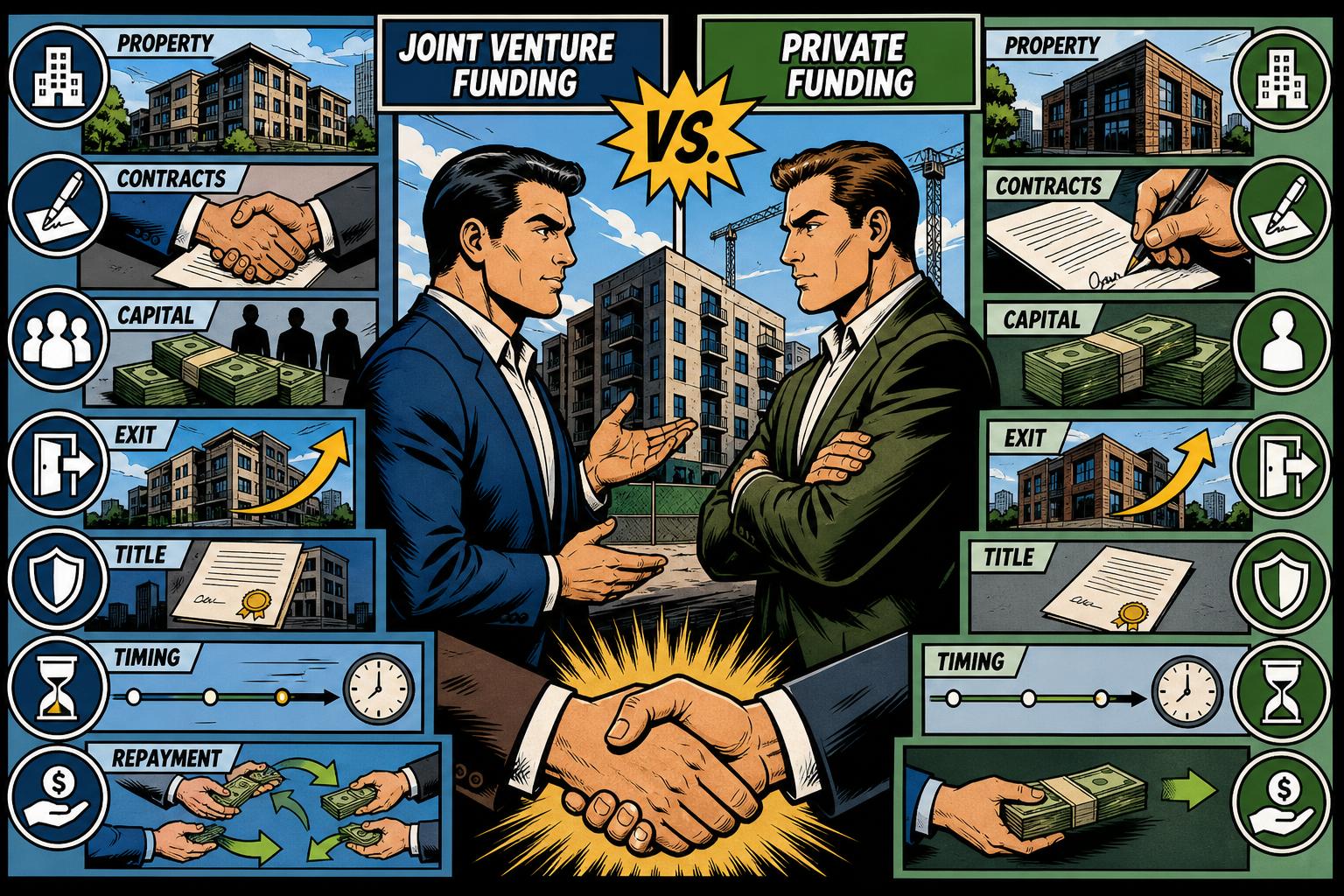
These show up on both sides of the table.
- A “partner” who wants a fixed return, a lien, and full control. That’s a lender with a JV label. The documents will show it.
- No written agreement, or a one-page agreement for a six-figure deal. Roles, splits, and exit terms need to be spelled out.
- Returns promised as guaranteed. Equity returns are not guaranteed. A lender promising a “guaranteed profit” on top of a note is describing something else.
- ARV based only on the borrower’s opinion.
- Rehab budgets with no bids, no contingency, and no schedule.
- No reserves. If the borrower has just enough for closing, there’s no room for surprises.
- Fees that appear late. Extension fees, exit fees, and “administrative” charges should be disclosed up front.
- Unclear decision rights in a JV. Who approves change orders, extends the timeline, or decides to sell? If the agreement is silent, a dispute is coming.
- Pressure to close before diligence is complete.
- A seller or partner who won’t allow title and insurance review.
Before a lender reviews proof of liquidity, your file should be organized enough to answer basic underwriting questions quickly.
Borrower Readiness Checklist
Before you approach any capital source, have these ready:
- Executed purchase contract or clear acquisition timeline
- Property address, photos, and a summary of condition
- Scope of work with contractor bids
- Comparable sales supporting ARV
- Itemized budget: purchase, rehab, closing, carry, and contingency
- Exit strategy with a backup
- Entity documents, if buying through an LLC
- Proof of funds for down payment and reserves (for a loan)
- Résumé of completed projects, with addresses and outcomes
- Personal financial statement and credit overview
- Insurance quotes
- Draft terms for any seller financing or other layered capital
If you’re combining seller financing with outside funding, every party needs to see the structure. Our articles on seller carryback financing, how investors structure seller carry back deals, and using the stack method show how to layer capital without leaving gaps.
How to Choose
Ask yourself these four questions:
- Do you have the cash the lender will require? If yes, and the deal has solid margin, a private loan usually leaves more profit in your pocket. If not, a JV may be your only path.
- How strong is the margin? Thin deals can’t carry high-cost debt or a big profit share. If the project barely clears with cheap money, it won’t clear with either of these.
- How much control do you need? Debt gives you control within loan covenants. A JV shares it.
- What’s your track record? Lenders want proof you can finish. Capital partners want that, plus confidence you’ll communicate and report honestly.
Some deals use both. A senior loan covers most of the cost, and a JV partner fills the equity gap. That adds complexity, so the intercreditor and lien issues above become critical, and each party’s priority must be clear before closing.
Frequently Asked Questions
Is a joint venture cheaper than a private loan?
Usually not on a strong deal. A JV shares profit, so the more the project earns, the more it costs you. On a weak deal, a JV can cost less in cash terms because the partner shares the shortfall. Cost depends on the outcome.
Can I get 100% funding?
Some capital sources, especially in JV structures, fund all or most of a project’s cost in exchange for equity and a preferred return. Private lenders more commonly lend against a percentage of cost or value and expect borrower equity. Availability depends on the deal, the sponsor, and the capital source.
Do I need a lien in a JV?
Not always, since the partner holds equity in the entity that owns the property. Some JVs add protective features, like security interests or step-in rights, but those should be negotiated and documented, not assumed.
Who is liable if a project loses money?
With a loan, the borrower owes the debt, often with a personal guaranty. In a JV, losses are generally shared according to the agreement, but sponsors can still carry guaranties on any senior financing. Read the guaranty provisions closely.
What does a capital partner look for in a sponsor?
Track record, a defined plan, realistic numbers, and clear communication. They also look at whether the sponsor has any of their own money or reputation at stake.
Can I refinance out of either structure?
Often yes, but the refinance has to appraise and underwrite on its own terms. Build the exit around what a permanent lender would actually approve, and confirm how a refinance affects the JV waterfall or the loan payoff.
Should I use an attorney?
Yes. JV agreements and loan documents should be reviewed by a real estate attorney licensed in the property’s state. Nothing in this article is legal or tax advice.
Next Step
If you have a deal under contract and aren’t sure whether debt or a joint venture fits, start with the numbers: purchase price, scope, ARV, timeline, and how much cash you can put in. From there, the right structure usually becomes clear.
You can submit your deal for review at JointVentureLoans.com. Send the basics, and we’ll tell you plainly if the file looks fundable, what’s missing, and which structure makes the most sense. All funding is subject to underwriting and documentation. Nothing here is a commitment to lend or invest.
Further Reading and Source Context
These outside references can help you compare definitions, market language, and general real estate financing context. They are provided for education only and do not imply endorsement by those publishers: