
Preserving Liquidity Without Losing the Deal: A Real Estate Operator's Guide
Every operator eventually runs into the same problem. The deal looks solid on paper, time is running out, and suddenly the seller or lender wants to see actual cash before they take you seriously. So you transfer money into escrow, a proof of funds account, or a reserve you can’t access for weeks. The deal might close, but now your capital is locked up, leaving you without cash for the next opportunity.
That’s the real challenge with “preserving liquidity.” It’s not about avoiding risk. It’s about making sure one deal doesn’t freeze the cash you need to keep working like a real investor, not just a one-hit wonder. Sellers want proof you can close. Lenders want to see reserves. Title companies want funds staged before scheduling closing. All of that makes sense from their side. The problem is, most operators solve it the costly way: by parking real cash where it can’t work for you, can’t earn, and can’t help you move on the next deal.
This guide is for operators who want to keep their capital working. We’ll break down how experienced operators think about liquidity when a deal is on the table, what capital providers really want to see, where operators lose flexibility without realizing it, and how tools like proof of liquidity, transactional funding, and short-term gap capital let you meet requirements without draining your position.
Why Liquidity Gets Sacrificed to Win a Deal
Most liquidity mistakes happen because of time pressure, not poor planning. Maybe a wholesaler brings you an off-market deal with a 10-day close. Maybe a seller’s agent won’t schedule a showing without proof of funds. Or a hard money lender wants to see your down payment already sitting in your account, not just “available.” The quickest way to check the box is to move cash into position and let it sit.
But if you’re juggling multiple deals, this gets expensive fast. If you’re working three or four deals at once, and each one wants you to park $50,000 to $150,000 in a dedicated account just to prove you’re serious, you end up with capital stuck all over the place, sometimes on deals that never close. On paper, you look liquid. In reality, you’re cash-poor.
This is where many operators confuse liquidity with capital commitment. Liquidity means you can access funds when you need them. Capital commitment means those funds are already spoken for or locked up. When a seller asks for “proof of funds,” what they really want is to know you can close, not that your money is sitting idle for weeks.
What Lenders and Sellers Actually Need to See
It’s important to separate what’s actually being verified from what operators assume is being verified. Institutional lenders are clear about this. For example, Fannie Mae’s Multifamily Guide defines liquid assets for sponsor verification and excludes things like promissory notes payable to the borrower unless you can justify them (Fannie Mae Multifamily Guide, Net Worth and Liquid Assets. The goal isn’t to make you freeze cash. It’s to confirm you have real, accessible capital, not just paper assets that can’t be converted quickly.
This applies to smaller operators too. Sellers and private lenders want to know two things: that you have access to enough funds to close, and that those funds are real and not tied up elsewhere. They rarely care if the money has been sitting untouched for months. Once you separate “verifiable access” from “immobilized cash,” you can structure around the requirement instead of just parking money and hoping the deal closes fast enough to free it up.
That’s the idea behind proof of liquidity structures, using a documented, verifiable liquidity position instead of a static cash deposit to satisfy a seller or underwriter. We’ve covered this in detail in The Ultimate Guide to Proof of Funds & Liquidity for Real Estate Investors. The details vary depending on deal size: proof of liquidity for a big commercial syndication isn’t the same as for a single-family flip. For more, see Proof of Liquidity for Syndications: How Investors Show Strength in Big Commercial Deals and Proof of Liquidity for Investors: How to Show Cash Without Tying It Up.
Strategies to Preserve Liquidity While Still Funding the Deal
Use proof of liquidity instead of a cash deposit. When a seller or agent wants confirmation of funds before accepting your offer, a documented proof of liquidity, a verified statement or letter tied to a real account or facility, often works without moving cash into escrow weeks before closing. We explain this in Proof of Liquidity: How Investors Show Sellers They're Serious Without Cash in the Bank. The seller gets real assurance. You keep your capital available.
Separate earnest money from the closing capital stack. Many operators over-fund earnest money just to “show strength.” In a hot market, that can help, but every dollar in escrow above the minimum is a dollar you can’t use elsewhere.
Use transactional or gap funding for closing instead of your own cash. If the deal supports a short-term facility, like a double close, a bridge to permanent financing, or a gap between contract and takeout, bringing in transactional funding lets you close on time without draining your reserves. This is common in wholesale-to-retail double closings and deals where your permanent capital source needs a few more weeks to fund.
Match reserves to actual holding-period risk, not just what feels safe. Lender-imposed reserves for taxes, insurance, or debt service cover a specific risk window, not a permanent buffer. Make sure the reserve amount matches the real carrying costs for the expected hold period, not just an arbitrary multiple.
Understand what your capital provider is really stress-testing. Bank regulators define liquidity risk as the ability to fund obligations and meet cash flow needs without disruption. Private lenders use the same logic when underwriting your ability to carry a deal through completion (see the OCC’s Comptroller’s Handbook on Commercial Real Estate Lending. If you know your lender is testing your ability to handle delays, a permit holdup, a slow refinance, a rehab that runs long, you can address that risk directly with a smaller, purpose-built reserve instead of a big, generic cash cushion.
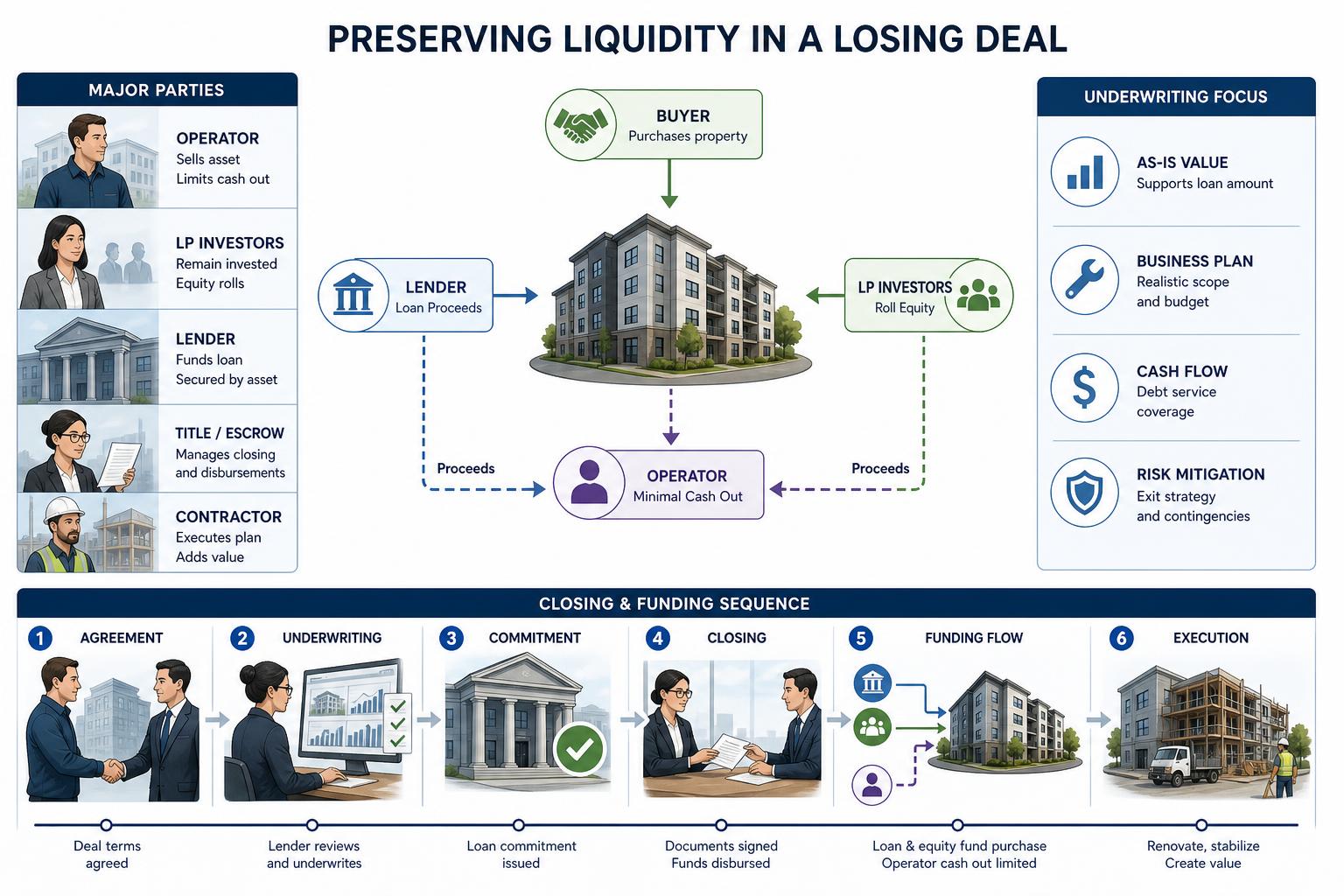
What I Would Review Before Funding This
If a borrower came to me with a deal structured around liquidity preservation, using transactional funding, a proof of liquidity letter, or a short-term gap facility instead of full cash, I’d want to see:
- Exit path and timeline. If this is a bridge to permanent financing or a double close, I want to see the takeout commitment or the buyer’s contract. Not just a verbal “the financing is in process.”
- Actual liquid position behind the borrower. Verified through bank or brokerage statements, not just a letter of intent from a third party promising future capital.
- How much of the requested funding is for closing costs versus purchase price. Gap funding for a real timing mismatch is different from gap funding because the deal lacks enough equity.
- Reserve structure and who holds it. If reserves are held by a title company or escrow agent instead of the borrower, that changes how I underwrite the risk.
- Track record on similar structures. An operator who’s closed several double closes or bridge-to-permanent transitions on schedule is a different risk than someone trying it for the first time under pressure.
- Property’s carrying cost during the gap period. I want to see that the borrower’s reserves actually cover it, not just the headline funding amount.
Red Flags
- The borrower can’t clearly explain why they need gap or transactional funding. The story keeps shifting between “faster close” and “the takeout lender fell through.”
- Proof of liquidity comes from an unverifiable source, a personal loan disguised as available capital, or funds shown as available on another deal.
- The exit strategy depends on a refinance or resale with no documentation, no term sheet, no signed buyer contract, no real timeline.
- Reserves are just a flat percentage of the loan amount, with no connection to actual carrying costs, taxes, insurance, or expected delays.
- The borrower is stacking multiple short-term facilities across several deals at once, with no clear plan for how each gets repaid.
- Urgency is used as a substitute for documentation. “We don’t have time to get the actual bank statement” isn’t a timeline problem. It’s a request to skip verification.

Hypothetical Example: A Cash Offer Without Cash Lockup in Charlotte, North Carolina
Let’s make this real with a hypothetical scenario, not a closed transaction. An investor in Charlotte finds a value-add duplex listed at $410,000 in a solid rental neighborhood. The listing agent says the seller wants proof of funds with any offer and expects a close within 21 days.
In this example, the investor has about $180,000 in liquid capital across a brokerage account and a business line of credit. That’s enough to close, but not enough to comfortably tie up $410,000 in escrow while chasing two other deals already under contract. Instead of moving the full purchase amount into a dedicated account, the investor gets a documented proof of liquidity showing verified access to enough funds, submits it with the offer, and structures the closing capital through a short-term bridge facility plus their own equity.
The seller gets the assurance they want. The investor closes on schedule without freezing their entire liquid position in one deal. Once the property is stabilized, the investor refinances into permanent debt and pays off the bridge facility. This setup isn’t unique to Charlotte. It’s common anywhere investors need to move fast and sellers want certainty without waiting for a buyer’s full cash position to sit in escrow. The Charlotte numbers are just for illustration.
Borrower Readiness Checklist
Before you approach a lender about a liquidity-preserving structure, transactional funding, a gap facility, or proof of liquidity, have these ready:
- Recent bank or brokerage statements showing your actual liquid position, not just a summary
- A clear, one-paragraph explanation of why you need the structure: timing mismatch, seller requirement, or capital efficiency across multiple deals
- The purchase contract or LOI with closing date and contingencies spelled out
- Documentation of your exit: refinance term sheet, buyer contract for a double close, or permanent lender pre-approval
- A carrying-cost estimate for the property during the gap period: taxes, insurance, debt service, planned rehab costs
- Your track record on similar deals, including how prior bridge or gap-funded transactions were resolved
- A realistic reserve number tied to the actual holding period, not just a round number for comfort
FAQ
Isn’t a proof of liquidity letter just a workaround for not having enough cash?
No. It’s a way to document capital that already exists without physically moving it into a dedicated account for a deal that hasn’t closed. The funds still need to be real and verifiable. It’s a documentation and structuring choice, not a substitute for actual capital.
When does it make more sense to just use cash instead of a gap or bridge facility?
If you have more liquidity than you need for your active pipeline, and the cost of a short-term facility is higher than the opportunity cost of tying up cash, using your own funds is often simpler. For operators running multiple deals, liquidity flexibility has real value.
How much reserve should I actually keep on hand for a deal like this?
Size it to the specific holding period and risk, carrying costs plus a buffer for realistic delays, not a fixed percentage across every deal.
Do sellers and agents generally accept proof of liquidity instead of a large earnest money deposit?
Many do, especially when they understand the difference between proof of access to funds and a deposit already sitting in escrow. It depends on the transaction and how competitive your offer needs to be, but it’s common in investor-driven markets.
Can this kind of structure work outside a market like Charlotte?
Yes. The mechanics aren’t market-specific. Any active investor market with competitive, time-sensitive deals creates the same pressure to show liquidity without locking up capital.
If you’re structuring a deal where liquidity flexibility matters as much as the acquisition itself, Joint Venture Loans works with operators on transactional funding, gap capital, and proof of liquidity structures built around the real timeline and risk of the deal, not a generic checklist. Reach out to discuss the structure before you tie up capital you might need for the next opportunity.
Further Reading and Source Context
These outside references can help you compare definitions, market language, and general real estate financing context. They are provided for education only and do not imply endorsement by those publishers: