
The Capital Problem Behind Every Double Closing
Let’s get right to it. You’re a wholesaler. You lock up a distressed property at $140,000 and already have an end buyer ready to pay $172,000. The profit is real, the deal is real, but you don’t have $140,000 sitting in your account to close the first leg before flipping it to your buyer, sometimes just minutes later.
This is exactly where transactional funding comes in. It’s short-term capital designed to let you buy from the original seller and immediately resell to your end buyer. The end buyer’s funds (or their lender’s funds) pay off the transactional loan before the day is over. There’s no credit check, no appraisal, no seasoning period. The loan doesn’t last long enough for any of that to matter.
If you’ve never used transactional funding, or you’ve only heard it mentioned in investor circles, you need to know how it actually works before you’re at the closing table trying to explain why your money didn’t show up. This article breaks down how the money moves, what a lender really looks at, and where these deals can fall apart.
What Transactional Funding Actually Is
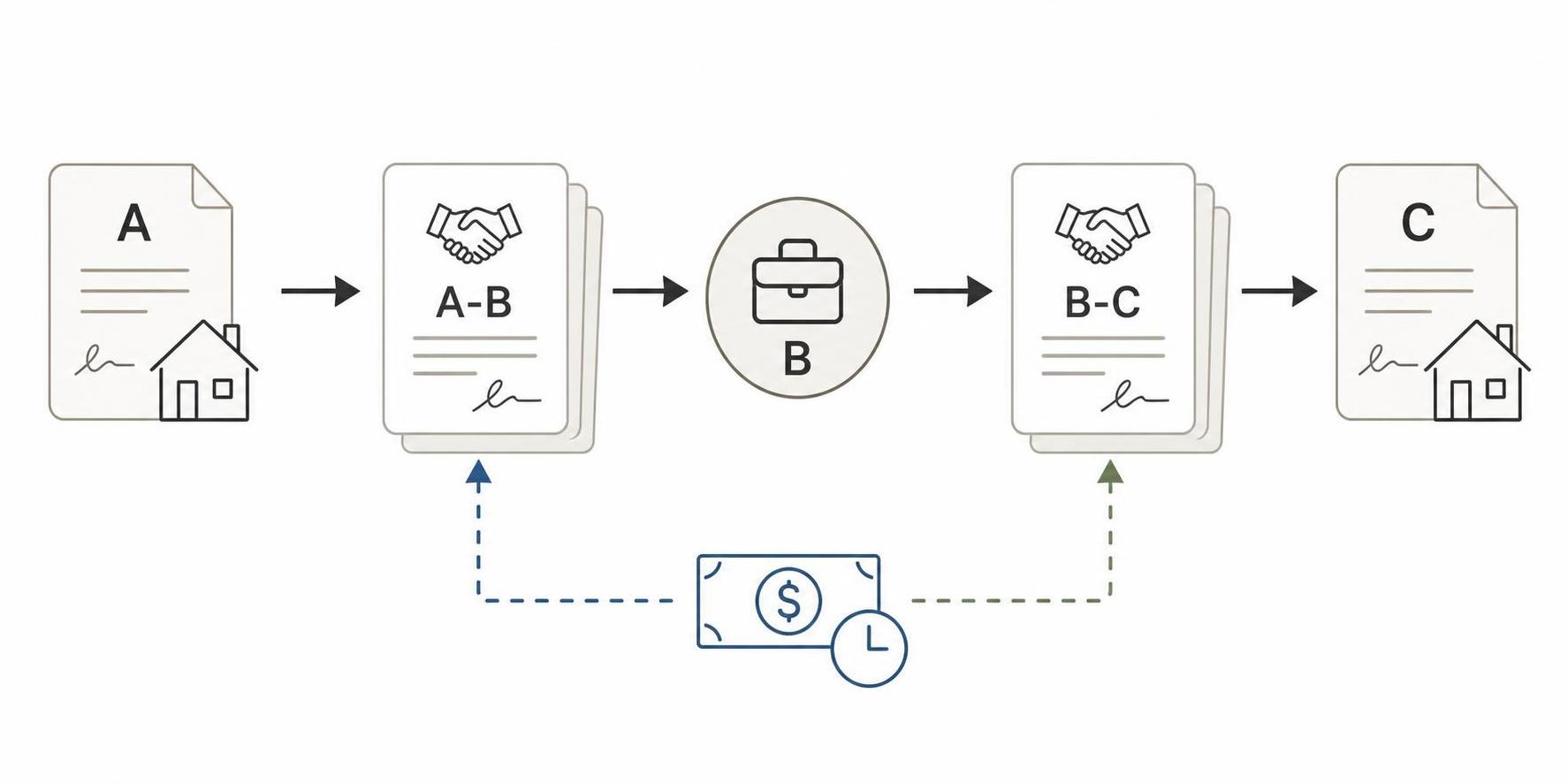
Transactional funding (sometimes called flash funding or AB-BC funding) is a short-term loan used to finance the first leg of a double closing, also called a simultaneous or back-to-back closing. It’s built for wholesale and assignment-style deals where you’re not risking your own capital and you don’t plan to hold the property.
Here’s the basic structure:
- A to B: The original seller (A) sells to you, the investor/wholesaler (B).
- B to C: You (B) immediately resell to your end buyer (C).
The transactional lender funds your A-to-B purchase. The B-to-C sale proceeds (wired in from your end buyer or their lender) pay off the transactional loan, usually within the same day. The loan is typically outstanding for just a few hours, sometimes a day or two if the closings are not perfectly lined up, but rarely more than 24 to 48 hours in a well-run deal.
If you want a deeper dive into the structure, check out our Ultimate Guide to Transactional Funding & Double Closings.
Why Investors Use Double Closings Instead of Assignments
Most wholesalers start with assignments. They’re simple, cheap, and don’t require funding. But assignments have real limitations that push experienced operators toward double closings:
- Double closings keep your profit private: it is simply the spread between two transactions, while assignment fees are visible to the end buyer’s closing team and can lead to friction, renegotiation, or a buyer who feels burned.
- Seller or buyer restrictions. Some sellers (especially banks, REOs, or certain agents) don’t allow assignable contracts. Double closings let you take title and immediately convey it, sidestepping those restrictions.
- Big spreads get more scrutiny. When the profit is large, title companies and end-buyer lenders are more comfortable with a documented sale-and-resale than a big assignment fee.
- Commercial and novation deals. In multifamily and commercial, double closings (and the transactional capital behind them) are used differently than in single-family. See our article on transactional funding for commercial and multifamily syndications for more on that.
The tradeoff: double closings require real capital to close the A-to-B leg. That’s where transactional funding comes in.
How the Money Actually Moves
Here’s how the process runs at the title company or closing attorney’s office:
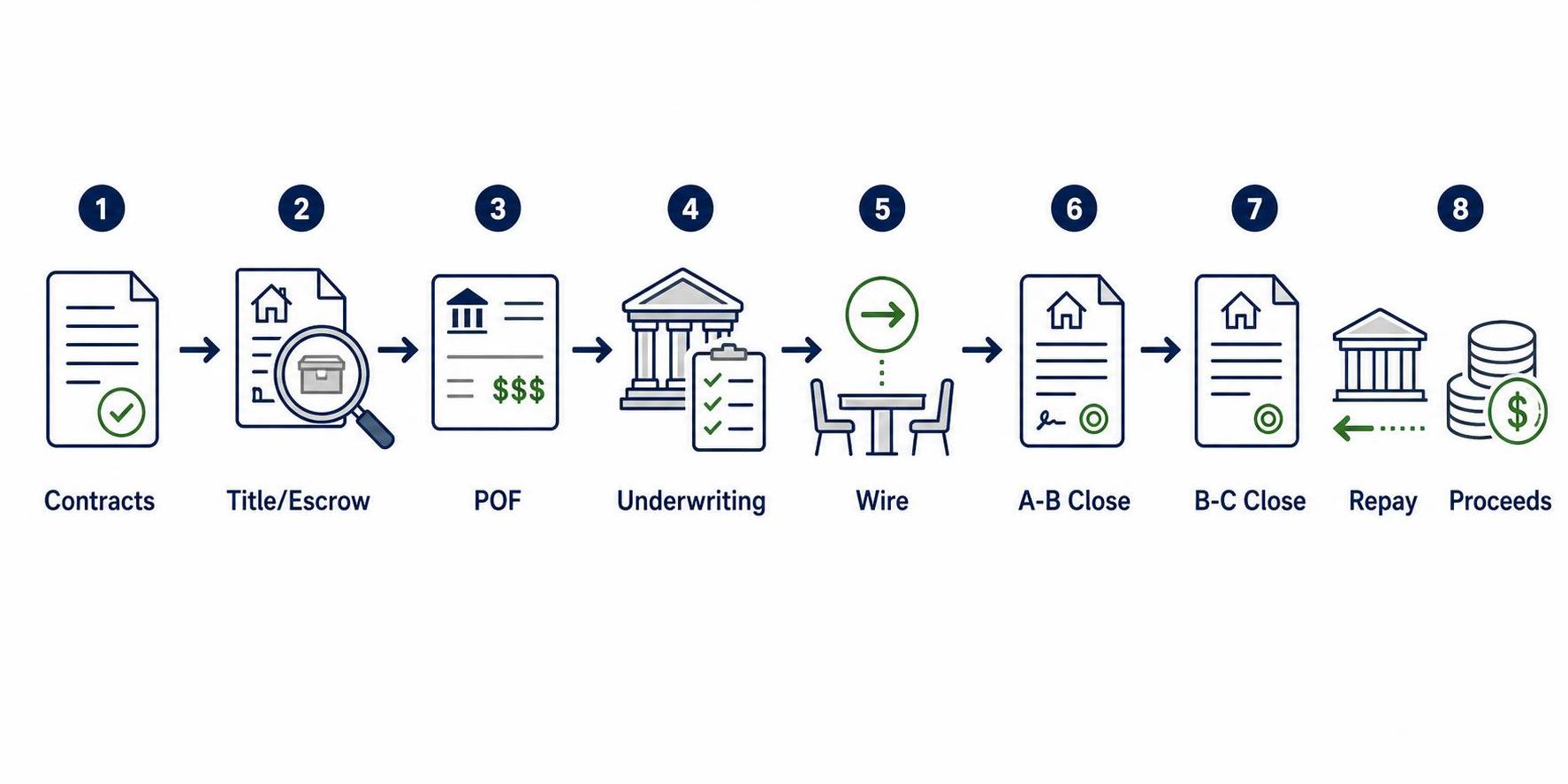
- Contracts in place. You have a signed purchase contract with the seller (A-B) and a signed contract with your end buyer (B-C). Both must allow you to take title and resell.
- End buyer’s funds are confirmed. Before a transactional lender wires anything, they need proof the B-C closing is funded and ready: either a mortgage commitment or verified proof of funds if it’s a cash buyer.
- Closings are scheduled back-to-back. The title company or attorney sets up both closings, usually with the same escrow officer so funds can move quickly.
- A-to-B closes first. The transactional lender wires funds to escrow, the deed is recorded in your name, and you now hold title.
- B-to-C closes immediately after. The end buyer’s funds come in. Escrow uses those proceeds to pay off the transactional loan, cover closing costs and lender fees, and pay you the profit.
- Payoff and release. The transactional lender’s payoff is verified and their lien on the A-B transaction is released, usually the same day.
This whole structure depends on title and escrow executing cleanly and quickly. If you’re new to closings, the CFPB’s plain-language guide to mortgage closings is a good primer. A double closing just runs that process twice, back-to-back, with private capital bridging the gap.
What a Transactional Lender Actually Underwrites
Since the loan is only outstanding for hours and is paid off by the end buyer’s funds, the underwriting is focused and strict. The lender is not concerned with your credit; instead, they are verifying that the B-C leg is real and funded.
Proof the B-C sale is real and funded. This is the big one. If the end buyer is using a mortgage, the lender wants to see a loan commitment or clear-to-close letter. If it’s a cash buyer, they want verified proof of funds—not a screenshot, but a real bank or brokerage statement.
A clean, assignable A-B contract. The contract must let you take title and resell. If there’s anti-assignment language or unresolved contingencies, that can kill the deal.
Title company or attorney confirmation. The lender wants direct confirmation from the closing agent that both closings are scheduled, they understand the double-closing structure, and they’re comfortable handling same-day funding and payoff. Not every title company is.
Purchase price spread and exit price. If the B-C price looks way off from comparable sales, that’s a red flag for the end buyer’s lender. If their financing falls apart, the lender’s capital is exposed longer than planned.
Timeline confirmation. Same-day close is the goal. If the closings are days apart, the loan shifts from a flash to a short-term bridge, and the terms (and scrutiny) change.
What I Would Review Before Funding This
When a transactional funding request hits my desk, here’s the checklist I run through:
- Signed A-B and B-C purchase contracts
- End buyer’s loan commitment or verified proof of funds
- Title company or closing attorney confirmed and willing to handle the double close
- Both closings scheduled for the same day, or a clear explanation if not
- A-B purchase price versus B-C sale price—does the spread make sense for the property and market?
- Any liens, judgments, or title issues that could delay recording
- The investor’s track record with double closings (not a credit check, but a pattern check)
- Wiring instructions verified through a second channel (wire fraud targets these fast-moving closings)
That last point is critical: same-day closings are prime targets for wire fraud because everyone is moving fast and last-minute changes are common. Always confirm wiring details by phone, using a known number.
Red Flags
- End buyer’s financing isn’t confirmed. A pre-qual letter is not a clear-to-close, and “the buyer says they’re ready” is not proof of funds.
- Title company has never handled a double closing and doesn’t know how funds will flow or how the payoff will be documented.
- A-B contract has assignment restrictions or the seller doesn’t know the property will be resold same day.
- Spread is unusually large for the property’s value, which can spook the end buyer’s underwriter or appraiser.
- Closings aren’t scheduled back-to-back. If B-C is “expected sometime this week,” the lender’s capital is exposed for an undefined period.
- Investor is unreachable or evasive about basic transaction details. In a fast-moving deal, that’s a bigger warning sign than in a standard purchase.
- Pressure to skip verification steps because of the timeline. Speed is the nature of transactional funding, but you never skip confirming the B-C funds are real.
Before a lender reviews proof of liquidity, your file should be organized enough to answer basic underwriting questions quickly.
Borrower Readiness Checklist
Before you reach out to a transactional lender, you should have:
- Fully executed A-B purchase contract, assignable or structured for title transfer
- Fully executed B-C purchase contract with your end buyer
- End buyer’s loan commitment letter or verified proof of funds
- Title company or closing attorney lined up and confirmed for a same-day double close
- Both closings scheduled, with dates communicated to the lender
- Clear understanding of lender fees and how they’ll be paid from B-C proceeds
- Verified wiring instructions from title, obtained through a trusted channel
- A basic backup plan if the B-C closing is delayed
Operators who show up with this list ready usually get funded quickly, because there’s nothing left to chase down.
A Hypothetical Example
Let’s say you contract to buy a single-family property from a motivated seller for $150,000 (A-B). At the same time, you have it under contract with an end buyer at $185,000 (B-C), who is a cash buyer with verified funds at a local bank.
The transactional lender reviews both contracts, confirms the end buyer’s proof of funds, and checks with the title company that both closings are scheduled for the same morning. The lender funds $150,000 plus estimated closing costs (let’s say $152,500 total) to close the A-B leg. Title records the deed in your name.
Later that same day, the B-C closing happens. The end buyer’s $185,000 wires in. Escrow uses those funds to pay off the transactional loan ($152,500 plus a lender fee—let’s say $2,500 for illustration), covers B-C closing costs, and you walk away with the remaining spread.
The transactional loan is outstanding for just a few hours. The lender’s fee covers the underwriting and same-day capital deployment, not months of interest. This is the key difference between transactional funding and a bridge loan you hold for months. For more on how the spread works, see our article on double closings and bigger profits.
These numbers are for illustration only. Actual fees, timelines, and structures vary by lender and by deal.
Transactional Funding vs. Other Short-Term Capital
Let’s be clear about what transactional funding is not. It’s not a bridge loan, not a hard money rehab loan, and not gap funding for a JV partner’s down payment. Each tool solves a different capital problem:
- Bridge and hard money loans finance a hold period (renovation, stabilization, lease-up) measured in months, and involve real underwriting of the asset and your exit plan.
- Transactional funding finances a same-day flip of title with no hold period. Underwriting is almost entirely about confirming the B-C sale is real and funded.
- Gap or JV equity fills a down payment or capital stack shortfall on a deal you plan to hold or develop. That’s a different risk profile than a loan outstanding for hours.
Investors sometimes confuse these because all three come from private lenders and move faster than banks. But the underwriting, fee structures, and what the lender is actually risking are different in each case. If you’re not sure whether your deal needs transactional funding, our transactional funding service page explains what we look at and how funding typically works. Our companion piece on how transactional funding for double closing works in 2026 goes deeper on current market conditions.
FAQ
How fast can transactional funding close?
Same-day is standard when both legs are properly scheduled and the end buyer’s funds are confirmed in advance. The bottleneck is almost never the lender—it’s whether title and both closings are actually coordinated to happen back-to-back.
Does transactional funding require a credit check or appraisal?
Generally no. Since the loan is repaid within hours from the B-C closing proceeds, underwriting focuses on the transaction’s structure and the end buyer’s funding, not your credit or a formal appraisal.
What happens if the B-C closing is delayed?
This is the main risk in a double closing. If the end buyer’s financing falls through or closing slips by a day or more, the transactional loan is outstanding longer than planned. A serious lender will want to know your backup plan before funding.
Can transactional funding be used for commercial or multifamily deals?
Yes, though it’s used differently than in single-family wholesaling—often ahead of a larger capital stack or in a syndication. See our article on transactional funding for commercial and multifamily syndications for more.
Is a double closing legal?
Yes. Double closings are a standard, legal real estate transaction structure, as long as both closings are properly documented, disclosed as required, and handled through a title company or attorney. It’s a question of sequencing and disclosure, not a legal gray area. Keep your title and closing team informed of both legs.
What does transactional funding typically cost?
Fee structures vary by lender and by loan size, and are usually either a flat fee or a percentage of the loan amount (not a traditional interest rate), since the capital is only outstanding briefly. Get exact terms from your lender before you rely on a number in your projected spread.
Get Funded for Your Next Double Closing
If you’ve got a double closing lined up and need same-day capital for the A-to-B leg, reach out to Joint Venture Loans before you’re up against a closing deadline. Have your contracts, your end buyer’s proof of funds, and your title company’s contact ready. That’s what lets us move at the speed these deals require. Contact Joint Venture Loans to talk through your specific transaction.
Further Reading and Source Context
These outside references can help you compare definitions, market language, and general real estate financing context. They are provided for education only and do not imply endorsement by those publishers:
- 8. Escrow
- CFPB Consumer Laws and Regulations RESPA CFPB April 2015 RESPA 1 Regulation X
- Closing disclosure explainer | Consumer Financial Protection Bureau
- I'm about to close on a real estate purchase transaction with a mortgage. What can I expect in the mortgage closing process? | Consumer Financial Protection Bureau