
Most wholesale deals are designed to close through assignment. You secure a property, find your end buyer, collect your assignment fee, and never handle the title. That’s usually the simplest way. But sometimes, something about the deal makes it clear it won’t work that way. Maybe the seller won’t work with an assignee. Maybe your buyer’s lender insists on a clean title chain. Maybe the title company won’t list your fee on the settlement statement. Or maybe you just don’t want your buyer to know your contract price.
Now you have a capital problem. If you still want the deal, you have to close on the property yourself, even if it’s only for a few hours, before selling it to your buyer. That’s a double closing. You need real funds for the first leg, and most investors don’t keep that kind of cash sitting idle. Traditional lenders can’t move fast enough for this.
Let’s break down when assignment stops being practical, how transactional funding fits in, and what I look for before funding the first leg of a back-to-back closing. For a full overview, start with The Ultimate Guide to Transactional Funding & Double Closings.
Assignment vs. Double Closing: The Practical Difference
With an assignment, you transfer your rights in the purchase contract to your end buyer. The end buyer closes directly with the original seller, and you get paid your fee at that closing. Your name never hits the chain of title, and you never fund a dime.
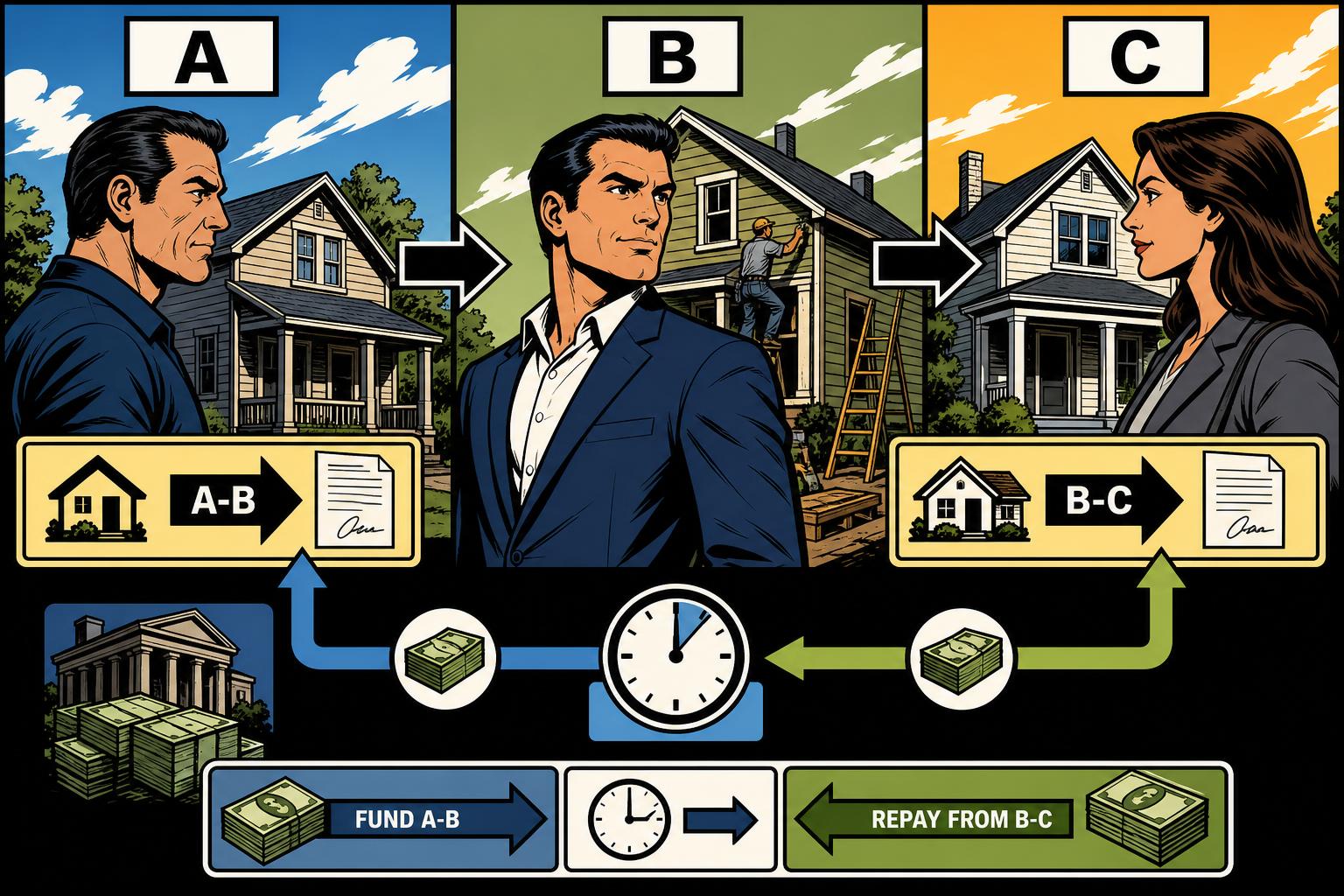
With a double closing, you’re doing two separate transactions, usually on the same day and often at the same title company:
- A-to-B: The original seller (A) sells to you (B). You must fund this purchase.
- B-to-C: You sell to your end buyer (C). The end buyer’s funds pay for the second closing and repay whatever you used to fund the first.
Both closings have their own settlement statements, and both get recorded. You hold title, even if only for a few hours, so you take on the risks of ownership. That’s why underwriting a double closing is a different animal than just collecting an assignment fee. The first closing needs real capital.
If you want to see how the funding mechanics work, check out How Transactional Funding for Double Closing Works in 2026. For the wholesaler’s playbook, see Double Closings for Wholesalers: Unlocking Profits Without Using Your Own Capital.
When an Assignment Stops Being Practical
Assignment is usually cheaper and simpler. I’m not here to steer you away from it unless the deal itself forces your hand. Here’s where assignment breaks down:
The contract restricts assignment. Some purchase agreements flat-out prohibit assignment, require seller approval, or only allow it to affiliates. Sellers with attorneys or experienced agents often add this language. Sometimes you can negotiate it out, sometimes not. If the seller finds out late that you plan to assign, they may just walk.
The end buyer’s lender wants a clean title chain. If your end buyer is using a conventional or government-backed loan, their lender may have seasoning, title, or disclosure requirements. Some lenders get nervous when there’s a middleman and a price jump. When the lender is the constraint, a double closing with two clean settlement statements is often easier to explain than an assignment fee tacked onto a mortgage file.
The seller doesn’t want to deal with your buyer. Sometimes the seller cares who ends up with the property. Maybe it’s an estate, a family sale, or someone with a reputation to protect. They’re comfortable with you, but not with an unknown assignee.
The title company won’t process the assignment fee. Some title companies are fine with assignment fees. Others have policies against showing or handling them. Title companies set their own risk rules, and you have to play by them.
You don’t want to disclose your spread. With an assignment, the seller and often the end buyer see your numbers. In a double closing, each party only sees their own side. That’s a valid business reason, but it should be about structure, not hiding something.
Licensing or disclosure issues. State rules on marketing contracts, brokerage activity, and required disclosures vary. Some investors prefer a double closing because they actually own the property, even if briefly, and are selling something they hold. That’s a legal call for your attorney, not something transactional funding solves on its own.
None of these automatically make a double closing better. The first question is always: does the deal still make sense after you factor in the cost of funding the first leg?
How Transactional Funding Fits
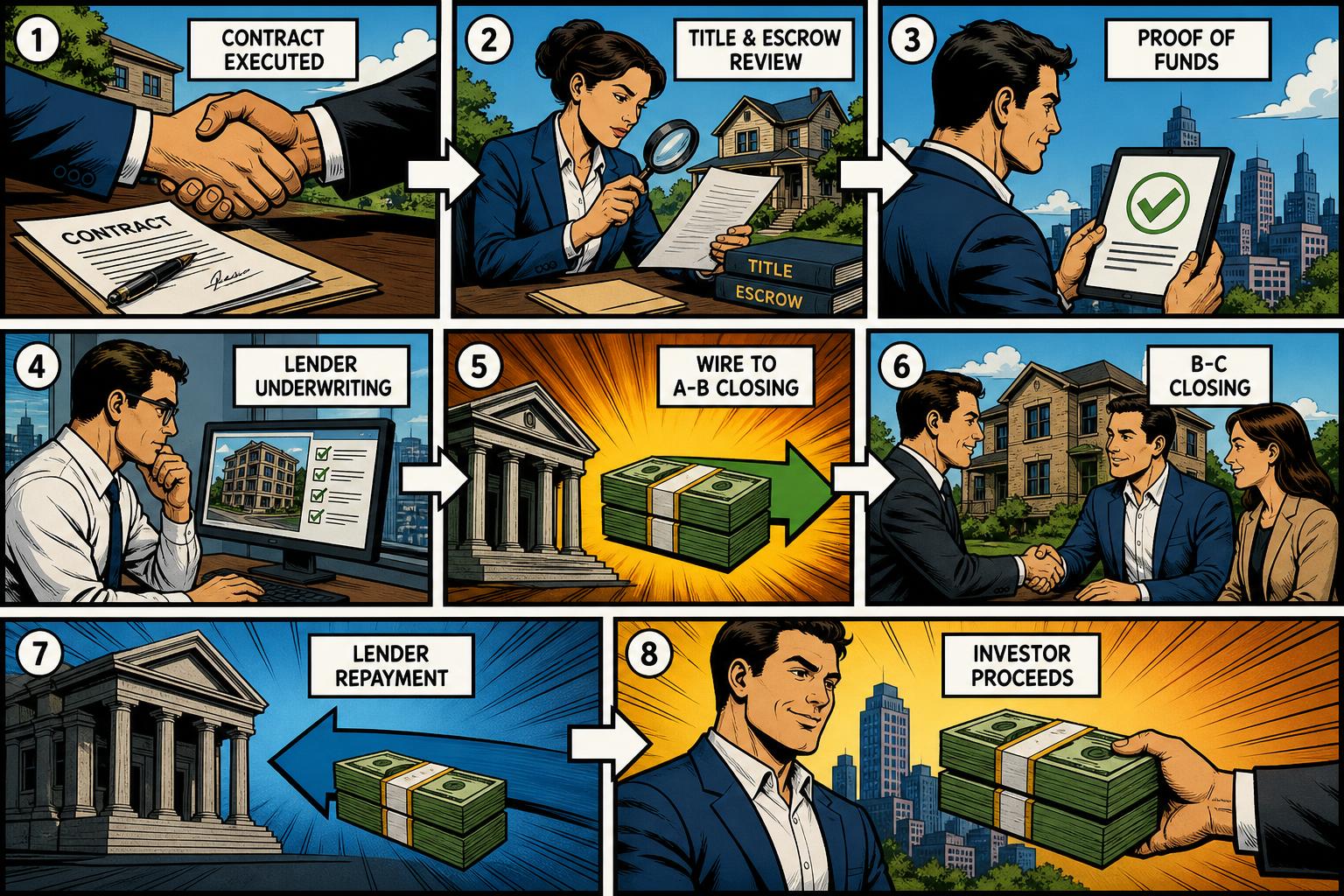
Transactional funding is short-term capital for the A-to-B closing, with repayment coming from the B-to-C closing, usually the same day. The money moves through the title or settlement company: funds are wired in for the first closing, the property transfers, the second closing funds, and the lender is paid back from those proceeds.
Here’s what defines transactional funding:
- The term is days, not months. Usually just one day, sometimes a few.
- Repayment depends on the second closing. The lender is really underwriting the end buyer’s ability and willingness to close, and the title company’s ability to handle the transaction.
- The cost is a flat fee, not monthly interest. Pricing depends on deal size, term, and risk. I’m not quoting rates here.
- The borrower usually needs little or none of their own cash in the deal. That doesn’t mean it’s risk-free, and not every file qualifies.
The mechanics run through the normal settlement process. The closing agent coordinates funds and documents. The Consumer Financial Protection Bureau explains how closing agents collect funds and signatures in a mortgage closing. That’s for consumer mortgages, not investor double closings, but the principle is the same: money moves through a neutral third party, and the paperwork has to match.
For a service overview, see the Transactional Funding page. For larger deals like commercial and multifamily syndications, the same logic applies, but diligence is heavier and the title/entity work takes longer.
Hypothetical Example: A Double Closing in Indianapolis, Indiana
This is a hypothetical example, not a real transaction. The numbers are round for clarity. Nothing here describes a real borrower or closing funded by Joint Venture Loans.
Let’s say an Indianapolis investor has a signed contract to buy a vacant single-family house from an estate. The contract price is $142,000. The investor has a cash buyer lined up at $171,500, with proof of funds and a signed sale contract. The estate’s attorney won’t allow assignment and wants the investor on title. The cash buyer is fine with a double closing as long as both closings happen the same day at the same title company.
The investor doesn’t have $142,000 available. This is where transactional funding in Indiana comes in.
Funding request:
| Item | Amount |
|---|---|
| A-to-B purchase price | $142,000 |
| A-to-B closing costs (paid by B) | $1,200 |
| Total funds needed at first closing | $143,200 |
| Illustrative funding fee (2% of $142,000) | $2,840 |
Second closing:
| Item | Amount |
|---|---|
| B-to-C sale price | $171,500 |
| Payoff of funding (principal) | $143,200 |
| Funding fee | $2,840 |
| B-to-C seller-side closing costs | $1,400 |
| Net to the investor | $24,060 |
The gross spread is $29,500. After the funding fee and both sets of closing costs, the investor nets $24,060 on a deal that required no personal capital at closing.
But there are risk points. If the cash buyer’s funds are delayed even a day, the funding stays outstanding and costs go up. If the buyer’s proof of funds is shaky, the lender is exposed on the first closing without a reliable second. If the title company can’t handle two closings in sequence, the whole structure falls apart. If appraisal or inspection issues come up on the end buyer’s side, the second closing can slip while the investor owns a vacant house.
So the real question isn’t whether the spread looks good. It’s whether the second closing is as certain as the first.
What I Would Review Before Funding This
When a double closing request comes in, I treat it as a short-term credit decision that depends on one event happening on schedule. Here’s what I want to see:
Both contracts, complete. I want the A-to-B purchase agreement and the B-to-C sale agreement, with all addenda. I check that buyer, seller, price, closing date, and property description match across both. I look for assignment restrictions, financing contingencies, inspection or due diligence periods, and any language that lets the end buyer walk.
End buyer’s proof of funds. Recent bank statements, a lender letter, or evidence the money is already at the title company. A cash buyer with vague proof of funds is a repayment risk. If the buyer is using financing, I want to know who the lender is and where the file stands.
Title company and settlement agent. I confirm the title company has agreed to handle a double closing, can close both transactions the same day, and will accept the funding structure. I want written wire instructions, verified independently. The ALTA Settlement Statements are a good reference for how charges are itemized. The numbers on both statements should reconcile to your expected net.
Title status. A preliminary title report on the property. I’m looking for liens, judgments, probate issues, tax problems, or ownership questions. A clean A-to-B closing depends on the seller being able to deliver clear title.
Numbers on both sides. I run the spread net of every cost: funding fee, closing costs on both closings, prorations, commissions, and what happens if the second closing is delayed a few days. If the deal only works if everything goes perfectly, it’s thin.
Property and value. Even when the second closing is the main repayment source, I want to understand the collateral. If the end buyer disappears, what could the property realistically sell for, and how long would it take? A purchase price well below market value can also signal title or condition problems.
Borrower’s experience and backup plan. Has the borrower done this before? Do they understand they’re on title and responsible for the property during the gap? What’s their plan if the end buyer fails to close?
Entity and authority. Who is the buyer on the A-to-B contract? Is it an LLC with documents in order? Can the person signing actually sign?
Red Flags
Some of these will kill a request fast. Others just mean more questions.
- End buyer can’t or won’t provide proof of funds, or the proof doesn’t match the buyer on the contract.
- The two closings are scheduled for different days with no explanation, or the second closing is more than a few days after the first.
- Title company hasn’t agreed to do a double closing, or is unfamiliar with the structure.
- The contract price and resale price are far apart with no explanation. A big spread can be real, but it draws attention from sellers, lenders, and sometimes regulators.
- Seller doesn’t understand the investor is reselling, or was told something that isn’t accurate.
- End buyer’s contract has a long inspection period, financing contingency, or a clause allowing cancellation for any reason.
- Wire instructions arrive by email without verification, or change late in the process.
- Borrower can’t explain what happens if the second closing falls through.
- Title commitment shows unresolved liens, probate gaps, or ownership questions.
- The numbers only work with no costs and no delays.
- Borrower wants to move fast and skip documents. Speed is common in these deals, but missing paperwork is not.
Borrower Readiness Checklist
Before you request funding, make sure you can check off these boxes:
- I have a fully signed A-to-B purchase contract, and nothing in it prohibits the structure I’m using.
- I have a fully signed B-to-C sale contract with a firm closing date.
- I have current proof of funds from my end buyer, and it matches the buyer’s name on the contract.
- My title company has confirmed it will handle both closings, and it knows about the funding source.
- I have a preliminary title report or commitment and have reviewed it for liens or other issues.
- My net numbers include the funding fee, both sets of closing costs, and a cushion for a short delay.
- I have an entity in good standing, with an operating agreement and someone authorized to sign.
- I’ve checked state and local rules on marketing, disclosure, and licensing with my attorney.
- I have a plan for what happens if my end buyer doesn’t close.
- I can provide ID, entity documents, and the contracts promptly.
If you can’t check most of these, the deal probably isn’t ready. Better to learn that before funding than after.
FAQ
Is a double closing legal?
Generally, yes. It’s two separate sales, and the investor takes title in between. Rules on disclosure, licensing, and marketing differ by state, and some lenders and title companies have their own policies. Talk to a real estate attorney in the state where the property sits.
Why not just assign the contract?
If assignment works, it’s usually simpler and cheaper. Double closing makes sense when the contract restricts assignment, the end buyer’s lender wants a clean chain, the title company won’t process an assignment fee, or you don’t want to disclose your spread.
How long does transactional funding last?
Usually a day, sometimes a few. The structure assumes the second closing happens right after the first. If it doesn’t, costs and risk both go up.
Do I need my own money in the deal?
Often very little, but it depends on the file. Closing costs, deposits, and the funding fee still have to be covered, and some deals require a portion from the borrower.
What do I need to submit?
Typically both contracts, proof of funds from the end buyer, title company contact info, a preliminary title report if available, entity documents, and ID. The more complete the package, the faster the review.
What if my end buyer doesn’t close?
That’s the central risk. The funding is outstanding, you own the property, and you need another buyer or another way to pay it back. This is why I scrutinize the end buyer before funding.
Can this work outside residential wholesale deals?
Yes, but larger or more complex properties bring heavier diligence, entity work, and timelines. The commercial article linked above covers that side.
Will the title company know about the funding?
It should. The funding moves through the settlement agent, and they need the instructions and payoff info to close correctly.
Next Step
If your assignment has hit a wall but you still have a real deal, bring the full file before the first closing date is set. A complete package is much easier to review: both contracts, your end buyer’s proof of funds, your title company’s contact, and your numbers.
You can start on the Transactional Funding page at JointVentureLoans.com. Funding is always subject to underwriting, documentation, and approval. Nothing in this article is a commitment to fund any specific transaction.
Further Reading and Source Context
These outside references can help you compare definitions, market language, and general real estate financing context. They are provided for education only and do not imply endorsement by those publishers:
- Wet Settlement Procedure Act – Maryland Real Estate Commission (MREC) – Division of Occupational and Professional Licensing
- § 1026.38 Content of disclosures for certain mortgage transactions (Closing Disclosure). | Consumer Financial Protection Bureau
- CFPB Consumer Laws and Regulations RESPA CFPB April 2015 RESPA 1 Regulation X