
What Private Lenders Review Before Funding a Real Estate Transaction
Most real estate deals don’t fall apart because the numbers don’t add up. They fail because the money isn’t ready when it’s needed, or because a lender finds something the operator missed, title problems, a shaky exit plan, a rehab budget that doesn’t fit the work, or a timeline that was never realistic. By the time these issues come up during underwriting, the seller’s gone, the contract’s dead, or the project’s schedule has slipped and the numbers no longer make sense.
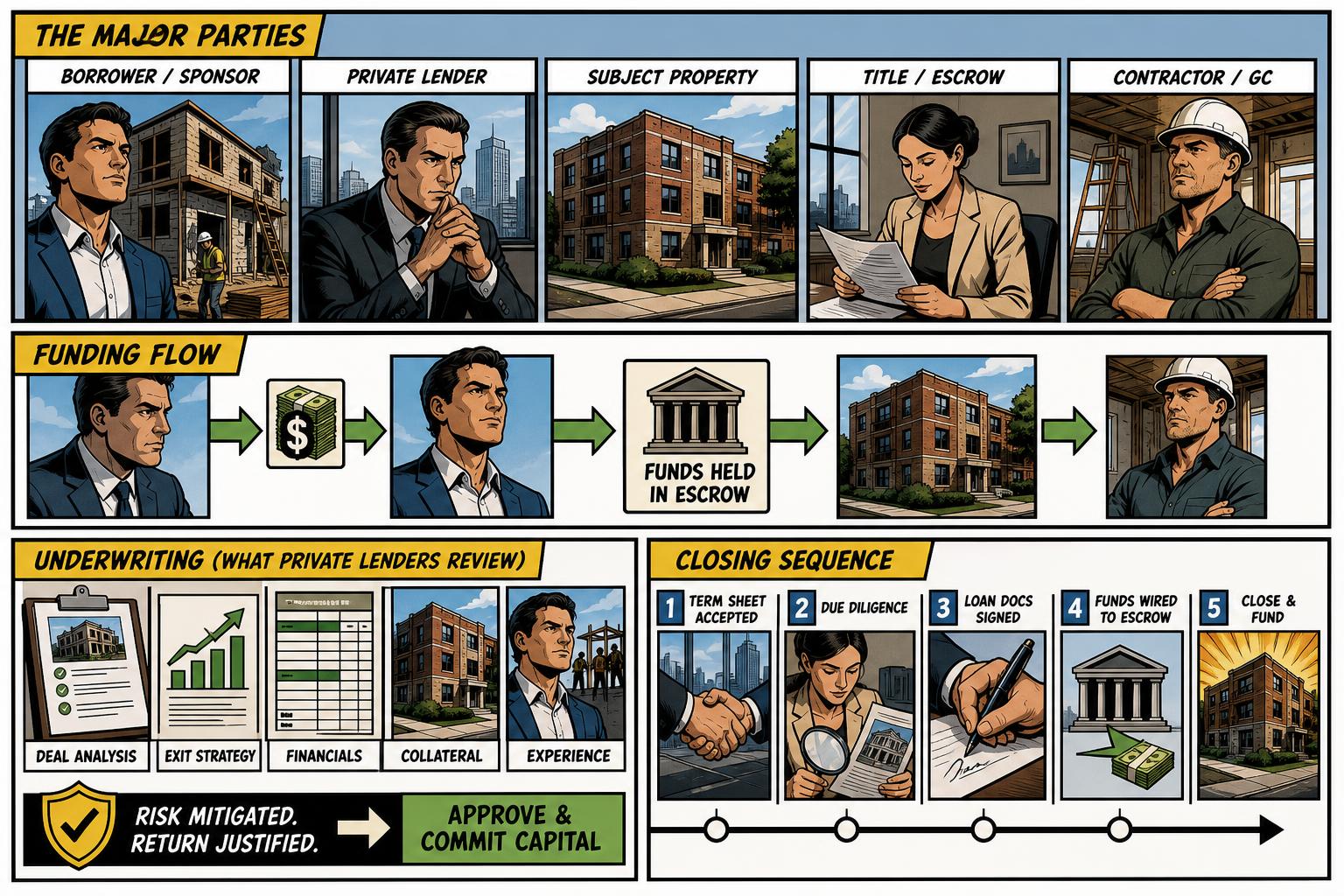
Private lenders move faster than banks, but faster doesn’t mean they cut corners. Their focus is on what really matters: the collateral, the operator’s ability to deliver, and the exit strategy. Knowing what gets reviewed, and in what order, can be the difference between closing in days or dragging out and losing trust with every new question.
Let’s walk through what a private lender actually looks at before funding, how that differs from a bank, and what you should have ready if you want your deal reviewed quickly. I’ll break down a hypothetical deal, show you how I’d approach it as an operator-minded lender, and point out the red flags that kill deals before any money changes hands.
Why Private Lending Underwriting Looks Different From Bank Underwriting
Banks underwrite people. They want to see your income, tax returns, W-2s, debt ratios, and employment history. The credit decision comes before the property. If you don’t meet their criteria, no matter how good the deal is, you’re out.
Private lending flips that. The property is the security, so collateral gets the first and toughest look. Your experience and liquidity matter, but mainly as proof you can execute the plan. That’s why private capital can close in 10 days while a bank might take 45.
Don’t mistake speed for looseness. The review isn’t lighter, just focused differently. A private lender wants absolute clarity on value, exit, and title before wiring funds. There’s no fallback to your W-2 if the deal goes sideways. If the exit fails, the lender owns the problem.
Operator’s Perspective: Why This Matters
Private capital isn’t “easy money.” It’s disciplined money. Lenders aren’t looking for reasons to say yes, they’re hunting for reasons to say no, and only fund when those concerns are addressed. The best operators anticipate these questions and answer them upfront. That’s how deals close fast.
The Property: Collateral Comes First
Every private lending decision starts with one question: if this deal doesn’t perform, what am I actually holding?
That means reviewing:
- As-is value and after-repair value (ARV): Not your estimate, but a value the lender can defend. That means real comps, a broker price opinion, or an appraisal.
- Scope of work: Does the rehab budget match what the property really needs, or is it padded, skimpy, or missing obvious items?
- Property condition and marketability: Will this property sell or lease within a reasonable time after rehab, or does it have structural, zoning, or location issues that limit buyers?
- Loan-to-value and loan-to-cost: How much cushion is there between the loan and the collateral’s value if the market softens or the project runs long?
Padding a rehab budget or inflating ARV kills credibility fast because lenders can easily check.
Operator’s Perspective: How I Think About Collateral
I don’t care what your spreadsheet says if the comps are cherry-picked or the scope is wishful thinking. I’m looking for:
- The ARV is based on recent sales of similar properties, not just the highest price in the zip code.
- A rehab budget that matches the actual work. If the property needs a new roof and the budget says “roof repair: $1,500,” that’s a problem.
- Marketability: If the neighborhood averages 90+ days on market and your exit plan assumes 30, your numbers don’t hold up.
- Loan-to-value: If the loan is 85% of ARV with no cushion for overruns or a softening market, the risk is too high.
The Borrower: Track Record, Liquidity, and Exit Discipline
Once the collateral checks out, the next question is whether you can actually execute the plan. That’s not the same as having good credit.
Lenders look at:
- Relevant experience: Have you completed projects like this before? Five wholesale deals aren’t the same as a gut rehab.
- Liquidity: Do you have reserves to cover holding costs, carrying costs, and overruns? Gap funding can help, but it’s no substitute for a real plan.
- Exit plan specificity: “I’ll sell it” isn’t a plan. A real exit plan names comps, expected days on market, and a fallback (refinance, rent, price drop) if the primary exit slips.
- Payment history on prior private loans: How you handled draws, extensions, and payoffs with other lenders says more than your credit score.
Being conservative here isn’t about distrust. It’s about pricing risk accurately, which keeps private credit sustainable.
Operator’s Perspective: What I Look For
- Have you done this kind of deal before? If not, who on your team has?
- Do you have enough liquidity to handle a timeline slip, or are you counting on everything going perfectly?
- Is the exit plan real, or just “I’ll sell for top dollar in a cooling market”?
- If you’ve had extensions or slow payoffs before, do you own the story or make excuses?
The Numbers: How Lenders Stress-Test the Deal
Beyond the property and borrower, the deal itself gets stress-tested as a whole:
- Budget-to-timeline alignment: Does the draw schedule match real construction sequencing, or is it front-loaded?
- Carrying cost math: Insurance, taxes, utilities, and debt service add up. Are these costs accounted for in your cash plan, or just assumed away?
- Sensitivity to delay: What happens if the project runs 60 or 90 days late? A deal that only works on the fastest timeline is fragile.
- Exit market conditions: Comps that are six months old in a cooling market are a red flag, no matter how good the rehab looks.
This is where many underwriting conversations turn into carrying cost discussions. Projects that pencil out at the start can run into trouble when a permit delay or slow subcontractor eats into reserves.
Operator’s Perspective: How I Stress-Test
- If the project is supposed to take 90 days, what happens if it takes 150?
- If holding costs are $2,000/month, do you have $10,000 in reserve, or are you hoping for a quick sale?
- If the exit price is $350,000 but the best offer is $330,000, is there still a profit, or does the deal go negative?
- Are draw requests tied to real progress, or are you asking for 50% of the rehab budget upfront?

Hypothetical Example: Breaking Down a Real Deal
Let’s walk through a hypothetical deal and see how I’d review it as a private lender.
The Deal
- Purchase price: $200,000
- EMD (Earnest Money Deposit): $5,000
- Rehab budget: $60,000
- ARV (After Repair Value): $325,000 (based on comps)
- Loan request: $210,000 (covers purchase + partial rehab)
- Borrower liquidity: $30,000 in cash reserves
- Exit plan: Sell retail after rehab, expected days on market: 45
- Timeline: 5 months total (2 months rehab, 3 months to sell/close)
What I Would Review Before Funding This
- Purchase Price vs. Value: Is $200,000 a real market price, or is the borrower overpaying? I’d pull comps and check if similar as-is properties are trading at $190,000 or $210,000. If the price is above market, the deal is already off.
- EMD Amount: $5,000 is reasonable for a $200,000 purchase, but I want proof of funds and the escrow receipt. If the EMD is borrowed or coming from a partner without a clear agreement, that’s a problem.
- Rehab Budget: $60,000 for a $325,000 ARV flip is tight but possible. I want a line-item budget, contractor bids, and a walkthrough video or photos. If the budget is missing big-ticket items (roof, HVAC, foundation), I’ll flag it.
- ARV: $325,000 needs support from recent, similar sales. If the comps are six months old or from a better neighborhood, the ARV is inflated.
- Loan-to-Value: $210,000 on a $325,000 ARV is about 65% LTV, which is reasonable. But I’ll also check loan-to-cost: $210,000 on $260,000 total cost (purchase + rehab) is about 80%. That’s a bit high, so I want to see strong reserves.
- Borrower Liquidity: $30,000 in reserves can cover some overages, but if the project runs long or the rehab goes over budget, it could get tight. I want a backup plan, gap funding, partner support, or access to more credit.
- Exit Plan: Selling retail in 45 days is possible in a hot market, but if the average days on market is 60+, you need to plan for a longer hold.
- Repayment Path: Is the borrower relying only on the sale, or is there a refinance fallback? If the market softens, can they rent and refinance, or will they be forced to sell at a loss?
Red Flags I’d Watch For
- Overstated ARV: If the comps are cherry-picked or not truly comparable, the exit price is fiction.
- Underfunded Rehab: If the budget is thin and there’s no contingency, the project will stall at the first surprise.
- Weak Liquidity: If the borrower is all-in with no reserves, one delay can kill the deal.
- Unrealistic Timeline: If the borrower counts on a 45-day sale in a 90-day market, the numbers don’t work.
- No Real Exit Plan: If the only exit is “sell for top dollar,” there’s no backup if the market shifts.
- Borrowed EMD or Down Payment: If the borrower can’t show their own skin in the game, the risk is higher.
What I Would Review Before Funding This (Operator’s Checklist)
- Title and Lien Search: Are there any title issues, unpaid taxes, or liens that could delay closing or cloud the lender’s position?
- Insurance: Is builder’s risk or vacant property insurance in place before funding?
- Contractor Bids and Scope: Are the bids real, signed, and from reputable contractors? Is the scope realistic for the budget?
- Draw Schedule: Is the draw schedule tied to real milestones, or is it front-loaded?
- Borrower’s Track Record: Has the borrower completed similar projects? Can they provide references or proof?
- Market Conditions: Are there signs the market is turning, inventory is rising, or days on market are increasing?
- Exit Specificity: Does the borrower have a backup plan if the sale doesn’t happen on time or at the expected price?
- Repayment Path: Is the repayment plan realistic, or does it rely on everything going perfectly?
Red Flags That Kill Deals
- Title Issues: Unresolved liens, probate problems, or unclear ownership.
- Inflated ARV: Comps that aren’t real or come from different neighborhoods.
- Thin Rehab Budget: No contingency or missing major repairs.
- No Skin in the Game: Borrower is using 100% other people’s money with no personal investment.
- Unrealistic Timeline: Rehab or sale timeline that ignores local market realities.
- No Exit Plan: No backup if the primary exit fails.
- Poor Communication: Borrower can’t answer basic questions or dodges details.
- Overleveraged Borrower: Too many projects at once or too much debt compared to liquidity.
How to Make Your Deal Fundable
If you want private capital to move quickly, think like a lender before you submit your file:
- Provide real, recent comps that support your ARV.
- Show a detailed, line-item rehab budget with contractor bids.
- Document your liquidity and reserves.
- Be specific about your exit plan and have a backup.
- Be transparent about your experience, if you’re new, show who’s on your team.
- Address title, insurance, and contractor issues upfront.
- Be honest about risks and how you’ll handle them.
The best operators don’t just find deals. They understand how capital moves, what lenders need to see, and how to package a deal so it holds up under real scrutiny.
Frequently Asked Questions
1. What documents should I have ready before submitting a deal to a private lender?
You need a signed purchase contract, proof of EMD, a detailed rehab budget with contractor bids, recent comps supporting your ARV, proof of liquidity/reserves, a clear exit plan, and any relevant experience or references. Title and insurance info should be ready or in process.
2. How much liquidity do I need to show?
There’s no universal number, but most private lenders want to see enough cash to cover at least 3-6 months of holding costs plus a contingency for rehab overruns. If your reserves are thin, be ready to explain your backup plan.
3. Can I use gap funding or partners for my down payment or EMD?
Yes, but you need to be transparent about where the money comes from and have clear agreements. Lenders want to see you have real skin in the game and that your capital stack is organized.
4. What happens if my project runs over budget or timeline?
If you have reserves and a realistic plan, you can usually work through delays. If you’re undercapitalized, a delay can force a fire sale or default. Lenders want to see you’ve planned for the “what ifs,” not just the best-case scenario.
5. How do private lenders verify my ARV and rehab budget?
They’ll pull their own comps, review your budget line by line, and may order an appraisal or broker price opinion. If your numbers don’t hold up, your credibility takes a hit and the deal may die.
6. What’s the difference between a fundable deal and one that just looks good on paper?
A fundable deal holds up under real questions: Is the collateral strong? Is the operator credible? Is the exit real? Are the numbers stress-tested? If yes, capital can move. If not, the deal stalls or dies.
Conclusion and Next Steps
Private lending isn’t about chasing yield or moving fast just for speed’s sake. It’s about disciplined capital, reviewing collateral, operator, and exit with a sharp eye for what can go wrong. The best operators anticipate these questions, package their deals accordingly, and move to the front of the line when capital is ready.
If you’re working on a deal and want to know if it’s fundable, or if you need help structuring your capital stack, clarifying your exit, or stress-testing your numbers, JointVentureLoans.com is where the application starts. A clean file and a real plan get you a real answer, not just a maybe.
Ready to see if your deal deserves capital? Submit your package and let’s find out if it holds up to the questions that matter.
For related context, see Gap Funding for Carrying Costs: Keeping Projects Alive Between Draws.
For related context, see Gap Funding for Rehab Costs: Keeping Projects Alive When Budgets Run Tight.
Further Reading and Source Context
These outside references can help you compare definitions, market language, and general real estate financing context. They are provided for education only and do not imply endorsement by those publishers: