
Proof of Funds vs. Proof of Liquidity vs. Bank Statements in Real Estate: What Sellers, Lenders, and Operators Actually Need
Every real estate operator runs into this at some point: a listing agent or seller says, “Show me you can close.” Suddenly, you’re scrambling. Do they want a bank statement? A letter from your bank? Something from a fund or a lender? The terms get tossed around like they mean the same thing, but they don’t. That confusion kills deals. Offers get passed over, timelines drag, or you end up sharing way more financial detail than necessary.
Proof of funds, proof of liquidity, and bank statements aren’t interchangeable. Each serves a different purpose, gets requested by different people at different stages, and reveals a different level of your financial picture. If you don’t know which one you’re being asked for, or which one protects your privacy while still getting the job done, you’re not ready to compete. Most investors only figure this out after losing a contract.
Let’s break down what each document really is, when it’s used, where it falls short, and what I look for when underwriting liquidity from the lending side.
Proof of Funds: The Baseline Document
Proof of funds (POF) is the simplest and most common of the three. It’s usually a bank letter, brokerage statement, or account screenshot showing a specific amount of money in a specific account on a specific date. Sellers and listing agents ask for it to make sure your offer isn’t just talk before they take a property off the market or start serious negotiations.
A typical POF letter includes:
- The account holder’s name
- The financial institution
- The account balance as of a certain date
- Sometimes a bank officer’s signature or contact info
Here’s the catch: POF is just a snapshot. It shows the money was there on one date. It doesn’t say if it’s still there, if it’s already committed to another deal, or if it’s actually liquid and ready to move at closing. A screenshot from three weeks ago might satisfy most POF requests, even if you’ve already wired the funds elsewhere.
For straightforward residential deals and smaller transactions, POF usually works fine. Sellers just want to know you’re not wasting their time. But for bigger acquisitions, commercial properties, or anything involving joint venture capital, POF alone rarely holds up under real scrutiny.
Proof of Liquidity: A Deeper, More Current Standard
Proof of liquidity goes further. Instead of a static snapshot, it shows your capital is genuinely accessible and uncommitted, not tied up in another deal, not locked by withdrawal restrictions, and not overstated compared to what’s actually available.
This matters most in competitive offers, syndications, and larger commercial deals where the seller, broker, or capital partner wants to know a specific amount of capital can move quickly if needed. Institutional lenders rely on this standard. For example, Fannie Mae’s Multifamily Guide ties borrower and key principal qualification to combined net worth and post-closing liquid assets, not just a balance on a statement. The real question isn’t “Did this money exist?” It’s “What’s left, and how usable is it, after this deal closes?” (See Net Worth and Liquid Assets in the Fannie Mae Multifamily Guide.)
If you want to dig into the details, see Proof of Liquidity: How Investors Show Sellers They're Serious Without Cash in the Bank and Proof of Liquidity for Investors: How to Show Cash Without Tying It Up. Both articles address the same problem: how to show financial strength without freezing up capital you need for other deals.
Proof of liquidity often includes:
- Direct verification from a financial institution or liquidity provider (not just a printed letter)
- Confirmation that the funds aren’t earmarked or tied up in another pending transaction
- A structure that can be re-verified close to closing, not just at the time of offer
For larger commercial and syndicated deals, the bar is even higher. Freddie Mac’s Multifamily Guide requires specific liquidity verification as part of sponsor underwriting. (See Freddie Mac Multifamily Guide, Chapter 9SBL.) If you’re working at that level, check out Proof of Liquidity for Syndications: How Investors Show Strength in Big Commercial Deals for a walkthrough of what sponsors and capital partners expect.
Bank Statements: The Most Invasive and Least Efficient Option
Many investors default to bank statements when asked for “proof” of anything. Export a PDF, send it, move on. But bank statements are actually the bluntest and most exposing option for several reasons:
- They show every transaction, not just a balance, deposits, withdrawals, transfers, payments to others
- They reveal account activity unrelated to the deal
- They’re easy to misinterpret, a big outgoing transfer the week before might look like the capital is gone, even if it isn’t
- They’re a delayed snapshot, a statement from last month tells nothing about the current balance
Underwriters and institutional lenders still ask for bank statements, but usually as one piece of a bigger puzzle, not as a substitute for liquidity verification. The OCC’s Comptroller’s Handbook on commercial real estate lending makes this clear: analyzing a borrower’s or guarantor’s ability to service debt is about overall repayment capacity, not just one document. (See Comptroller's Handbook: Commercial Real Estate Lending.)
If you’re an investor, handing over full bank statements when a seller only needs confirmation of funds is unnecessary exposure. Know the difference before you send anything.
Why the Distinction Actually Matters in a Transaction
| Proof of Funds | Proof of Liquidity | Bank Statements | |
|---|---|---|---|
| What it shows | A balance on a specific date | Accessible, unencumbered capital, often re-verifiable | Full account activity over a period |
| Typical requester | Listing agent, seller | Broker, capital partner, institutional lender | Underwriter, lender, sometimes a cautious seller |
| Disclosure level | Low | Moderate | High |
| Best fit | Standard purchase offers | Competitive bids, syndications, larger deals | Formal underwriting, loan files |
| Weakness | Easily outdated | Requires a verification relationship or provider | Overexposes account activity |
Problems arise when you send the wrong document for the situation. Sending an old POF letter to an institutional underwriter who wants verified liquidity slows everything down. Sending full bank statements to a seller who only wanted a POF letter is an unnecessary privacy risk. Matching the document to the request is a small step that saves real time and headaches.
For a deeper dive, see The Ultimate Guide to Proof of Funds & Liquidity for Real Estate Investors and Proof of Liquidity in Real Estate: Why Sellers in Phoenix Say "Show Me the Money" for more on why these requests are becoming more common and specific.
Hypothetical Example: A Competitive Bid in Charlotte, North Carolina
Let’s run through a hypothetical scenario, no real investor, property, or transaction.
An operator is bidding on a $1.4 million value-add multifamily property in Charlotte, North Carolina. It’s a market with steady investor activity, so sellers see multiple offers on well-priced deals. The listing broker tells all bidders: no verified funds, no consideration.
The operator has $400,000 in a brokerage account. A basic proof of funds letter from the week before shows that balance. But two other bidders submit proof of liquidity, verified confirmation that their capital is accessible and not committed elsewhere, current within days, not weeks.
The seller’s broker, looking at three similar offers, moves forward with the two verified-liquidity bids. The operator with only a static POF letter gets a follow-up request for something more current, losing several days when speed matters.
The lesson isn’t that proof of funds is useless. In a competitive Charlotte bid, or any market with multiple qualified buyers, proof of liquidity carries more weight. It’s harder to fake and easier to re-verify on short notice.

What I Would Review Before Funding This
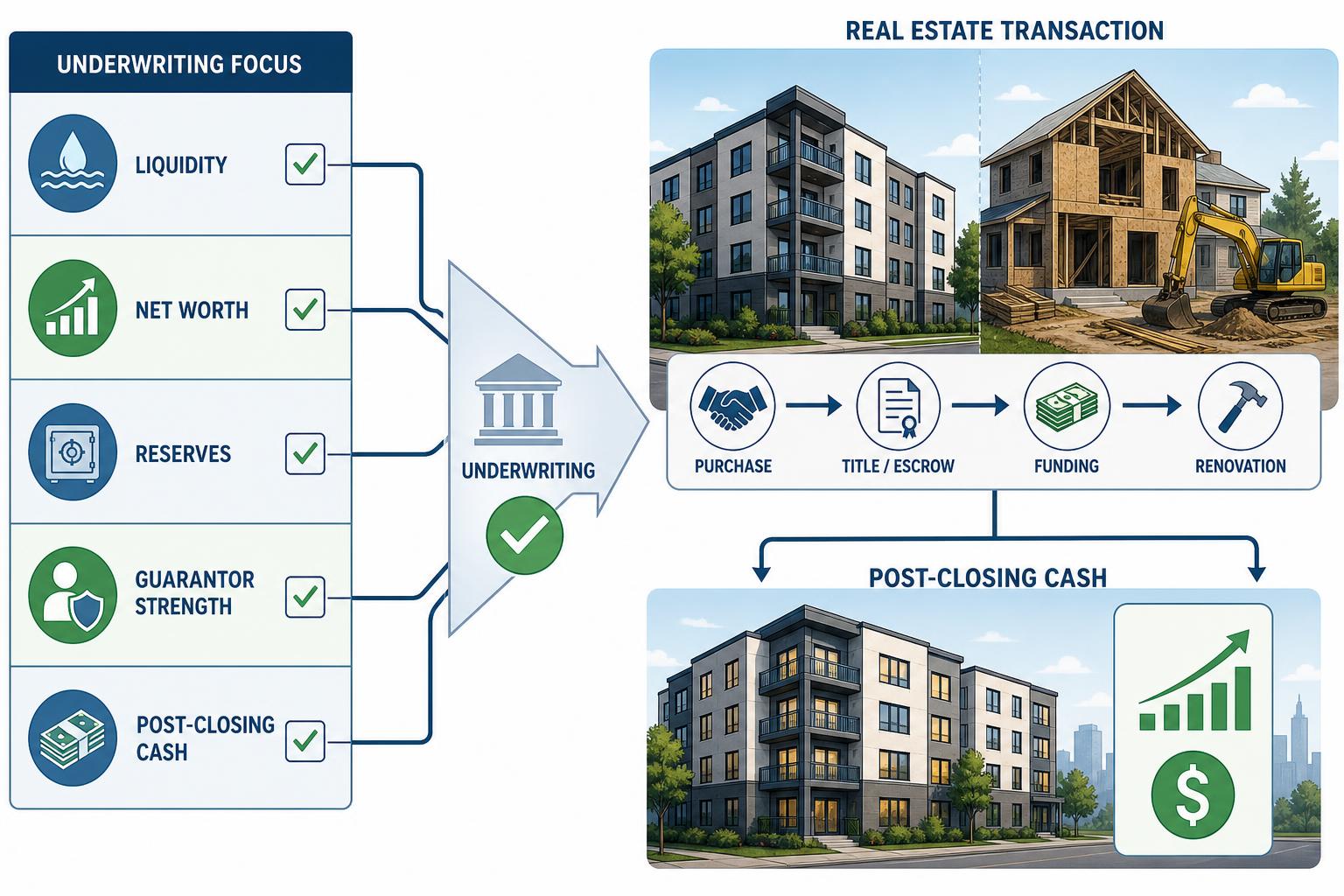
When I’m underwriting a deal where liquidity documentation is part of the file, here’s what I focus on:
- Source of funds. Where did the capital come from, and does that story match the account history?
- Encumbrance status. Is this capital already committed to another deal, held as a deposit, or subject to a lien or restriction?
- Timing of verification. How recent is the confirmation, and can it be re-verified close to closing without the balance changing?
- Consistency across documents. Do the POF letter, liquidity verification, and any bank statement on file tell the same story, or are there gaps?
- Who’s providing the verification. A letter from a recognized financial institution or liquidity provider carries more weight than a self-generated PDF.
- Does the liquidity match the deal size. If the capital barely covers the purchase price with nothing left for reserves, closing costs, or carry, that’s a different risk than having a real cushion.
This is the same logic institutional guidelines use. Fannie Mae’s multifamily underwriting separates net worth from post-closing liquid assets because a borrower can look strong on paper but be thin on actual accessible cash. (See Overview, Fannie Mae Multifamily Guide.)
Red Flags
Here are a few patterns that should raise concerns when reviewing liquidity documentation, whether you’re a broker, capital partner, or lender:
- A POF letter with no institution contact info or way to verify it
- A balance that matches the purchase price exactly, with no cushion
- Documents older than a few weeks with no willingness to refresh them
- Reluctance to have funds verified directly by the institution instead of through a forwarded PDF
- Liquidity claimed across multiple deals at once, with no clarity on whether it can cover all of them
- Bank statements showing large, unexplained transfers right before the statement date
- An operator or borrower who substitutes a general net worth statement when specifically asked for liquid, accessible capital
None of these automatically kill a deal, but they’re reasons to ask more questions before trusting the documentation.
Borrower Readiness Checklist
Before you get to the point where a seller, broker, or lender asks for proof of capital, get these basics in order:
- Know which document is actually being requested, POF, proof of liquidity, or full bank statements, and don’t over-disclose by default
- Keep at least one verification source (bank, brokerage, or liquidity provider) that can quickly provide a current letter
- Understand which of your capital is genuinely unencumbered versus already earmarked for another deal
- If you’re relying on a capital partner or joint venture, know in advance how that partner documents and verifies their liquidity
- Update documentation shortly before you plan to use it. A letter from six weeks ago can be a liability in a competitive bid.
- Keep your reserve position visible, not just the number that matches the purchase price
- If bank statements are requested for formal underwriting, know what’s on them before you send them, don’t be surprised by your own account activity
FAQ
Is proof of liquidity the same as proof of funds?
No. Proof of funds is usually a static snapshot showing a balance on a given date. Proof of liquidity is a more current, often re-verifiable confirmation that capital is accessible and not committed elsewhere. Sellers and brokers usually ask for POF. Institutional lenders and capital partners typically want proof of liquidity.
Why would a lender ask for bank statements if I already provided proof of funds?
Bank statements show activity over time, not just a balance. A lender doing full underwriting wants to see the pattern behind the number, deposits, transfers, and account behavior, not just confirmation that money existed on one date. It’s a deeper review, usually for formal loan files, not initial offers.
Can I show proof of liquidity without handing over full bank statements?
Yes. Proof of liquidity is typically verified directly through the financial institution or liquidity provider, confirming the funds are accessible without exposing your full transaction history. That’s why it’s a more efficient option for operators who want to protect their privacy while still satisfying the request.
Does proof of funds expire?
Not officially, but its usefulness fades. A letter that’s several weeks old carries less weight in a competitive situation because the balance may no longer reflect reality. Most brokers and sellers expect something current, even if they don’t specify a date range.
Do I need proof of liquidity for a small residential deal?
Usually not. A standard POF letter is typically enough for straightforward residential purchases. Proof of liquidity becomes more relevant as deal size increases, competition heats up, or when a capital partner, syndicator, or institutional lender is involved.
What if my capital is tied up in a fund or another investment?
That’s exactly what proof of liquidity is for. Instead of pulling capital out just to prove you have it, a verified liquidity confirmation can show accessible capital without disrupting where it currently sits. This is common for active operators who don’t want idle cash sitting in a checking account just to prove a point.
If you’re trying to figure out which document fits your next deal, or need capital documentation structured right before a competitive bid, talk to Joint Venture Loans about how we help operators show strength without tying up capital that should be working elsewhere.
Further Reading and Source Context
These outside references can help you compare definitions, market language, and general real estate financing context. They are provided for education only and do not imply endorsement by those publishers: