

Joint Venture Funding vs Private Lending for Real Estate Deals
Most investors don’t lose deals because they picked the wrong property. They lose them because the capital stack wasn’t built right. You find a deal that looks good, run the numbers over and over, then spend weeks chasing funding, only to realize the structure you defaulted to (usually hard money, since that’s what shows up first online) doesn’t actually fit the risk, timeline, or your own balance sheet.
Private lending and joint venture funding both address the immediate need for capital to control a property, but they work in very different ways. One involves borrowing money (debt), while the other means sharing ownership (equity). Confusing the two or simply choosing whichever option is easiest to get approved can backfire. You might find yourself stuck with forced refinances, reduced profits, or personal guarantees on a deal that was supposed to be non-recourse from the beginning.
Let’s break down how each works, where each fits, and what a real underwriter looks for when you bring a deal to the table.
What Private Lending Actually Is
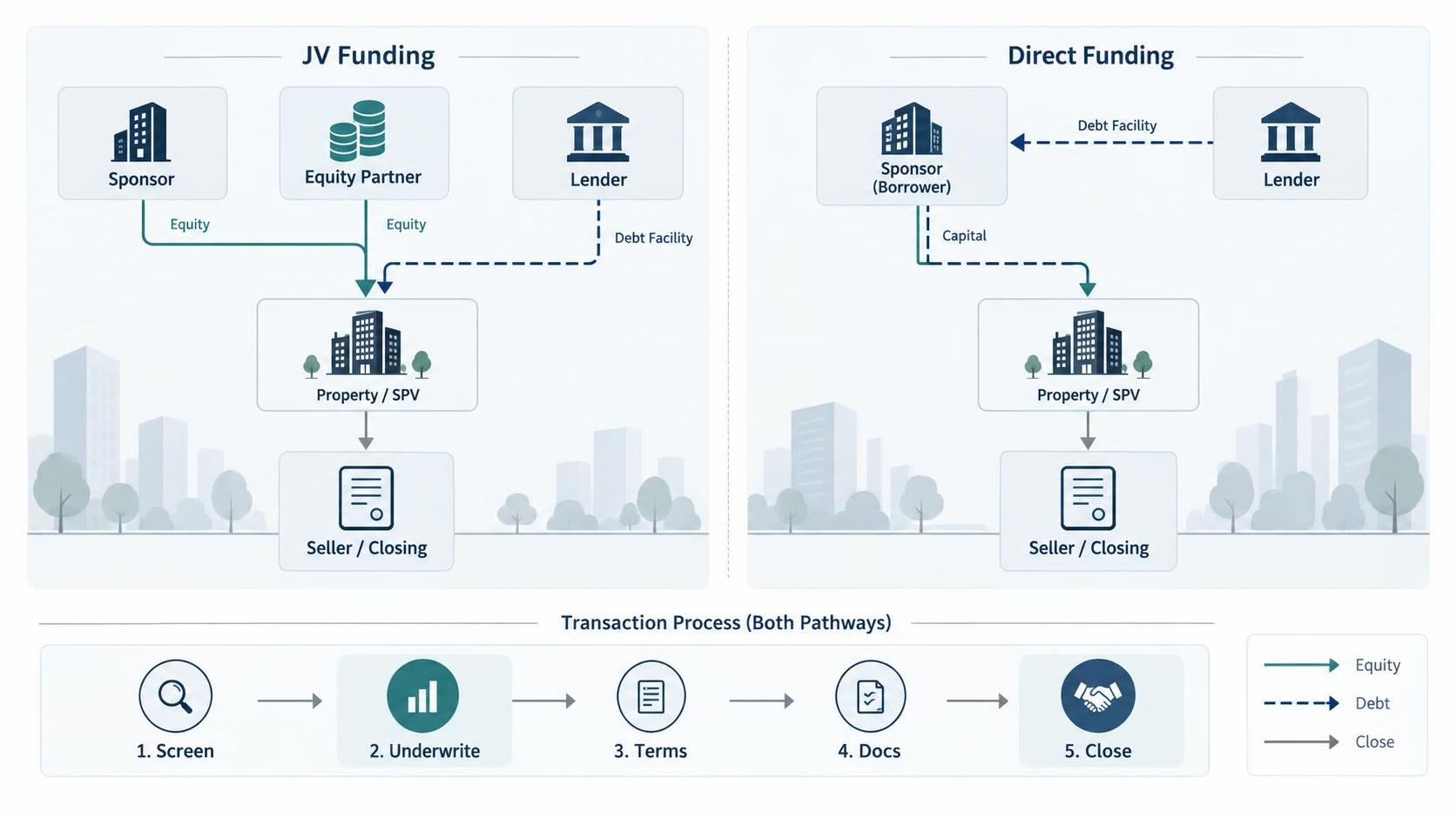
Private lending is debt. You borrow money secured by the property, pay interest (and usually points), and you’re contractually obligated to pay it back on a schedule, no matter how the deal performs. The lender’s return is fixed. They get their interest and principal back whether you make $20,000 or $200,000 on the flip.
Because it’s debt, underwriting focuses on collateral and exit. A private lender wants to know:
- What’s the property worth now and after repairs?
- What’s the loan-to-value or loan-to-cost ratio?
- What’s the exit plan, sale, refinance, or rental takeout, and is it realistic within the loan term?
- Does the borrower have enough liquidity to cover carrying costs if the timeline slips?
Private lenders don’t care about your business plan beyond whether it gets them paid back. They’re not partners in your profit. That’s the tradeoff: you keep all the upside, but you’re on the hook for the downside. If the market shifts or the rehab drags, the lender doesn’t share your risk.
Private lending works best when you have a clear exit and enough capital or track record that a lender is comfortable being just a creditor.
What Joint Venture Funding Actually Is
Joint venture (JV) funding is equity. Instead of borrowing money and owing it back on a schedule, you bring in a capital partner who takes an ownership stake and shares in the profit, and the risk, based on your agreement. There’s usually no fixed monthly payment, no personal guarantee tied to a loan, and no forced repayment date.
That flexibility comes with a price. A JV partner underwrites the deal differently:
- Can the operator (you) actually execute the plan without hand-holding?
- Is the projected profit split big enough to justify the partner’s risk, since there’s no fixed return?
- What happens if the deal doesn’t perform as expected? Who absorbs the loss, and in what sequence?
- Is there a clear waterfall for how proceeds get distributed at exit?
JV structures make sense when the deal has more upside than a typical flip, when the operator can’t or won’t carry debt personally, or when the timeline and outcome are uncertain enough that fixed debt service would create real risk if things slow down. For a deeper dive on JV versus straight equity share, see Equity Share vs. Joint Venture: Which Structure Is Better for Real Estate Investors?. The distinction matters once you’re negotiating who controls decisions versus who just shares in outcomes.
The Core Differences That Matter
Forget the marketing. Here’s what really changes between these two structures.
Cost of capital. Private lending has a fixed, known cost, points and interest, quoted upfront. JV funding’s cost varies. Your partner’s profit share only gets expensive if the deal does well, and costs you nothing extra if it doesn’t (assuming the structure is set up right).
Control. With private lending, as long as you’re making payments and not in default, the lender usually stays out of your way. With a JV, your partner may have approval rights over budget changes, scope, or timeline extensions, depending on the operating agreement.
Risk allocation. A private loan puts the downside on you. If the deal loses money, you still owe the loan. A JV, if structured properly, shares the downside with the capital partner, though most JV agreements protect the partner’s principal before the operator’s profit.
Personal liability. Private loans often require personal guarantees, especially for newer operators or thinner deals. JV equity is contributed capital, there’s no debt to personally guarantee, though you’re still expected to perform under the operating agreement.
Underwriting focus. Lenders underwrite the asset and the exit. JV partners underwrite the operator and the business plan. That’s the biggest mental shift: are you asking someone to bet on the property, or on you?
Credit and documentation. Private lending, especially asset-based, puts less weight on personal credit and liquidity than banks but still wants to see it. JV funding leans more on your track record, past deals, and the strength of your plan, because the partner is exposed to the outcome, not just the collateral.
When Private Lending Makes More Sense
Private lending fits when the deal has a short, defined timeline and a clear repayment path. If you’re doing a fix-and-flip with a six- to nine-month hold, a bridge loan on a value-add property with a refinance exit lined up, or a deal where you have enough capital to cover debt service and reserves, debt is usually more efficient. You keep all the profit, and the lender’s return is capped.
It also works for operators with a track record and liquidity. The fixed cost of debt is cheaper than giving up equity when you don’t need a partner to execute, you just need capital.
When Joint Venture Funding Makes More Sense
JV funding fits better when the deal has meaningful upside but also real execution risk, when the operator doesn’t have the liquidity to service debt through a longer or uncertain timeline, or when the deal is big enough that a straight loan would create dangerous leverage. It’s common for newer operators without an established lending relationship or track record. A capital partner willing to share the outcome may fund a deal a lender wouldn’t touch on debt terms, since the partner’s return isn’t capped and they can price for risk through their equity share.
JV structures are also worth considering if you want to protect your personal balance sheet and avoid another guaranteed obligation, especially if you’re already carrying debt on other projects.
Blended and Stacked Approaches
You don’t always have to pick one or the other. It’s common to layer private debt for most of the acquisition and rehab, with a smaller JV equity piece covering the gap between what the lender will fund and what the deal actually needs. That means using equity to fill the down payment or reserve requirement, instead of writing that check yourself. If you want to see how operators stack multiple funding layers, Creative Finance in Real Estate: Using the Stack Method to Close Deals Others Can't walks through that approach, and the broader Ultimate Guide to Creative Finance Strategies in Real Estate covers where JV and private debt fit alongside seller financing and other creative structures.
Seller carryback financing can also come into play, especially when the seller is willing to hold a note on part of the price. If that’s relevant, Seller Carry Back Financing: How Investors Structure Deals in 2025 and Seller Carryback Financing: How Creative Deals Are Closing in Today's Market both cover how that layer interacts with primary debt and equity.
Hypothetical Example: A Value-Add Deal in Dallas, Texas
This is a hypothetical scenario for illustration only, not a real transaction, borrower, or closing.
Imagine an investor finds a small multifamily property in Dallas, Texas, a market where value-add multifamily and single-family rehabs are common enough that funding sources know the playbook. Purchase price is $650,000, with $150,000 in renovations to bring units up to market rent. All-in cost: $800,000. Estimated after-repair value: $1,050,000.
The investor has done three similar projects but doesn’t have $200,000 in liquid reserves for a 20% down payment plus contingency, a common gap for operators in Dallas who have experience but not the balance sheet to self-fund at that scale.
With private lending alone, a lender might fund 75% of the purchase and 100% of verified rehab, leaving the investor to bring about $200,000 to closing, capital they don’t have.
With a blended structure, the investor brings in a JV partner to fund $150,000 of that gap in exchange for a negotiated share of net profit at exit, while a private lender funds the senior debt on the rest. The operator controls the renovation and leasing, the capital partner is underwritten on the operator’s track record and the deal’s margin, and the private lender is underwritten on loan-to-cost and the exit. Each capital source does the underwriting it’s built for, the lender looks at the asset and exit, the JV partner looks at the operator and the plan.
That’s the real value of understanding both instruments: it’s rarely about picking one forever, it’s about knowing which lever to pull for a specific gap in a specific deal.
What I Would Review Before Funding This
If this deal landed on my desk, whether as a straight private loan, a JV, or a blend, here’s what I’d look at before moving capital:
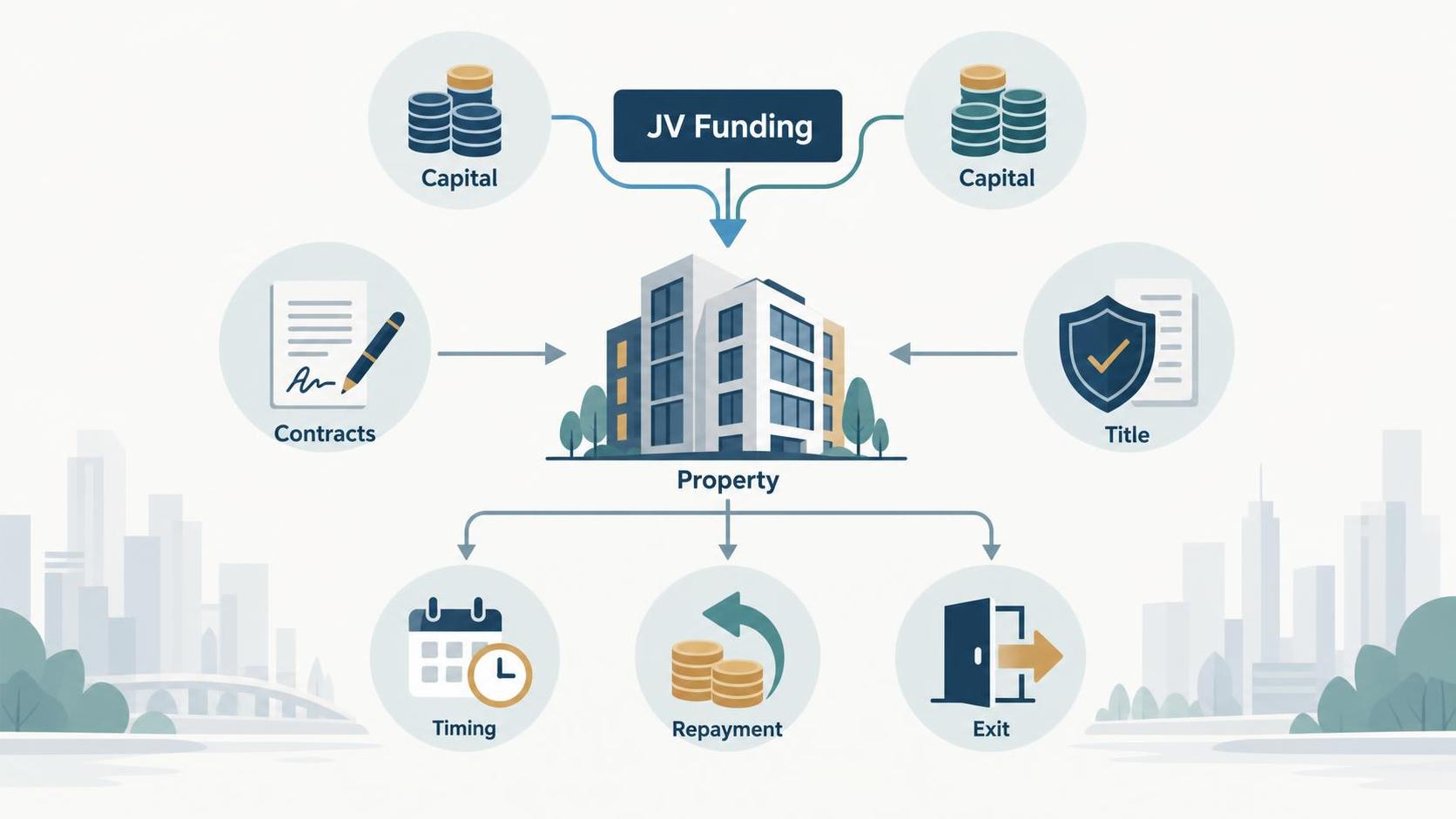
- Exit clarity. Is the plan a sale, refinance, or hold? Is that exit realistic given current rates and comps, not just optimistic projections?
- Operator track record. Has this person completed similar projects on time and on budget? Track record can substitute for missing collateral in a JV.
- Budget detail. If the rehab budget is just a lump sum with no line items, the operator probably hasn’t walked the property with a contractor.
- Reserve position. What happens if the renovation runs 90 days late or 20% over budget? Is there a real contingency or just hope?
- Waterfall and priority of returns: In any joint venture, who gets paid first when the deal exits, in what order, and what happens if the returns fall short of projections?
- Title and entity structure. Is the property held in a clean entity? Are there any liens, judgments, or unresolved probate issues that could slow closing or refinancing?
- Local market support for the exit value, not just the purchase price. A comp set that supports the purchase price doesn’t automatically support the after-repair value.
Red Flags
- The operator can’t clearly explain the difference between what they owe a lender and what they owe a JV partner. That confusion usually means the structure was never agreed to in writing.
- No signed operating agreement or promissory note before funds move. Verbal splits and handshake deals fall apart when a deal underperforms.
- Rehab budget with no contractor bids or scope of work attached.
- Exit strategy that depends on a specific rate environment or market condition that hasn’t happened yet.
- Operator pushing for equity (JV) just to avoid personal liability on a deal that’s thin enough it probably shouldn’t be funded at all.
- Multiple capital sources stacked without anyone confirming the combined leverage actually works against the after-repair value.
Before a lender reviews proof of liquidity, your file should be organized enough to answer basic underwriting questions quickly.
Borrower Readiness Checklist
- [ ] Purchase contract or executed LOI in hand
- [ ] Renovation scope of work with contractor bids, not just estimates
- [ ] After-repair value supported by recent, comparable closed sales
- [ ] Personal financial statement and liquidity documentation ready
- [ ] Clear statement of what capital gap exists and why (down payment, reserves, gap between lender proceeds and total cost)
- [ ] Entity formation documents and operating agreement drafted or in progress
- [ ] Realistic timeline with milestones, not just a single completion date
- [ ] Track record summary of past projects, including ones that didn’t go as planned
FAQ
Is joint venture funding more expensive than private lending?
Not always upfront, there’s often no origination fee or interest on a JV piece, but it can cost more overall if the deal performs well, since the capital partner shares in the upside. Private debt has a known, capped cost. JV equity’s cost depends on performance.
Can I combine private lending and JV funding on the same deal?
Yes, and it’s common. Senior debt from a private lender usually covers acquisition and rehab, while JV equity fills a down payment or reserve gap. The two need to be structured so debt service doesn’t create risk for the JV partner, and vice versa.
Does a JV partner need to be actively involved in the project?
That depends on the operating agreement. Some partners are fully passive and just want reporting; others want approval rights on major changes. This should be negotiated and documented before funds move.
Is private lending only for experienced investors?
No, but track record and liquidity affect terms. Newer operators can still get private loans, usually with more conservative leverage or added reserves, since lenders underwrite the exit more cautiously without a long track record.
What documentation does a lender or JV partner want to see first?
At minimum: the purchase contract, a renovation budget or scope of work, comps supporting both purchase price and after-repair value, and a personal financial statement. For a JV, expect more questions about past project performance and how profit will be split and distributed.
Where This Leaves You
Neither structure is better by default, they solve different problems. Private lending fits when you have a clear exit and enough liquidity to carry fixed debt service. Joint venture funding works when the deal’s upside or uncertainty makes sharing risk with a capital partner smarter than a lender who just wants to be repaid on schedule. The investors who structure deals well aren’t the ones who pick a favorite, they’re the ones who match the tool to the actual gap in the deal.
If you’re evaluating a deal and aren’t sure whether it fits private debt, a joint venture structure, or a blend, reach out through JointVentureLoans.com and walk through the numbers with us before you commit to a structure that doesn’t fit.
For related context, see Seller Carryback Financing: How Creative Deals Are Closing in Today’s Market.