
Why Proof of Funds Helps Real Estate Investors Compete for Deals
Every serious real estate offer eventually hits the same question: can this buyer actually close? Sellers and listing agents don’t care how sharp your underwriting is or how many flips you’ve done. They want to know one thing: will the money hit escrow on time? Proof of funds answers that question before it becomes a problem. In a market where multiple offers come in within hours, the investor who can prove their capital fastest usually wins the contract.
This isn’t just paperwork for the sake of it. It’s about closing the trust gap between “I have the money” and “here’s the proof.” That gap is where deals slip away to buyers who look better on paper, even if they aren’t actually better funded.
What Proof of Funds Actually Shows (and What It Doesn’t)
A proof of funds letter or statement simply verifies that you have liquid capital available and accessible when you make your offer. That’s it. It doesn’t guarantee you’ll close, lock in financing, or replace real underwriting once you’re under contract.
What it does do is remove one key objection from the seller: “Is this buyer real?” In a multiple-offer situation, a clean, current, and verifiable proof of funds tells the listing agent your offer isn’t dependent on scrambling for money later. That’s a different level of offer than someone who’s just “pre-qualified” or “pretty sure they can get funded.”
If you're curious about the difference between proof of funds and proof of liquidity, and why sellers are increasingly asking for both, The Ultimate Guide to Proof of Funds & Liquidity for Real Estate Investors breaks it down.
Why Competitive Deals Are Won on Documentation, Not Just Price
Many investors think price is everything. But certainty of execution often wins the deal, even at a slightly lower price. If a listing agent has been burned by a buyer who couldn’t fund, they’ll favor the offer that removes that risk, even if it’s $5,000 less.
You see this clearly in three cases:
Off-market and wholesale deals. These sellers want speed and certainty, not just top dollar. If you can show proof of funds within hours, you have an edge over someone who needs to “check with their lender.”
Distressed and auction properties. Courthouse steps, REOs, and distressed sales often require proof of funds or a deposit just to bid. No documentation means no seat at the table.
Fast-moving retail listings in hot investor markets. Agents expect proof of funds with every serious offer. If you don’t include it, your offer stands out for the wrong reasons.
Bottom line: proof of funds isn’t just supporting your offer anymore. It’s often the price of admission.
Where Proof of Funds Fits in the Deal Timeline
Proof of funds usually comes up at three points, and treating it as a one-time document is a rookie mistake.
- At offer submission. This is the baseline: a letter or account statement attached to your purchase agreement showing you have the funds for the purchase price (and rehab budget, if needed).
- During due diligence or earnest money deposit. Title companies and escrow officers may ask for updated proof closer to closing, especially on bigger deals.
- If you’re working with gap funding, a joint venture partner, or a private lender, they’ll want to do their own verification, separate from what you provided to the seller.
That third point trips up many investors. Institutional liquidity standards are stricter than what a seller’s agent asks for. For example, Fannie Mae’s multifamily guidance doesn’t count unsecured promissory notes payable to the borrower as usable liquidity (Fannie Mae Multifamily Guide – Net Worth and Liquid Assets. That’s big-league lending, but the logic applies everywhere: funds that are tied up, conditional, or borrowed against don’t count the same as real, unencumbered cash. The seller’s agent might not dig that deep, but your capital partner will.
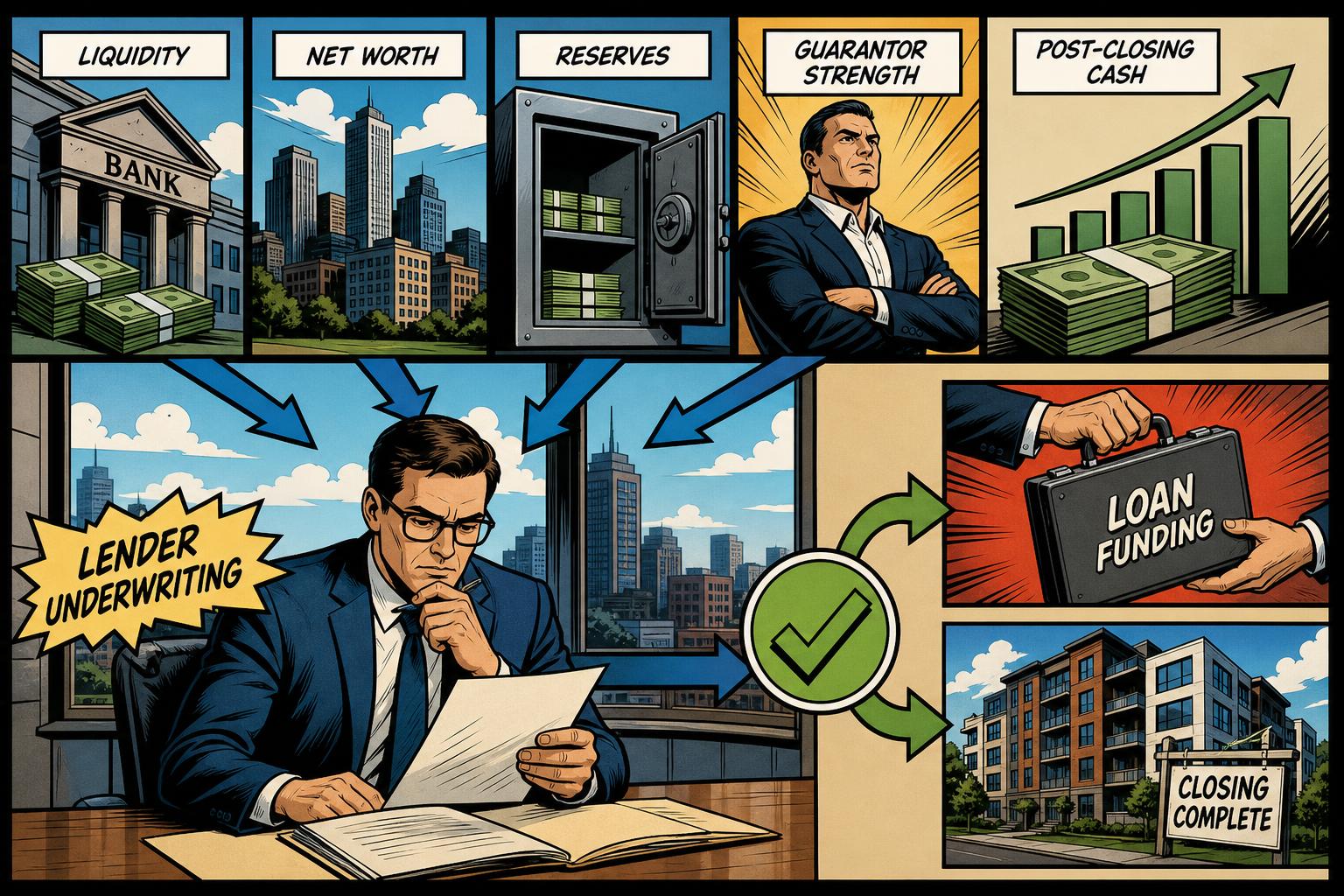
Types of Proof of Funds Documentation
Not all proof of funds documents carry the same weight. Here’s what a savvy agent or lender will actually trust, roughly in order:
- Bank or brokerage statements showing your balance, dated within the last 30 days (sometimes less).
- Bank letters on official letterhead confirming your balance and account ownership. These are stronger than screenshots but weaker than a full statement unless paired together.
- Liquidity verification letters from a capital provider. If you’re drawing on a credit line, fund commitment, or proof-of-liquidity arrangement instead of sitting on idle cash, this is common. More on this in Proof of Liquidity for Investors: How to Show Cash Without Tying It Up.
- Letters of credit or verified lines of credit. These appear in larger commercial and syndicated deals with more complex capital stacks. Proof of Liquidity for Syndications: How Investors Show Strength in Big Commercial Deals explains how this works when multiple LPs or JV partners are involved.
The key: the document should be current, verifiable, and match the deal size. If you attach a six-figure proof of funds to a seven-figure offer, you’re raising more questions than you’re answering.
Hypothetical Example: Competing for a Value-Add Deal in Phoenix, Arizona
This example is for illustration only and doesn’t reflect any real client, borrower, or closed transaction.
Imagine an investor spots a 12-unit value-add multifamily property in Phoenix, Arizona, listed at $1.4 million. The listing agent expects three offers within the week. That’s normal for a property priced below replacement cost in a hot market.
The investor plans to combine their own money with short-term private real estate loans in Phoenix to cover the acquisition, then refinance after the renovations. They have about $280,000 in liquid capital, which is enough for the down payment and reserves but not enough to appear fully funded without additional support.
Instead of submitting an offer with just a bank statement showing $280,000 against a $1.4 million purchase, the investor lines up a liquidity verification letter from their capital partner confirming the rest of the funds are committed and available to close. The combined documentation, their own statement plus the partner’s letter, gives the listing agent a full picture: purchase price covered, no financing contingency gap, and a believable closing timeline.
Against offers that only show partial funding or a financing contingency with no verification, this one looks the most executable, even if it’s not the highest price. That’s the practical value of treating proof of funds as a complete package, especially for a Phoenix deal of this size where the capital stack has more than one source.

What I Would Review Before Funding This
If an investor brought us a deal like the Phoenix example and wanted gap or bridge capital to round out their proof of funds, here’s what I’d look at before moving any money:
- Source and seasoning of the investor’s own capital. If funds just landed in the account 48 hours ago, I want to know where they came from. Seasoned funds with a clear history are always stronger.
- If your liquidity covers only a small part of the purchase price, I want to see the full breakdown of the remaining capital, not just a single total.
- Exit plan and refinance feasibility. Proof of funds gets you to closing. I care just as much about how the capital gets replaced or repaid, especially on a value-add hold where the refinance depends on post-renovation performance.
- Property-level numbers. Not just the capital stack, rent roll, occupancy, deferred maintenance, and whether the renovation budget is realistic for the market.
- Whether the liquidity being shown is actually accessible. If you’re showing the same $280,000 as proof of funds on three simultaneous offers, you’re not actually liquid for any of them.
- Experience with the asset type and market. A first-time 12-unit buyer and a seasoned multifamily operator get different levels of scrutiny on timeline and execution risk, even with identical capital.
Red Flags
Here are documentation issues that get flagged immediately, by us, sellers’ agents, and title companies:
- Stale statements. Anything older than 30 days (and often 10-14 days for competitive deals) will trigger a follow-up request that slows you down.
- Screenshots instead of verifiable statements or letters. Screenshots are easy to alter and easy to doubt.
- Mismatched names. If your proof of funds is in your personal name but you’re closing in an LLC, and there’s no explanation for how the money moves, that’s a problem.
- Round, suspiciously clean numbers that don’t match any other document in the file.
- Funds that are really a line of credit or loan but shown as cash on hand without disclosure can affect institutional liquidity standards. Refer to the Fannie Mae guidance above for what counts as usable liquidity.
- No explanation for the gap between proof of funds and purchase price, when a gap clearly exists.
- Reluctance to provide updated verification closer to closing. If you stall when asked to refresh documentation, it’s a sign the funds were never fully reliable.
Borrower Readiness Checklist
Before you submit an offer where proof of funds is required, make sure you can check off all of these:
- [ ] Bank or brokerage statement dated within the last 2-4 weeks
- [ ] Statement or letter shows a balance that matches the offer (not wildly off)
- [ ] Entity name on the statement matches, or is clearly linked to, the closing entity
- [ ] If using a capital partner, gap lender, or JV structure, a liquidity verification or commitment letter is lined up in advance, not thrown together after the offer is accepted
- [ ] A clear answer for how your full capital stack (your funds plus any outside capital) adds up to the purchase price, closing costs, and reserves
- [ ] A realistic refinance or exit plan if any of the capital is short-term or bridge
- [ ] No duplicate use of the same liquid funds across multiple simultaneous offers without disclosure
FAQ
Does proof of funds need to show the full purchase price?
Usually yes, or a credible combination of your own funds plus verified outside capital. If your proof of funds only covers part of the price with no explanation, you’re raising more questions than you’re answering.
Can I use proof of liquidity instead of a bank statement?
In many cases, yes. Proof of liquidity, verification that capital is accessible even if it’s not sitting idle in a checking account, is increasingly accepted by sellers and agents, especially for investors who keep capital deployed elsewhere. See Proof of Liquidity: How Investors Show Sellers They're Serious Without Cash in the Bank for more on how that works.
How fast can proof of funds be arranged?
If you’re using your own capital, it’s as quick as pulling a current statement. But when verification involves a capital partner or gap funding, the timing depends on how early you’ve established that relationship. That’s why it’s best to set it up before you start bidding, rather than scrambling after you’ve found a deal.
Does proof of funds expire?
Not formally, but most agents, title companies, and lenders treat anything older than 30 days as stale and will ask for a refresh. In fast-moving markets, some want something from the last two weeks.
Is proof of funds different for commercial versus residential deals?
The core idea is the same, but commercial and syndicated deals, especially multifamily, usually involve more complex capital stacks and more formal verification from each capital source. Proof of Liquidity for Syndications: How Investors Show Strength in Big Commercial Deals covers how that works when multiple parties contribute capital.
What if my funds are tied up in other deals?
That’s a real underwriting conversation, not an automatic disqualifier, but you need to disclose it. Showing the same funds as proof of funds on multiple active offers without disclosure is one of the fastest ways to lose credibility with agents, title companies, and capital partners.
Next Steps
Proof of funds isn’t a box to check after you find a deal. It’s part of being ready to compete. If your own capital needs to be paired with gap funding, bridge capital, or a JV partner to show a complete, verifiable capital stack, have that conversation before you’re up against a deadline. Reach out to Joint Venture Loans to talk through what your proof of funds package should look like for the deals you’re chasing.
Further Reading and Source Context
These outside references can help you compare definitions, market language, and general real estate financing context. They are provided for education only and do not imply endorsement by those publishers: